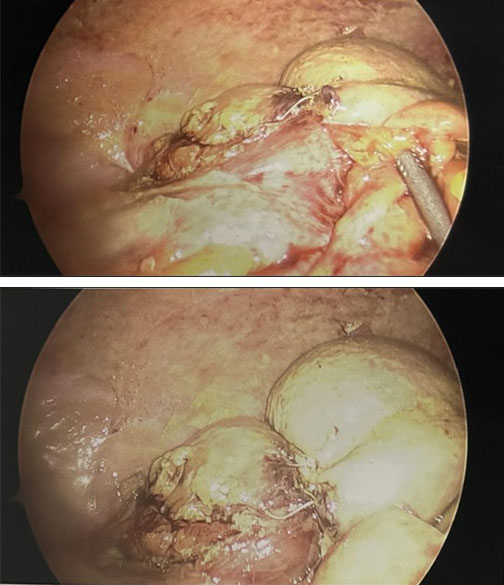
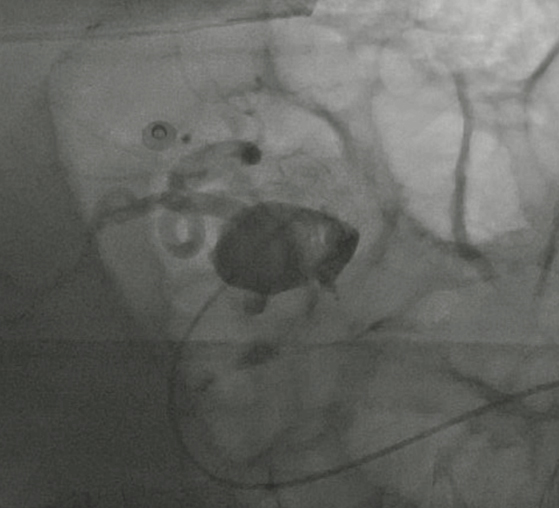
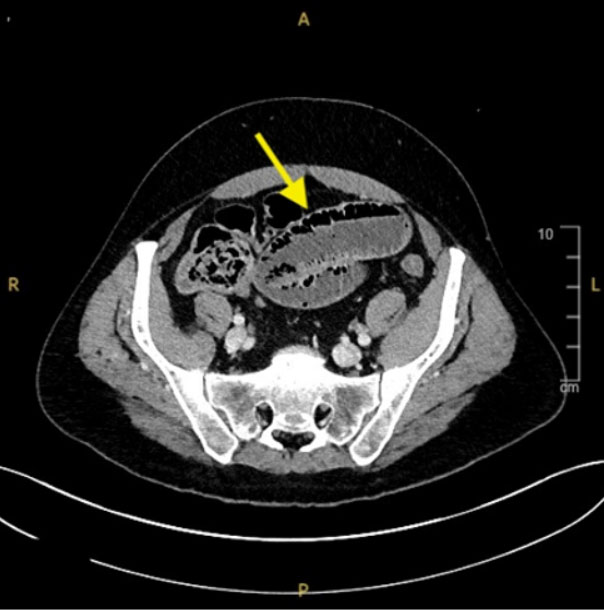
|
Case Report
An unexpected twist: Isolated fallopian tube torsion in a term nulliparous patient
1 Department of Obstetrics and Gynecology, New York University Grossman Long Island School of Medicine, Mineola, NY, USA
2 New York University Grossman Long Island School of Medicine, USA
3 Division of Maternal Fetal Medicine, New York University Grossman Long Island School of Medicine. Mineola, NY, USA
Address correspondence to:
Yael Eliner
222 Station Road, 5th floor, Mineola, NY 11501,
USA
Message to Corresponding Author
Article ID: 101545Z01CA2026
Access full text article on other devices

Access PDF of article on other devices


How to cite this article
Alterman C, Walker E, Gunabalan S, Eliner Y, Herman J, Wat K, Chavez M, Rekawek P. An unexpected twist: Isolated fallopian tube torsion in a term nulliparous patient. Int J Case Rep Images 2026;17(2):26–29.ABSTRACT
Introduction: Isolated fallopian tube torsion (IFTT) is the rotation of a fallopian tube without involvement of the ovary or adjacent vascular structures. It is a profoundly rare gynecologic emergency. Diagnosis is challenging because presenting symptoms and imaging findings are nonspecific and may be even more challenging during pregnancy due to the gravid uterus and attributing the pain to an obstetrical origin.
Case Report: We describe a case of a 20-year-old G1P0 patient who presented at 36 weeks and 6 days of gestation with acute right lower quadrant abdominal pain. Abdominal ultrasound was non-diagnostic, and abdominal magnetic resonance imaging demonstrated a nonspecific loculated fluid in the right lower quadrant. Fetal status was reactive and reassuring. Due to persistence of the pain despite administration of opioids and high levels of suspicion for adnexal torsion, the patient had a primary cesarean section and pelvic exploration that revealed a purple-black, edematous, necrotic right hydrosalpinx twisted more than six times. The patient had a concurrent salpingectomy. She was discharged from the hospital on postoperative day 2 with a healthy newborn.
Conclusion: This case highlights the importance of maintaining a high index of suspicion for IFTT in pregnant patients with severe, narcotic-refractory abdominal pain. Early recognition and prompt intervention are critical to optimize pregnancy outcomes.
Keywords: Abdominal pain, Fallopian tube torsion, Salpingectomy, Term pregnancy
Introduction
Isolated fallopian tube torsion (IFTT) is defined as the rotation or twisting of a fallopian tube without involvement of the ovary or adjacent vascular structures [1]. It is an exceedingly rare gynecologic emergency, with an estimated incidence of 1 in 1.5 million women [2]. The true incidence is likely underestimated because many cases remain unrecognized until surgery. Most cases occur in non-pregnant individuals, though rare instances have been reported during pregnancy. A recent systematic review identified 10 English-language case reports between 2011 and 2021, only two of which occurred at term [3].
The etiology of IFTT remains unclear. Proposed extrinsic risk factors include trauma, prior pelvic surgery, cysts, adhesions, and pregnancy itself, whereas intrinsic risk factors include congenital tubal anomalies, hydrosalpinx, and neoplasm [1]. Pregnancy may increase torsion risk by altering pelvic anatomy and exerting rotational forces from uterine enlargement [4].
Diagnosis is challenging because presenting symptoms and imaging findings are nonspecific, leading to a broad differential diagnosis that includes obstetrical, gynecologic, and general surgical conditions [4]. The most frequent complaint is unilateral lower quadrant abdominal or pelvic pain, often accompanied by nausea or vomiting [1],[3]. Physical findings may be subtle, and laboratory studies are typically normal. Ultrasound or magnetic resonance imaging (MRI) may demonstrate a hydrosalpinx, tubular cystic structure, or free fluid with a normal-appearing ovary [5]. When IFTT is suspected, surgical management is required for diagnosis and treatment [4].
We report a case of IFTT in term pregnancy, characterized by an atypical clinical presentation and diagnostic challenges that delayed recognition until the time of surgery.
Case Report
A 20-year-old G1P0 female at 36 weeks and 6 days of gestation with an overall uncomplicated prenatal course presented to labor and delivery with complaints of severe acute right lower quadrant abdominal pain. According to the patient, the pain was described as 10 out of 10 in severity without associated nausea, vomiting, diarrhea, subjective fevers, or chills. The pain woke her up from sleep; it was constant with intermittent periods of worsening. She thought that she was in labor; however, she denied leakage of fluids or vaginal bleeding. In triage, the patient was afebrile with normal heart rate and blood pressure. Physical examination revealed a gravid uterus and non-reproducible right lower quadrant abdominal pain out of proportion to physical examination findings with negative rebound, guarding, or distention. She reported normal fetal movements. The cervix was closed on pelvic exam. Electronic fetal monitoring demonstrated reactive and reassuring fetal tracing without decelerations or contractions.
Initial laboratory evaluation showed a leukocyte count of 11,500 cells/µL, hemoglobin of 11.5 g/dL, normal metabolic panel, and unremarkable urinalysis. Abdominal ultrasound did not visualize the appendix, and renal ultrasound showed no acute pathology. Magnetic resonance imaging of the abdomen demonstrated a normal appendix and nonspecific loculated fluid in the right lower quadrant measuring 9.6 2.5 × 6.4 cm.
Urology and general surgery consultations recommended no immediate intervention. The patient received intravenous fluids and five doses of 4 mg intravenous (IV) morphine overnight but continued to experience breakthrough pain. The following morning, the maternal-fetal medicine team recommended surgical exploration in the setting of narcotic-refractory pain of unclear etiology associated with a large intra-abdominal fluid collection. Given the concern for potential deterioration of maternal and fetal status—with differential diagnoses including perforated appendicitis or adnexal torsion—the decision was made to proceed with operative delivery.
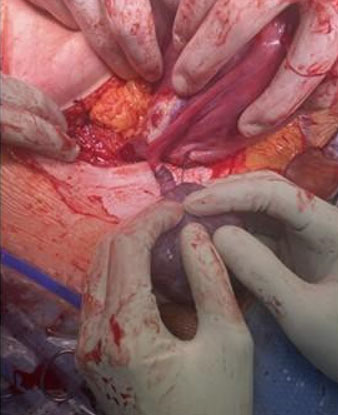
The patient was not a candidate for laparoscopy at that time, given her full term gravid uterus. A cesarean section was performed at 37 weeks and 0 days, resulting in delivery of live vigorous male infant. Pelvic exploration revealed a purple-black, edematous, right hydrosalpinx twisted more than six times (Figure 1). The uterus, bilateral ovaries, and left fallopian tube appeared normal. A right salpingectomy was performed. Gross pathologic examination revealed a fallopian tube including a normal-caliber segment (3 × 0.5 cm) with its fimbriated end, as well as a significantly dilated segment (6.5 × 6.0 cm). The outer serosa was smooth. The dilated segment demonstrated a lumen filled with clear serous fluid, consistent with hydrosalpinx. The inner lining of the dilated segment was hemorrhagic (pink-violet to tan) with focal excrescences measuring 0.3–1.0 cm. The presence of congested vessels and stromal hemorrhage was also identified, consistent with the diagnosis of torsion. The postoperative course was uncomplicated, and the patient met all milestones without difficulty. The mother and infant were discharged home two days later in stable condition.
Discussion
Few cases of IFTT during pregnancy, particularly at term, have been described [3],[4]. In this patient, pregnancy was the only identifiable risk factor, which made definitive management by surgery particularly challenging. The decision to proceed with operative intervention required careful consideration of maternal and fetal risks, including the implications of early-term delivery versus the potential for worsening maternal or fetal condition if intervention was delayed.
Isolated fallopian tube torsion is a surgical emergency due to the risk of ischemia and necrosis, with potential maternal and fetal morbidity [1]. Prompt surgical intervention is essential to prevent sepsis, preserve fertility, and maintain fetal well-being [5]. Laparoscopy is considered the diagnostic gold standard but is technically limited in late pregnancy. In our case, cesarean delivery with concurrent laparotomy enabled definitive diagnosis and treatment. As in most reports, the diagnosis was made intraoperatively [3]. Timely recognition and management allowed preservation of the ovary and favorable maternal-fetal outcomes.
Conclusion
This case highlights the importance of maintaining a high index of suspicion for isolated fallopian tube torsion in pregnant patients with severe, narcotic-refractory abdominal pain of unclear origin. Early recognition and prompt intervention are critical to optimize maternal and fetal outcomes. Given the rarity of IFTT at term and the unclear clinical picture, clinicians must exercise a low threshold for surgical exploration when abdominal pain remains unexplained and refractory. Continued reporting of such cases is essential to improve understanding, facilitate earlier diagnosis, and guide management strategies for isolated fallopian tube torsion in pregnancy.
REFERENCES
1.
Varghese S, Seldon Y, Raperport C, Rinne N, Patel K, Zaid RZ. Isolated fallopian tube torsion: A systematic review of case reports. Eur J Obstet Gynecol Reprod Biol 2024;296:140–7. [CrossRef]
[Pubmed]

2.
Hansen OH. Isolated torsion of the fallopian tube. Acta Obstet Gynecol Scand 1970;49(1):3–6. [CrossRef]
[Pubmed]
3.
Gulino FA, Ettore C, Morreale G, Siringo S, Russo E, D’Asta M, et al. Isolated tubal torsion in a term pregnancy: Case report and systematic review of literature of the last 10 years. Front Surg 2022;9:856915. [CrossRef]
[Pubmed]
4.
Park SN. Isolated tubal torsion in the third trimester of pregnancy managed with simultaneous salpingectomy and cesarean section. Yeungnam Univ J Med 2019;36(1):59–62. [CrossRef]
[Pubmed]
5.
Macedo M, Kim B, Khoury R, Narkiewicz L. A rare case of right lower quadrant abdominal pain. Am J Emerg Med 2017;35(4):668.e1–e2. [CrossRef]
[Pubmed]
SUPPORTING INFORMATION
Acknowledgments
In accordance with the journal’s guidelines, AI was utilized for initial literature screening and review, but all intellectual content, data interpretation, and final drafting remain the responsibility of the authors. The authors used OpenEvidence AI Medical Knowledge Assistant at https://www.openevidence.com.
Author ContributionsCarly Alterman - Conception of the work, Design of the work, Acquisition of data, Analysis of data, Drafting the work, Revising the work critically for important intellectual content, Final approval of the version to be published, Agree to be accountable for all aspects of the work in ensuring that questions related to the accuracy or integrity of any part of the work are appropriately investigated and resolved.
Emma Walker - Acquisition of data, Drafting the work, Revising the work critically for important intellectual content, Final approval of the version to be published, Agree to be accountable for all aspects of the work in ensuring that questions related to the accuracy or integrity of any part of the work are appropriately investigated and resolved.
Silpaa Gunabalan - Acquisition of data, Drafting the work, Revising the work critically for important intellectual content, Final approval of the version to be published, Agree to be accountable for all aspects of the work in ensuring that questions related to the accuracy or integrity of any part of the work are appropriately investigated and resolved.
Yael Eliner - Analysis of data, Drafting the work, Revising the work critically for important intellectual content, Final approval of the version to be published, Agree to be accountable for all aspects of the work in ensuring that questions related to the accuracy or integrity of any part of the work are appropriately investigated and resolved.
Jonathan Herman - Conception of the work, Design of the work, Revising the work critically for important intellectual content, Final approval of the version to be published, Agree to be accountable for all aspects of the work in ensuring that questions related to the accuracy or integrity of any part of the work are appropriately investigated and resolved.
Karyn Wat - Conception of the work, Design of the work, Revising the work critically for important intellectual content, Final approval of the version to be published, Agree to be accountable for all aspects of the work in ensuring that questions related to the accuracy or integrity of any part of the work are appropriately investigated and resolved.
Martin Chavez - Conception of the work, Design of the work, Revising the work critically for important intellectual content, Final approval of the version to be published, Agree to be accountable for all aspects of the work in ensuring that questions related to the accuracy or integrity of any part of the work are appropriately investigated and resolved.
Patricia Rekawek - Conception of the work, Design of the work, Revising the work critically for important intellectual content, Final approval of the version to be published, Agree to be accountable for all aspects of the work in ensuring that questions related to the accuracy or integrity of any part of the work are appropriately investigated and resolved.
Guarantor of SubmissionThe corresponding author is the guarantor of submission.
Source of SupportNone
Consent StatementWritten informed consent was obtained from the patient for publication of this article.
Data AvailabilityAll relevant data are within the paper and its Supporting Information files.
Conflict of InterestAuthors declare no conflict of interest.
Copyright© 2026 Carly Alterman et al. This article is distributed under the terms of Creative Commons Attribution License which permits unrestricted use, distribution and reproduction in any medium provided the original author(s) and original publisher are properly credited. Please see the copyright policy on the journal website for more information.