
 |
Case Report
Chronic steroid use and staple line failure after laparoscopic appendectomy
1 Surgery Resident, Surgery, HCA Healthcare, Ocala, FL, USA
2 Colorectal Surgeon, Surgery, University of Florida, Leesburg, FL, USA
Address correspondence to:
Alexa Wacker
1431 SW 1st Avenue, Ocala, FL 34470,
USA
Message to Corresponding Author
Article ID: 101544Z01AW2026
Access full text article on other devices

Access PDF of article on other devices


How to cite this article
Wacker A, Sanchez CR. Chronic steroid use and staple line failure after laparoscopic appendectomy. Int J Case Rep Images 2026;17(2):22–25.ABSTRACT
Acute appendicitis is a common, usually benign inflammatory process of the appendix. It is typically treated with antibiotics or surgery. Transection of the appendix during surgery can be performed using a stapler, endoloops, or clips. We present the case of an 87-year-old male with acute appendicitis on chronic steroids who failed conservative management with antibiotics. He was treated with laparoscopic appendectomy using a powered stapler. We believe this is an unusual case reporting staple line failure after laparoscopic appendectomy in a patient with an intact staple line through viable tissue at the conclusion of surgery.
Keywords: Appendectomy, Re-operation, Staple line, Steroids
Introduction
Acute appendicitis is one of the most common surgical emergencies worldwide, with appendectomy remaining the standard treatment [1]. The adoption of laparoscopic techniques has improved outcomes, offering reduced postoperative pain, shorter hospital stays, and low complication rates. Transection of the appendix is routinely performed using staplers, clips, or endoloops, all considered safe and effective methods for closure of the appendiceal base.
Complications following laparoscopic appendectomy are uncommon but may include surgical site infection, intra-abdominal abscess, and, rarely, failure of stump closure. Staple line disruption in this setting is exceedingly rare, with limited literature describing its incidence or risk factors. Impaired wound healing, particularly in patients with advanced age, comorbidities, or chronic corticosteroid use, may increase the risk of tissue dehiscence.
We present a rare case of staple line failure following laparoscopic appendectomy in an elderly patient on chronic steroids, highlighting important considerations in high-risk surgical patients.
Case Report
The patient is an 87-year-old male with a past medical history of chronic obstructive pulmonary disease (COPD) on chronic steroids and home oxygen as needed who presented to the Emergency Department with right lower quadrant abdominal pain. His abdominal pain started the day of his presentation to the hospital. Computed tomography (CT) scan of the abdomen and pelvis showed acute non-complicated appendicitis. On exam, he had mild right lower quadrant tenderness to palpation.
For COPD management, he was on home oxygen as needed, multiple inhalers, and daily prednisone. He had recently experienced a COPD exacerbation requiring an increase in his Prednisone dose from 10 mg daily to 40 mg daily. He was advised by his primary care provider to take 40 mg of Prednisone for 4 days, 20 mg for 4 days, then return to his normal dose of 10 mg daily. On the day of presentation, he was on his last day of 20 mg.
Because of the patient’s history of chronic steroid use, we attempted a trial of nonoperative management with intravenous (IV) antibiotics alone. However, after one day of conservative management, his abdominal pain had worsened, therefore the decision was made to take him to surgery. Before surgery, he was evaluated by the pulmonology team who deemed the patient to be moderate risk for surgery and recommended IV steroids for three days. The patient received 40 mg of Methylprednisolone daily. Before his laparoscopic appendectomy, he received 60 mg of Methylprednisolone, which is equivalent to 80 mg of prednisone.
During surgery, his appendix was noted to be inflamed, without perforation, free fluid, or adhesions. The mesoappendix was freed using a bipolar device and the base of the appendix transected using a 45 mm stapler with a blue load. After transection, the staple line was inspected and noted to be without any active bleeding or staple line defects.
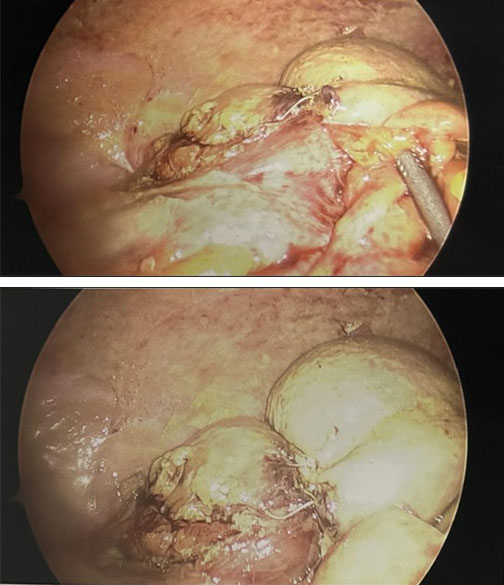
The morning after surgery, the patient was noted to be progressing well with mild surgical incision site pain. On postoperative day two, his white blood cell (WBC) was noted to increase from 10.8 to 16.3. He developed tachycardia overnight, and worsening abdominal pain. A repeat CT scan of the abdomen and pelvis was done which showed post-surgical changes and nonspecific distention of the cecum. Because of the cecal dilation, gastrointestinal (GI) was consulted. However, by the time that the images could be seen from the CT scan, the patient’s abdominal pain was worsening, and his clinical status was deteriorating as his abdominal exam worsened. The decision was made to return to the operating room for a diagnostic laparoscopy. Prior to beginning the case, he was given 125 mg of Methylprednisolone by the anesthesia team. During this surgery, focal peritonitis, stool spillage, and purulent fluid were seen in the right lower quadrant as well as a 1 cm staple line defect in the center of the prior staple line. Using 3-0 Vicryl sutures, the defect was closed in an interrupted fashion. The entire staple line was then oversewn in 2 layers (Figure 1). The right lower quadrant and pelvis were irrigated with copious amounts of normal saline until the aspirate was clear. We then made the decision to perform a loop ileostomy given the patient’s history of chronic steroid use and likely poor wound healing abilities.
Consideration was given for a formal ileocolic resection with end ileostomy; consideration was also given for a formal right colectomy due to the dilated cecum although the etiology of this was unclear. However, there was no indication for a formal resection. The cecum itself and surrounding tissues appeared viable and well perfused. Performing a formal resection would have increased the size of the staple line. Considering that the staple line failure could have been the result of steroid use, increasing the staple line size would further have increased his risk for another staple lines failure along with the morbidity of a formal resection in a patient who had not had recent colorectal cancer screening. Before ileostomy closure, he underwent a Gastrografin enema which showed no leaks and no colonic feeling defects, masses, or tumors.
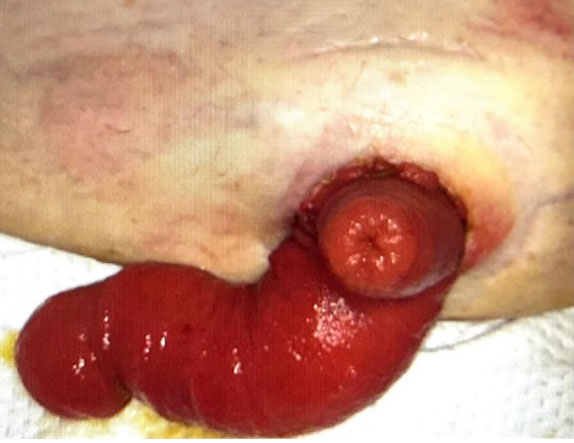
After surgery, he progressed well. He had return of bowel function on postoperative day three from his takeback surgery. On postoperative day four, he was discharged to an acute rehab center. We were consulted four days later while the patient was in rehab for evaluation of ileostomy prolapse (Figure 2). At that time, the ileostomy was functioning, and no intervention was done. Three months later, he underwent a Gastrograffin enema which showed no leaks in the cecum or intraluminal defects. He was then scheduled for elective ileostomy reversal. A side-to-side anastomosis was accomplished using a linear stapler. He progressed without complication and was discharged on postoperative day three. Because he was on his usual 10 mg daily dose of Prednisone, he was not given additional steroids before surgery.
Discussion
Worldwide, acute appendicitis is the most common surgical emergency with 300,000 yearly associated hospital visits in the United States alone [1]. The treatment for acute appendicitis is most often surgical, but treatment can also be attempted with antibiotics in the case of non-complicated appendicitis including those cases without perforation, abscess, generalized peritonitis, or necrosis. In the Comparing Outcomes of Antibiotic Drugs and Appendectomy (CODA) Trial, at 30 days, antibiotics were reported to be non-inferior to surgery [2]. However, by 90 days, 29% of the patients treated with antibiotics had undergone an appendectomy [2]. Longer term outcomes in the antibiotics group were reported as 40% having an appendectomy at 1 year follow up, 46% at 2 years and 49% at 3 and 4 years [3].
Glucocorticoids are stress hormones that help to regulate multiple physiological processes [4]. They are used to treat many inflammatory and autoimmune disorders to decrease the body’s response to these chronic high inflammation states. Risks and benefits of glucocorticoid use must be considered because of the risks of harmful side effects. Side effects include “diabetes”, impaired wound healing, skin atrophy, muscle atrophy, hypothalamic-pituitary-adrenal (HPA) dysfunction, cataracts, peptic ulcers, hypertension, metabolic syndrome, osteoporosis, and water/electrolyte imbalance [4].
In a retrospective evaluation of 635,265 patients using NSQIP (National Surgical Quality Improvement Program) public use files from 2005 to 2008, 3.2% used steroids preoperatively [5]. Wound dehiscence increased 2 to 3 times from normal with steroid use [5]. The risk of wound dehiscence was 2.0% in patients on steroids compared to 0.6% in nonsteroid patients (p <0.001). 11.2% of steroid use patients required reoperation [5]. Additionally, numerous animal studies have been done to examine the effect of high-dose corticosteroids tensile wound strength and bursting pressures of anastomoses. When considered together, the studies found an approximately 30% reduction in tensile wound strength at cortisone doses of 15 to 40 mg/kg/day which is equivalent to 200 to 560 mg/day of prednisone in humans [6]. Unfortunately, these results cannot be generalized among animals or to humans.
Because of his chronic steroid use, our patient received stress dose steroids before his laparoscopic appendectomy. There are many opponents to the practice of “stress-dose” steroids. A prospective trial was conducted that included 92 patients with irritable bowel disease (IBD) who were undergoing major colorectal surgery. Patients were treated with 100 mg hydrocortisone IV 3 times daily or low-dose corticosteroids which were IV hydrocortisone or equivalent oral dosing, followed by a taper [7]. The primary outcome examined was the absence of postural hypotension on postoperative day 1 defined as 20 mmHg decrease in systolic blood pressure after standing from a sitting position [7]. 95% of the patients who received high dose steroids and 96% of those who received low dose steroids had absence of postural hypotension on the first postoperative day. The study concluded that IBD patients on chronic steroids could be treated preoperatively with low dose steroids [7]. Data from the early 2000s suggest that 20 mg of prednisone daily increased the rate of anastomotic leak in colorectal surgery patients [8]. Our patient received both stress-dose steroids before the initial appendectomy and low-dose steroids between the initial surgery and the subsequent take-back procedure.
Considering our patient’s age, partially dependent functional status, severe systemic disease, and chronic steroid use, he was high risk for complications after surgery. Using the NSQIP Surgical Risk Calculator, our patient had a 17.6% risk of serious complication (compared to 1.9% average risk), 2.2% risk of return to the operating room (0.6% average risk), 6.7% risk of death (0.0% average risk) [9].
We were unable to find any previously reported incidences of staple line failures after laparoscopic appendectomy; however, numerous cases have been reported of staple line failures after laparoscopic gastric sleeve. Staple line failure can be attributed to mechanical or ischemic causes [10]. Staple misfiring and tissue injuries are classified as mechanical causes and are usually discovered in the patient within two days of surgery. Therefore, the choice of staple size and color is also important to ensure an appropriate tissue closure. In addition, stapling should allow time for tissue compression before firing the stapler. It is recommended to wait 15 seconds between closing the stapler and firing it [10]. In our case, compression was held with the stapler for at least 15 seconds before firing. The staple line was inspected, and no obvious defects were seen in the staple line and there was no bleeding.
This report opens the floor to questions regarding possible options in these types of patients, especially after patients have failed nonoperative management.
Conclusion
This case presents an 87-year-old man on chronic steroids who underwent laparoscopic appendectomy and two days later was found to have a 1 cm staple line defect on re-operation. This case highlights the importance of considering nonoperative management whenever possible in patients on steroids. However, given his failure of conservative management, we believe that surgery was the best option.
REFERENCES
1.
Lotfollahzadeh S, Lopez RA, Deppen JG. Appendicitis. In: StatPearls. Treasure Island (FL): StatPearls Publishing; 2026.
[Pubmed]

2.
CODA Collaborative; Flum DR, Davidson GH, Monsell SE, Shapiro NI, Odom SR, et al. A randomized trial comparing antibiotics with appendectomy for appendicitis. N Engl J Med 2020;383(20):1907–19. [CrossRef]
[Pubmed]
3.
CODA Collaborative; Davidson GH, Flum DR, Monsell SE, Kao LS, Voldal EC, et al. Antibiotics versus appendectomy for acute appendicitis—Longer-term outcomes. N Engl J Med 2021;385(25):2395–7. [CrossRef]
[Pubmed]
4.
Ramamoorthy S, Cidlowski JA. Corticosteroids: Mechanisms of action in health and disease. Rheum Dis Clin North Am 2016;42(1):15–31, vii. [CrossRef]
[Pubmed]
5.
Ismael H, Horst M, Farooq M, Jordon J, Patton JH, Rubinfeld IS. Adverse effects of preoperative steroid use on surgical outcomes. Am J Surg 2011;201(3):305–8; discussion 308–9. [CrossRef]
[Pubmed]
6.
Wang AS, Armstrong EJ, Armstrong AW. Corticosteroids and wound healing: Clinical considerations in the perioperative period. Am J Surg 2013;206(3):410–7. [CrossRef]
[Pubmed]
7.
Zaghiyan K, Melmed GY, Berel D, Ovsepyan G, Murrell Z, Fleshner P. A prospective, randomized, noninferiority trial of steroid dosing after major colorectal surgery. Ann Surg 2014;259(1):32–7. [CrossRef]
[Pubmed]
8.
Lake JP, Firoozmand E, Kang JC, Vassiliu P, Chan LS, Vukasin P, et al. Effect of high-dose steroids on anastomotic complications after proctocolectomy with ileal pouch-anal anastomosis. J Gastrointest Surg 2004;8(5):547–51. [CrossRef]
[Pubmed]
9.
ACS Risk Calculator. [Available at: https://riskcalculator.facs.org/RiskCalculator/]
10.
Silecchia G, Iossa A. Complications of staple line and anastomoses following laparoscopic bariatric surgery. Ann Gastroenterol 2018;31(1):56–64. [CrossRef]
[Pubmed]
SUPPORTING INFORMATION
Author Contributions
Alexa Wacker - Conception of the work, Design of the work, Acquisition of data, Analysis of data, Drafting the work, Revising the work critically for important intellectual content, Final approval of the version to be published, Agree to be accountable for all aspects of the work in ensuring that questions related to the accuracy or integrity of any part of the work are appropriately investigated and resolved.
Cesar Reategui Sanchez - Analysis of data, Revising the work critically for important intellectual content, Final approval of the version to be published, Agree to be accountable for all aspects of the work in ensuring that questions related to the accuracy or integrity of any part of the work are appropriately investigated and resolved.
Guarantor of SubmissionThe corresponding author is the guarantor of submission.
Source of SupportNone
Consent StatementWritten informed consent was obtained from the patient for publication of this article.
Data AvailabilityAll relevant data are within the paper and its Supporting Information files.
Conflict of InterestAuthors declare no conflict of interest.
Copyright© 2026 Alexa Wacker et al. This article is distributed under the terms of Creative Commons Attribution License which permits unrestricted use, distribution and reproduction in any medium provided the original author(s) and original publisher are properly credited. Please see the copyright policy on the journal website for more information.


