
 |
Clinical Image
Aortobifemoral bypass graft infection with candida tropicalis
1 Resident, Internal Medicine Department A, Rambam Health Care Campus, Haifa, Israel
2 Director, Internal Medicine Department A, Rambam Health Care Campus, Haifa, Israel, Assistant Professor at Technion Israel Institute of Technology the Ruth and Bruce Rappaport Faculty of Medicine
Address correspondence to:
Rabea Shehadi
Haifa 3501225,
Israel
Message to Corresponding Author
Article ID: 100954Z01RS2018
Access full text article on other devices

Access PDF of article on other devices


How to cite this article
Shehadi R, Raz-Pasteur A. Aortobifemoral bypass graft infection with candida tropicalis. Int J Case Rep Images 2018;9:100954Z01RS2018.ABSTRACT
No Abstract
Keywords: Aortobifemoral bypass, Candida tropicalis, Graft infection, Vascular grafts
CASE REPORT
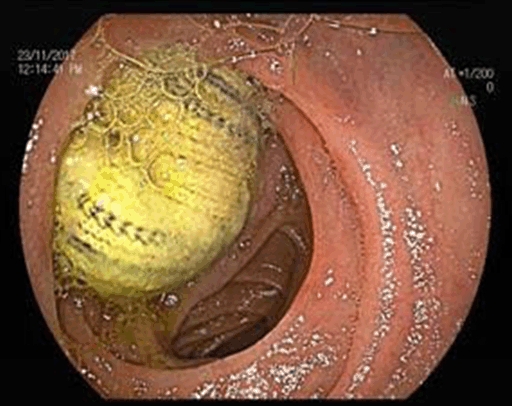
A 77-year-old female patient was admitted to the internal medicine department due to high fever. Her medical history included hypertension, hyperlipidemia, Type 2 diabetes, but more importantly severe peripheral artery disease affecting blood flow to her left femoral artery, and necessitating an aortobifemoral bypass surgery. She had underwent a bypass surgery a month prior to her admission. Fever workup including chest X-ray, blood and urine cultures were negative for bacterial pathogens. She was treated with empiric antibiotic therapy (Ceftriaxone), until 10 days after her admission, one of the blood cultures (from a total of four blood culture sets) that were previously drawn was positive for candida tropicalis. In hopes of unveiling a focus for this candidemia, she had undergone an abdominal CT, which demonstrated surprising results. Close proximity between the synthetic aortic graft and the third part of the duodenum, was established on CT scan. The border between the two structures was poorly defined. The patient was referred to gastroscopy, during which the following findings were demonstrated, as shown in Figure 1. The synthetic aortic graft had fistulated and is seen inside the duodenal lumen. The patient later underwent a successful multidisciplinary surgery including general surgeons and vascular surgeons, the involved duodenal wall was primarily sutured and the aortobifemoral bypass was replaced with a silver-coated bypass. One week after her surgery she was released home in generally good condition.
DISCUSSION
Vascular grafts are frequently used in the treatment of peripheral vascular disease when blood supply to the lower limbs is at risk and conventional noninvasive medical treatments fail. Synthetic grafts include polytetrafluoroethylene (Teflon) and polyethylene terephthalate (Dacron). Acute complications of vascular grafts include acute graft occlusion (2.9% aortofemoral, 10.4% femoropopliteal, and 25.3% femorotibial grafts), whereas late complications are more rare and include vascular graft infection (2-6%), pseudoaneurysm formation and enteric fistulas to small or large intestine (1–2%). Staphylococcus aureus is the predominant microorganism involved in graft infection including Methicillin Resistant Staph Aureus (MRSA), other causative agents include Candida species and Pseudomonas Aeruginosa [1],[2]. Reports of vascular graft infection by the fungal species are anecdotal, only 13 reported cases can be found in the literature over a 20 year period from 1966 to 1986, Candida is involved in 8 of those cases, Aspergillus in 4 cases, and Mucor in one case [3].
There are numerous clinical presentations of Candida Tropicalis infection, most frequent oral candidiasis, arthritis and sponylodiscitis, in medical literature review only two other cases of candidiatropicalis vascular graft infection have been reported [3],[4],[5].
CONCLUSION
There have been very few reports of vascular graft infection by fungal species, and even fewer by a candida species. In this publication we present a very rare case of a vascular graft infection with candida tropilcaliscandidemia complicated with duodenal fistula. In a patient with a vascular graft, candidemia warrants a deferential diagnosis of a graft infection.
REFERENCES
1.
Wilson WR, Bower TC, Creager MA, et al. Vascular graft infections, mycotic aneurysms, and endovascular infections: A scientific statement from the American heart association. Circulation 2016 Nov 15;134(20):e412–60. [CrossRef]
[Pubmed]

2.
Campbell WB, Tambeur LJ, Geens VR. Local complications after arterial bypass grafting. Ann R Coll Surg Engl 1994 Mar;76(2):127–31.
[Pubmed]
3.
Doscher W, Krishnasastry KV, Deckoff SL. Fungal graft infections: Case report and review of the literature. J Vasc Surg 1987 Oct;6(4):398–402. [CrossRef]
[Pubmed]
4.
Kothavade RJ, Kura MM, Valand AG, Panthaki MH. Candida tropicalis: Its prevalence, pathogenicity and increasing resistance to fluconazole. J Med Microbiol 2010 Aug;59(Pt 8):873–80. [CrossRef]
[Pubmed]
5.
Oichi T, Sasaki S, Tajiri Y. Spondylodiscitis concurrent with infectious aortic aneurysm caused by Candida tropicalis: A case report. J Orthop Surg (Hong Kong) 2015 Aug;23(2):251–4. [CrossRef]
[Pubmed]
SUPPORTING INFORMATION
Author Contributions
Rabea Shehadi - Substantial contributions to conception and design, Acquisition of data, Analysis of data, Interpretation of data, Drafting the article, Revising it critically for important intellectual content, Final approval of the version to be published
Ayelet Raz-Pasteur - Substantial contributions to conception and design, Acquisition of data, Analysis of data, Interpretation of data, Drafting the article, Revising it critically for important intellectual content, Final approval of the version to be published
Guarantor of SubmissionThe corresponding author is the guarantor of submission.
Source of SupportNone
Consent StatementWritten informed consent was obtained from the patient’s children for publication of this clinical image.
Data AvailabilityAll relevant data are within the paper and its Supporting Information files.
Conflict of InterestAuthors declare no conflict of interest.
Copyright© 2018 Rabea Shehadi et al. This article is distributed under the terms of Creative Commons Attribution License which permits unrestricted use, distribution and reproduction in any medium provided the original author(s) and original publisher are properly credited. Please see the copyright policy on the journal website for more information.


