|
|
|
|
Case Report
| ||||||
| Penile strangulation due to a metal ring: A case report | ||||||
| Matsumiya K1, Kawahara T1,2, Yamashita Y2, Hayashi Y2,1,3, Shimokihara K1, Tsutsumi S1, Takamoto D1, Mochizuki T1, Hattori Y1, Teranishi J1, Miyoshi Y1, Yumura Y1, Yao M3, Uemura H1 | ||||||
|
1Departments of Urology and Renal Transplantation, Yokohama City University Medical Center, Yokohama, Japan
2Department of Dental Surgery, Yokohama City University Medical Center, Yokohama, Japan 3Department of Urology, Yokohama City University Graduate School of Medicine, Yokohama, Japan | ||||||
| ||||||
|
[HTML Abstract]
[PDF Full Text]
[Print This Article] [Similar article in Pumed] [Similar article in Google Scholar] 
|
| How to cite this article |
| Matsumiya K, Kawahara T, Yamashita Y, Hayashi Y, Shimokihara K, Tsutsumi S, Takamoto D, Mochizuki T, Hattori Y, Teranishi J, Miyoshi Y, Yumura Y, Yao M, Uemura H. Penile strangulation due to a metal ring: A case report. Int J Case Rep Images 2017;8(7):470–472. |
|
ABSTRACT
| ||||||
|
Introduction:
Penile strangulation is a condition in which a foreign material compresses the penis, resulting in penile enlargement due to a circulatory disturbance. Keywords: Strangulation, Incarceration, Penile | ||||||
|
INTRODUCTION
| ||||||
|
Penile strangulation is a condition in which a foreign material compresses the penis, resulting in penile enlargement due to a circulatory disturbance [1]. We herein describe a case of penile strangulation due to a metal ring that the patient had worn to the reduce pain of varicocele. | ||||||
|
CASE REPORT
| ||||||
|
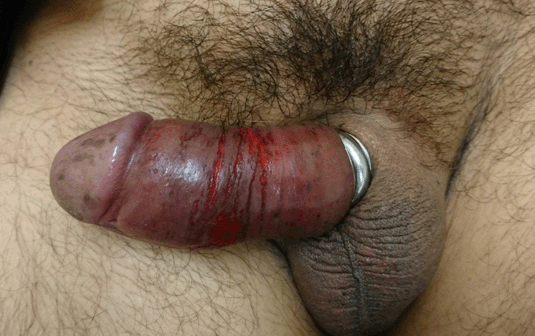
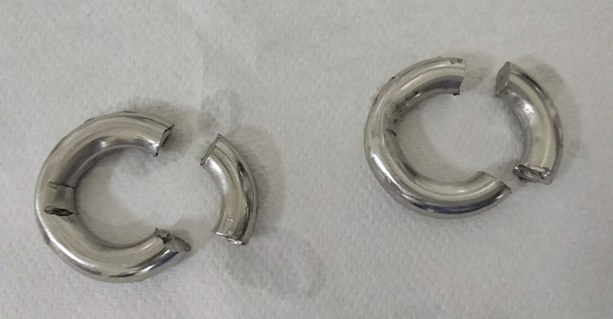
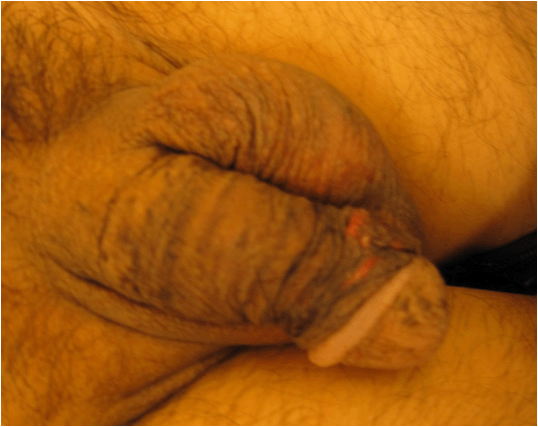
A 68-year-old male was referred to our hospital with an enlargement of his penis due to a metal ring. He had been inserting his penis into a metal ring to reduce the pain associated with varicocele for ten years. Three hours before his initial visit, he could not remove this ring and experienced difficulty in urination (Figure 1). To treat his condition, the patient was referred to our hospital at six hours after penile strangulation. We initially attempted to remove the ring using a ring cutter and wire cutter; however, this failed to cut the ring. We then asked a dental surgeon to cut the ring using an airtime cutter. The ring was successfully cut and removed from his penis (Figure 2) and (Figure 3). | ||||||
| ||||||
| ||||||
| ||||||
|
DISCUSSION
| ||||||
|
Penile strangulation is caused when an object compresses the penis. In most cases, the removal of the foreign body is difficult because of priapism in the external penis. Penile strangulation represents an emergency disease, as the compression of the penis for an extended period of time interrupts the blood flow, resulting in penile ischemia [1]. In previous reports, the strangled penile body was divided by soft and hard materials. Rubber and vinyl have been reported as soft materials, while metal rings, metallic pipes, and the tops of PET bottles have been reported as hard materials. Soft materials compress the skin deeply, with ulceration occurring in severe cases. Hard materials first lead to edema rather than ulceration. The duration of strangulation in the previously reported cases has ranged from one hour to ten years [1]. In the present case, the patient had strangled his penis in order to reduce the pain associated with varicocele. Previous reports showed that the reasons for penile strangulation were divided into non-sexual and sexual purposes. The sexual purposes have included (but are not limited to) improving energy, extending erection time, and enlarging the penis [2]. The duration of strangulation varied according to the reasons. The patients in whom penile strangulation occurred due to non-sexual reasons presented to hospital earlier than the patients in whom the purpose was sexual [3]. In this case, the patient performed penile strangulation for a therapeutic reason. The patient presented to a hospital in the early stage of penile strangulation, after experiencing difficult urination. We have to remind that inappropriate usage of foreign bodies resulting in penile strangulation. The removal of the object strangling the penis is the most important aspect of treatment in cases of penile strangulation. A previous report suggested that the object can be removed at up to 12 hours without any complications [1]. In our case, the rapid removal might have contributed to the lack of any complications. Instruments that have been used in removal have included pincers, a plaster cutter, a hammer, and a grinder [4][5][6]. However, air turbines for dental use are most frequently used to remove such objects [5]. The top of the air turbine is coated with diamonds and spins at a rate of 400,000 times per minute, which gives it a high cutting ability. Water can be poured to reduce the frictional heat and improve the safety of the procedure—as we did in our case [7]. When standard procedures including the use of a ring cutter fail to cut the object, the use of an air turbine with the assistance of a dental surgeon is sometimes necessary [8]. Followed-up is needed to confirm no ischemia after removal of metallic ring. | ||||||
|
CONCLUSION
| ||||||
|
We herein describe a case of penile strangulation due to a metal ring that the patient had worn to the reduce pain of varicocele. The removal of the object strangling the penis is the most important aspect of treatment in cases of penile strangulation. | ||||||
|
REFERENCES
| ||||||
| ||||||
|
[HTML Abstract]
[PDF Full Text]
|
|
Author Contributions
Kentaro Matsumiya – Substantial contributions to conception and design, Acquisition of data, Analysis and interpretation of data, Drafting the article, Revising it critically for important intellectual content, Final approval of the version to be published Takashi Kawahara – Analysis and interpretation of data, Revising it critically for important intellectual content, Final approval of the version to be published Yosuke Yamashita – Analysis and interpretation of data, Revising it critically for important intellectual content, Final approval of the version to be published Yutaro Hayashi – Analysis and interpretation of data, Revising it critically for important intellectual content, Final approval of the version to be published Kota Shimokihara – Analysis and interpretation of data, Revising it critically for important intellectual content, Final approval of the version to be published Sohgo Tsutsumi – Analysis and interpretation of data, Revising it critically for important intellectual content, Final approval of the version to be published Daiji Takamoto – Analysis and interpretation of data, Revising it critically for important intellectual content, Final approval of the version to be published Taku Mochizuki – Analysis and interpretation of data, Revising it critically for important intellectual content, Final approval of the version to be published Yusuke Hattori – Analysis and interpretation of data, Revising it critically for important intellectual content, Final approval of the version to be published Jun-ichi Teranishi – Analysis and interpretation of data, Revising it critically for important intellectual content, Final approval of the version to be published Yasuhide Miyoshi – Analysis and interpretation of data, Revising it critically for important intellectual content, Final approval of the version to be published Yasushi Yumura – Analysis and interpretation of data, Revising it critically for important intellectual content, Final approval of the version to be published Masahiro Yao – Analysis and interpretation of data, Revising it critically for important intellectual content, Final approval of the version to be published Hiroji Uemura – Analysis and interpretation of data, Revising it critically for important intellectual content, Final approval of the version to be published |
|
Guarantor
The corresponding author is the guarantor of submission. |
|
Source of support
None |
|
Conflict of interest
Authors declare no conflict of interest. |
|
Copyright
© 2017 Kentaro Matsumiya et al. This article is distributed under the terms of Creative Commons Attribution License which permits unrestricted use, distribution and reproduction in any medium provided the original author(s) and original publisher are properly credited. Please see the copyright policy on the journal website for more information. |
|
|