| |
|
|
|
Case Report
| ||||||
| Successive spontaneous abortions caused by a whole-arm translocation between chromosome 10 homologs | ||||||
| Hana Kathryn Cobb1, Dana Knutzen2, Alvin Yuhico Tiu3 | ||||||
|
1BS, Fourth Year Medical Student, University of Washington School of Medicine, Seattle, Washington, United States.
2CGC, Certified Genetic Counselor, CHI Franciscan Health, Tacoma, Washington, United States. 3MD, Attending Physician, Internal Medicine, VA Puget Sound Health Care System, Seattle, Washington, United States. | ||||||
| ||||||
|
[HTML Abstract]
[PDF Full Text]
[Print This Article]
[Similar article in Pumed] [Similar article in Google Scholar] 
|
| How to cite this article |
| Cobb HK, Knutzen D, Tiu AY. Successive spontaneous abortions caused by a whole-arm translocation between chromosome 10 homologs. Int J Case Rep Images 2017;8(2):112–115. |
|
Abstract
|
|
Introduction:
Whole-arm translocations between homologous chromosomes are rare genetic events that generally involve Robertsonian translocations between acrocentric chromosomes. These inter-homologous translocations only produce unbalanced zygotes, therefore never result in viable pregnancies. The only reports of whole-arm translocations between non-acrocentric homologs involve chromosomes 2, 4, 7 and 9.
Case Report: We report a 21-year-old healthy female with isochromosomes for the short and long arm of chromosome 10 who was ascertained due to successive spontaneous abortions. Genetic testing of decidual tissue and the patient's peripheral blood revealed a whole-arm translocation between the chromosome 10 homologs: 46, XX, t(10;10)(p10;p10). The result of this translocation was two isochromosomes: i(10p) and i(10q). Conclusion: This is the first reported case of a whole-arm translocation between chromosome 10 homologs and is a unique case of successive spontaneous abortions. Our case expands the limited spectrum of whole-arm translocations between non-acrocentric homologous chromosomes. | |
|
Keywords:
Isochromosome, Spontaneous abortion, Whole-arm translocation
| |
|
Introduction
| ||||||
|
Whole-arm translocations between homologous chromosomes are rare genetic events that generally involve Robertsonian translocations between acrocentric chromosomes. These inter-homologous translocations can only produce unbalanced zygotes, and never result in viable pregnancies [1][2][3][4][5]. The only reports of whole-arm translocations between nonacrocentric homologs involve chromosomes 2, 4, 7 and 9 [1] [2] [3] [4] [5] [6][7]. We report the first case of a whole-arm translocation between chromosome 10 homologs. | ||||||
|
Case Report
| ||||||
|
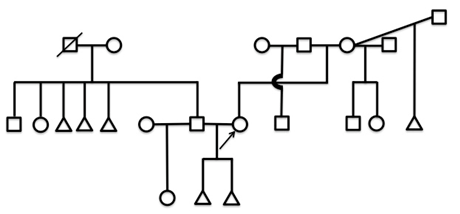
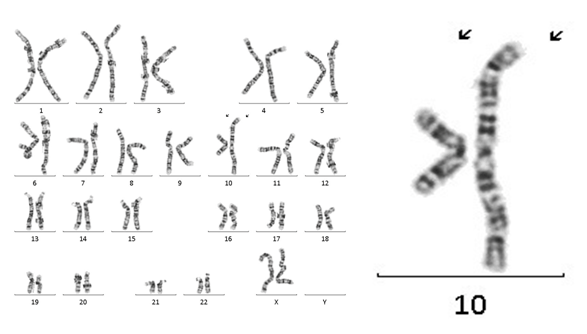
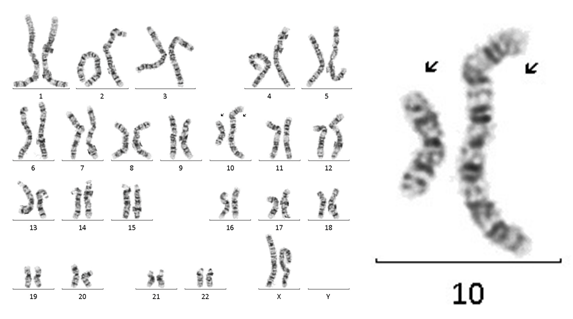
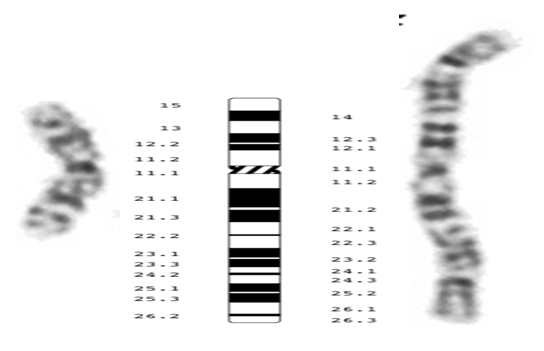
A 21-year-old G2P0020 phenotypically normal female was referred for genetic counseling following two spontaneous abortions and an abnormal chromosome analysis. A pedigree is shown in Figure 1. She smokes five cigarettes per day and takes no prescription medications. She had a deep venous thrombosis as a teenager thought to be secondary to oral contraceptives and tested negative for methylene tetrahydrofolate reductase (MTHFR) deficiency. Genetic testing showed that she was homozygous normal at the MTHFR 677C locus indicating no increased risk for cardiovascular events or arterial thrombosis. Her mother is healthy and had one spontaneous abortion. Her father has a history of systemic lupus erythematous, deep venous thrombosis, pulmonary embolus, MTHFR deficiency, and protein C and S deficiencies. The proband's spouse is healthy and has a five-year-old daughter with a cleft lip from a prior relationship. He was the father for both of the proband's pregnancy losses. His mother is healthy and had three spontaneous abortions. His father died from pancreatic cancer in between late 40s and early 50s. The family history is otherwise negative for stillbirths, neonatal deaths, birth defects or other spontaneous abortions. The proband's pregnancies both resulted in first trimester spontaneous abortions followed by dilation and curettage. The first pregnancy loss was not further evaluated. Tissue obtained during the second dilation and curettage was sent for chromosome analysis (Figure 2). Twenty cells were counted and all five metaphase cells analyzed and karyotyped revealed a female chromosome complement with a whole-arm translocation between the chromosome 10 homologs: 46,XX,t(10;10)(p10;p10). The result of this translocation was a 10p isochromosome and a 10q isochromosome: i(10p) and i(10q). The tissue appeared to be all maternal decidua and therefore the result was thought to represent the maternal rather than the fetal karyotype. The proband's peripheral blood was subsequently sent for chromosome analysis (Figure 3). Twenty cells were counted and all eight metaphase cells that were analyzed and karyotyped revealed a female chromosome complement with a balanced whole-arm translocation between the chromosome 10 homologs similar to the i(10p) and i(10q) isochromosomes seen in the analysis of placental tissue. The i(10p) and i(10q) isochromosomes are further illustrated when displayed next to a chromosome 10 idiogram (Figure 4). A reproductive endocrinology and infertility specialist evaluated the proband. She has regular monthly menses, transvaginal ultrasound showed a normal uterus and ovaries, lab evaluation of her hypothalamic-pituitary-ovarian axis was normal (thyroid stimulating hormone, follicle-stimulating hormone, luteinizing hormone and anti-mullerian hormone), and she had good ovarian reserve. Her evaluation indicated that she was capable of carrying a pregnancy, however, due to her unique genetic composition she was told that she would be unable to conceive with her own oocytes. Reproductive and family building options were discussed: (1) donor oocyte IVF using spouse's sperm and donor eggs, (2) embryo adoption of a donated embryo, and (3) child adoption. | ||||||
| ||||||
| ||||||
| ||||||
| ||||||
|
Discussion
| ||||||
|
Balanced chromosomal rearrangements are relatively common in humans. Balanced translocation carriers are usually phenotypically normal and are at high risk for recurrent spontaneous abortions [1]. Pregnancies of balanced translocation carriers have four potential outcomes: (1) a child with normal chromosomes, (2) a child with the same balanced translocation as the affected parent, (3) a child with a chromosomal imbalance which may cause an abnormal phenotype, and (4) spontaneous abortion. Translocations generally occur between non-homologous chromosomes. Whole-arm translocations between homologous chromosomes are rare genetic events that usually involve Robertsonian translocations between acrocentric chromosomes [1] [6]. Ohama [6] discussed in detail various mechanisms that could lead to whole-arm translocations between nonacrocentric homologous chromosomes. Potential mechanisms for whole-arm translocation between chromosome 10 homologs include:
All mechanisms except for (c) during mitosis result in unbalanced and nonviable zygotes due to the segregation of i(10p) and i(10q) into different daughter cells. Mechanism (c) is likely the event that led to our proband's genetic composition as it is the only one that would produce a balanced translocation zygote. If the translocation occurred between meiosis II and mitosis, it would result in a non-mosaic whole-arm translocation. If the translocation arose during early mitotic division, the result would be mosaicism [1] [5][6]. In our case, no normal cell lines were found in the two cell types analyzed, and therefore only abnormal maternal gametes are predicted. However, mosaicism must be considered given that a limited number of cells in only two cell types were analyzed. There are reports of mosaicism involving whole-arm homologous translocations in chromosome 2 [1] [6]. In male translocation carriers, gonadal mosaicism and chromosomally balanced sperm can be identified by FISH analysis. In female translocation carriers, identification of gonadal mosaicism and chromosomally balanced ovum requires invasive methods: ovarian biopsy or in vitro fertilization (IVF) with ovum collection [1]. Potential future investigations for this patient include analysis of more decidual and peripheral blood cells, analysis of skin fibroblasts, and ovarian biopsy to look for evidence of mosaicism. Additional testing could include segregation analysis of the patient and her parents to determine the parental origin of the two isochromosomes. However, the proband's father is deceased and mother is not available for genetic testing. | ||||||
|
Conclusion
| ||||||
|
This is the first reported case of a whole-arm translocation between chromosome 10 homologs and is a unique case of successive spontaneous abortions. Our case expands the limited spectrum of whole-arm translocations between nonacrocentric homologous chromosomes. Carriers of these unique chromosomal aberrations are likely to experience recurrent spontaneous abortions and will not be able to produce viable offspring. Mosaicism must be considered in cases of whole-arm translocations. These patients should receive genetic and infertility counseling to better understand their condition and their reproductive options. | ||||||
|
References
| ||||||
| ||||||
|
[HTML Abstract]
[PDF Full Text]
|
|
Author Contributions
Hana Kathryn Cobb – Substantial contributions to conception and design, Acquisition of data, Analysis and interpretation of data, Drafting the article, Revising it critically for important intellectual content, Final approval of the version to be published Alvin Yuhico Tiu – Substantial contributions to conception and design, Drafting the article, Revising it critically for important intellectual content, Final approval of the version to be published Dana Knutzen – Substantial contributions to conception and design, Acquisition of data, Analysis and interpretation of data, Revising it critically for important intellectual content, Final approval of the version to be published |
|
Guarantor of submission
The corresponding author is the guarantor of submission. |
|
Source of support
None |
|
Conflict of interest
Authors declare no conflict of interest. |
|
Copyright
© 2017 Hana Kathryn Cobb et al. This article is distributed under the terms of Creative Commons Attribution License which permits unrestricted use, distribution and reproduction in any medium provided the original author(s) and original publisher are properly credited. Please see the copyright policy on the journal website for more information. |
|
|