| |
|
|
|
Case Series
| ||||||
| Takayasu's arteritis: Rare but not infrequent... | ||||||
| Tasnim Ahsan1, Uzma Erum2, Rukhshanda Jabeen3, Danish Khowaja2, Urooj Lal Rehman3 | ||||||
|
1FRCP (Glasg), FRCP (Edin), FRCP(Lon), MRCP(Lon), Professor of Medicine, Medical Unit - II, Jinnah Postgraduate Medical Centre, Karachi, Pakistan.
2MBBS, Postgraduate Trainee (for FCPS - Medicine), Medical Unit - II, Jinnah Postgraduate Medical Centre, Karachi, Pakistan. 3MBBS, FCPS, Senior Registrar,Medical Unit - II, Jinnah Postgraduate Medical Centre, Karachi, Pakistan. | ||||||
| ||||||
|
[HTML Abstract]
[PDF Full Text]
[Print This Article]
[Similar article in Pumed] [Similar article in Google Scholar] 
|
| How to cite this article |
| Ahsan T, Erum U, Jabeen R, Khowaja D, Rehman UL. Takayasu's Arteritis: Rare but not infrequent...? Int J Case Rep Images 2016;7(2):75–80. |
|
Abstract
|
|
Introduction:
Takayasu's arteritis is a chronic systemic vasculitis, mainly involving aorta and its major branches. It presents clinically with varied ischemic symptoms, either due to stenotic lesions or thrombus formation.
Case Series: We report a series of five patients with the diagnosis of Takayasu's arteritis. Four of them were females and one was male. The range of clinical presentation included shortness of breath leading to congestive heart failure in two patients; loss of consciousness with hemiparesis due to stroke secondary to vasculitis in one patient; limb claudication and acute severe backache in the thoracolumbar region in the other two. Two patients, the one presenting with stroke and other presenting with limb claudication, were classified as Takayasu's type-I; Two of the patients with heart failure were labeled as Takayasu's type-II and III. The patient with thoracolumbar pain was diagnosed as Takayasu's type-IV. All patients were treated with steroid and/or azathioprine. Conclusion: Although, considered to be a rare disease, Takayasu's arteritis is not infrequent, as we report five cases seen over a four year period. A high index of suspicion is required for early diagnosis, so as to reduce the significant morbidity associated with the disease. | |
|
Keywords:
Azathioprine, Takayasu's arteritis, Vasculitis, Immunosuppression
| |
|
Introduction
| ||||||
|
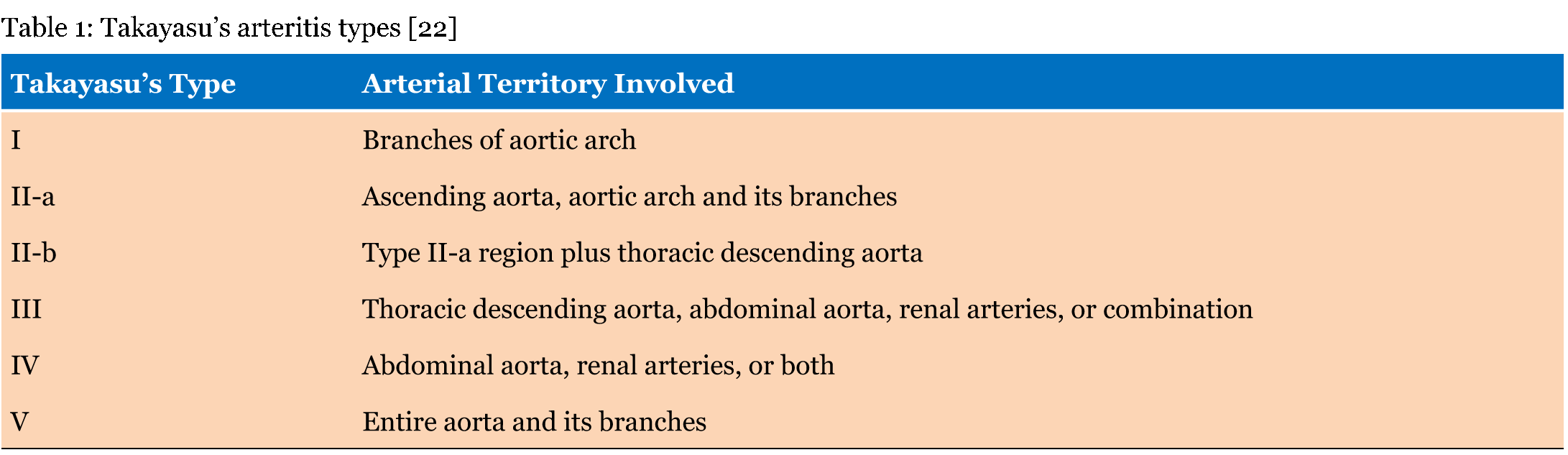
Takayasu's arteritis (TAK) is a rare, systemic, vasculitis of unknown aetiology. The disease has been reported worldwide, but it appears to be more prevalent in certain Asian countries, such as Japan, Korea, China, India, Thailand, Singapore, etc. Being a rare entity, the exact prevalence of TAK is not known. The estimated incidence of TAK in United States is reported to be 2.6 cases per million per year [1]. Although, the disease affects both genders, it appears to predominantly affect young women, especially in the second and third decade. The aetiology of the disease is largely unknown but genetic factors, infectious triggers, autoimmune mechanisms all thought to play role in its pathogenesis. The underlying mechanism involves cell mediated inflammatory pathways, with activation of inflammatory cells such as, macrophages, cytotoxic T-cells, natural killer cells, tumor necrosis factor-alpha, and increased levels of cytokines such as interferon gamma and interleukin-6 etc. The main mediator for the inflammatory cascade is T-cell mediated immune response, leading to the myointimal proliferation which subsequently results in mural thickening and luminal stenosis or segmental dilatation. The disease mainly involves the aorta and its major branches. It has a heterogeneous clinical presentation depending on the site of lesion and the degree of luminal stenosis. No serological markers specific to TAK have been identified so far; angiography is considered to be the gold standard for investigation of the disease and its extent. Based on angiography, TAK is classified into six types, given in Table 1. Type III being the most common type found in South-East Asia and Africa and is called 'middle aortic syndrome'. ACR criteria is used to classify TAK, which include age, claudication of extremity, blood pressure difference in arms, presence of bruits in aorta or subclavian arteries and angiographic evidence of narrowing or occlusion of aorta or its major branches. It requires the presence of three out of six items and is 97.8% specific [2]. No single therapeutic intervention can abrogate the systemic inflammation or vascular abnormality. However, the mainstay of treatment includes immunosuppression with steroids and other immunomodulatory drugs like azathioprine, cyclosporine, etc. | ||||||
| ||||||
|
| ||||||
|
Case Series
| ||||||
|
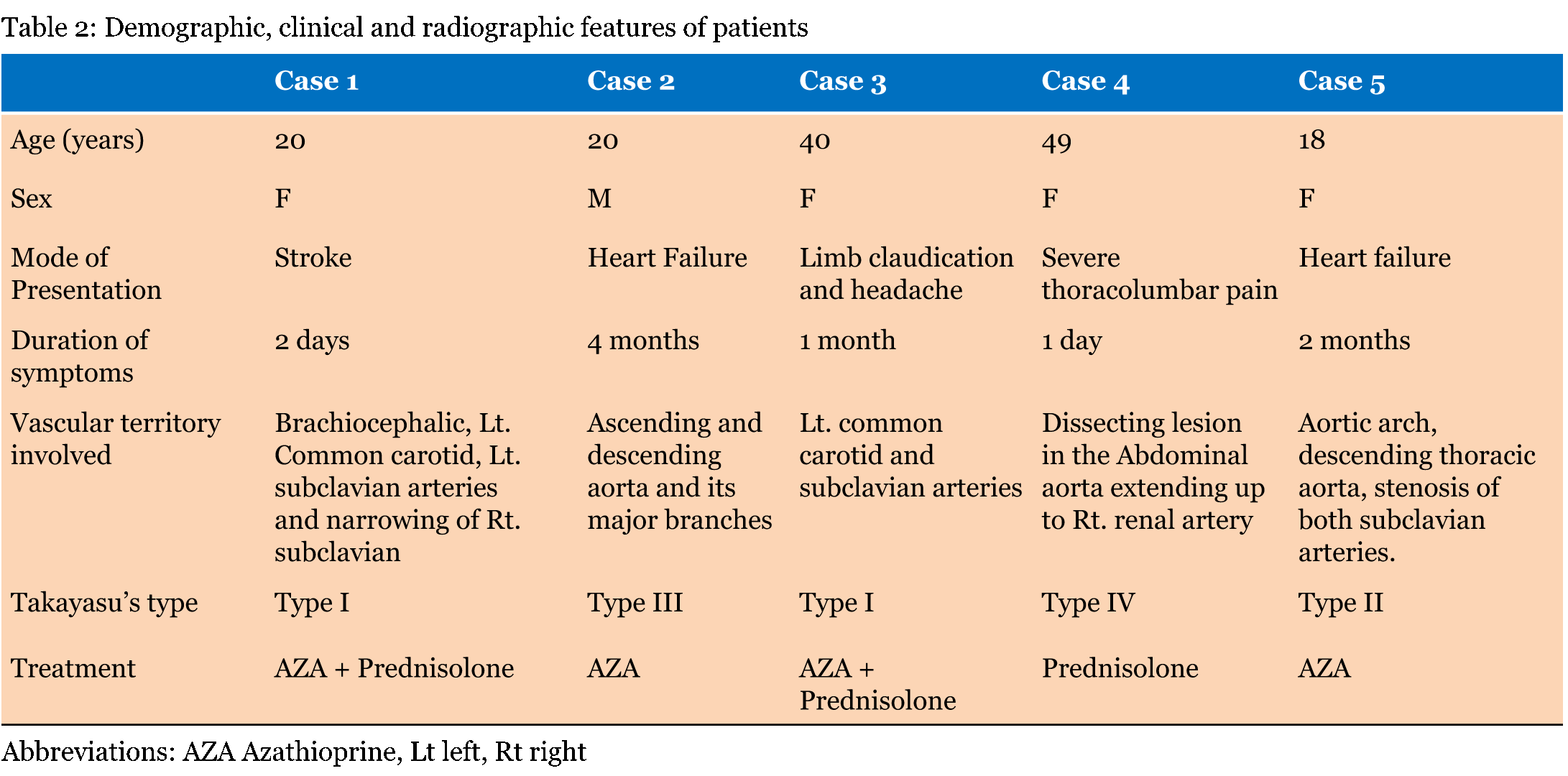
We report five cases of TAK that were seen over a period of four years. All five had diverse symptoms depending upon the affected arterial territory and variably raised inflammatory markers such as ESR and CRP. The most common finding was absent or diminished upper limb pulses in four of these patients and the clinical presentation included hemiparesis due to stroke, shortness of breath secondary to congestive heart failure, limb claudication and acute severe thoracolumbar backache. A brief description of the demographic features, clinical and radiological parameters have been given in Table 2. Case 1 Case 2 Case 3 Case 4 Case 5 The two patients with heart failure were the youngest among the five with low BMIs. Radiological findings classified two of them as having type-I, and other three as Takayasu's type-II, III and IV disease (Table 2). One patient was treated with steroid (prednisolone) alone, which was gradually tapered off in two years. Two patients received immunosuppression with azathioprine (AZA) alone, as they had severe heart failure; the other two were given AZA with maintenance dose steroids. These patients are being regularly followed-up; and are symptomatically improved. | ||||||
| ||||||
|
Discussion
| ||||||
|
There is wide variation in the incidence, gender predisposition, disease morbidity and mortality reported in TAK across the globe. However, it can be concluded that some genetic or environmental pre-disposition exists in certain regions of the world, where it appears to be more common. Although considered to be idiopathic, certain mechanisms have been proposed for understanding the aetiology of the disease. The "heat-shock protein hypothesis" has been proposed, suggesting that expression of 65 kDa heat-shock protein in the aortic tissue may induce major histocompatibility class I chain-related A (MICA), located on the vascular cells hence leading to activation of inflammatory cascade [3]. Infection has also been considered as a possible trigger in the pathogenesis of TAK. Tuberculosis particularly has been implicated in endemic areas. Mycobacterium tuberculosis has been thought to trigger 65kDa heat-shock protein [4]. A case of TAK in association with TB has been reported from Bangladesh [5]. However, none of our patients had a history of past or present tuberculosis. Although no auto-antigen has been identified yet, the association of TAK with different human leukocyte antigen (HLA) alleles in different populations points towards a suspected aetiological association with HLA as well [6] [7]. Although other studies have reported a negative correlation between HLA alleles and Takayasu's arteritis [8]. A few cases have been reported from Pakistan. Two case of global TAK have been reported previously, one a 55-year-old male from Rawalpindi and other was a 5-year- old girl from Skardu [9] [10]. Two cases of TAK presenting with ischemic stroke have been reported from Karachi [11]. Of the five patients we reported here, three presented in the second decade and two in the fourth decades of life. The presentation varied from cerebrovascular accident to congestive heart failure and classic symptoms of limb claudication; the most common finding among four patients was diminished or absent upper limb pulses. One patient presented with aortic dissection. Stroke is a rare presentation of TAK, as only 10–20% of patients manifest with cerebrovascular lesions. A retrospective analysis of 272 patients from South Africa, reported cerebrovascular symptoms in 20% cases of TAK [12]. The most common presentation of diminished upper extremity pulses have been reported in 88% of patients; constitutional symptoms in 66%; while cerebrovascular involvement was seen in only 18% of TAK patients [13]. Two of our patients had heart failure, although studies have reported infrequent involvement of coronary and pulmonary vasculature [14]. There is uncertainty with regards to progression of disease. There is also a poor correlation between clinical disease activity and the level of inflammatory markers in the serum [15]. Corticosteroids lead to remission in most of the patients. Many of the patients with progressive disease show lack of response to treatment, and no convincing reports are available to reflect the long-term outcome in these patients [16]. As far as our patients are concerned, all five have so far responded well to the treatment in terms of symptomatic improvement, as well as normalization of inflammatory markers such as, ESR and CRP. There is paucity of data from controlled, comparable trials of different treatment modalities in TAK. Different studies reported the use of different immune-suppressive drugs. No consensus has been established as to which of these drugs are to be preferred and for how long the treatment should be continued. Small open-label studies have reported the use of several immunosuppressive agents such as methotrexate, mycophenolate mofetil, and azathioprine [17] [18] [19]. Anti-TNF therapy has also been used successfully in a small number of patients [20] [21]. Our patients showed a good clinical response with steroid and azathioprine [22]. | ||||||
|
Conclusion
| ||||||
|
Takayasu's arteritis (TAK) is a rare disease, with a potential for devastating clinical consequences. Clinical presentation is varied. There is a need for further studies that could establish a strategy for the use of immune-suppressive agents, monitoring disease progression and response to therapy. An immunosuppressive regimen of azathioprine and prednisolone is safe, well tolerated, and effective in ameliorating symptoms, although the appropriate duration of treatment, monitoring response and long term safety of the treatment is unclear. | ||||||
|
References
| ||||||
| ||||||
|
[HTML Abstract]
[PDF Full Text]
|
|
Author Contributions:
Tasnim Ahsan – Substantial contributions to the conception and design, Drafting the article, Revising it critically for important intellectual content, Final approval of the version to be published Uzma Erum – Substantial contributions to the conception and design, Acquisition of data, Analysis and interpretation of data, Drafting the article, Revising it critically for important intellectual content, Final approval of the version to be published Rukhshanda Jabeen – Analysis and interpretation of data, Drafting the article, Revising it critically for important intellectual content, Final approval of the version to be published Danish Khowaja – Acquisition of data, Analysis and the interpretation of data, Drafting the article, Revising it critically for important intellectual content, Final approval of the version to be published Urooj Lal Rehman – Substantial contributions to the conception and design, Drafting the article, Revising it critically for important intellectual content, Final approval of the version to be published |
|
Guarantor of submission
The corresponding author is the guarantor of submission. |
|
Source of support
None |
|
Conflict of interest
Authors declare no conflict of interest. |
|
Copyright
© 2016 Tasnim Ahsan et al. This article is distributed under the terms of Creative Commons Attribution License which permits unrestricted use, distribution and reproduction in any medium provided the original author(s) and original publisher are properly credited. Please see the copyright policy on the journal website for more information. |
|
|