
  |

|
 |
|
Case Report
| ||||||
| A case of acute megakaryocytic leukemia associated with a nonseminomatous primary mediastinal germ cell tumor diagnosed through elevation of serum lactate dehydrogenase | ||||||
| Emi Noguchi1, Yasushi Omuro2, Yoshiharu Maeda3, Tsuneo Sasaki4 | ||||||
|
1Department of Medical and Breast Oncology, National Cancer Center Hospital, Tokyo, Japan.
2Department of Chemotherapy, Tokyo Metropolitan Cancer and Infectious Diseases Center Komagome Hospital, Tokyo, Japan. 3Director, Department of Chemotherapy, Tokyo Metropolitan Cancer and Infectious Diseases Center Komagome Hospital, Tokyo, Japan. 4Honorary Director, Department of Chemotherapy, Tokyo Metropolitan Cancer and Infectious Diseases Center Komagome Hospital, Tokyo, Japa. | ||||||
| ||||||
|
[HTML Abstract]
[PDF Full Text]
[Print This Article]
[Similar article in Pumed] [Similar article in Google Scholar] 
|


| How to cite this article |
| Noguchi E, Omuro Y, Maeda Y, Sasaki T. A case of acute megakaryocytic leukemia associated with a nonseminomatous primary mediastinal germ cell tumor diagnosed through elevation of serum lactate dehydrogenase. Int J Case Rep Images 2015;6(11):720–723. |
|
Abstract
|
|
Introduction:
Hematologic malignancies are seen in a small percentage of patients with primary mediastinal germ cell tumors (PMGCT).
Case Report: A 29-year-old male patient with a nonseminomatous primary mediastinal germ cell tumor was diagnosed with acute megakaryocytic leukemia. Serum lactate dehydrogenase (LDH) elevation was a diagnostic clue. We discussed our case with a review of literature. Conclusion: Oncologists should be aware of the association of PMGCT with hematologic malignancies and consider this phenomenon as a differential diagnosis when LDH elevation is present in patients with PMGCT. | |
|
Keywords:
Primary mediastinal germ cell tumor, Acute megakaryocytic leukemia, Hematologic malignancy, Differential diagnosis
| |
|
Introduction
| ||||||
|
The association of germ cell tumors (GCT) with hematologic malignancies is rare and has been described mostly in case reports and case series for more than 30 years [1] [2] [3] [4] [5] [6]. It has a separate etiology from treatment-related leukemia. In most cases, it affects patients with nonseminomatous primary mediastinal GCT (PMGCT). Megakaryocytic leukemia has been described to be more common in this setting. Herein, we report a case of acute megakaryocytic leukemia associated with a nonseminomatous primary mediastinal germ cell tumor whose diagnosis was challenging. Elevated serum lactate dehydrogenase (LDH) was a diagnostic clue. | ||||||
|
Case Report
| ||||||
|
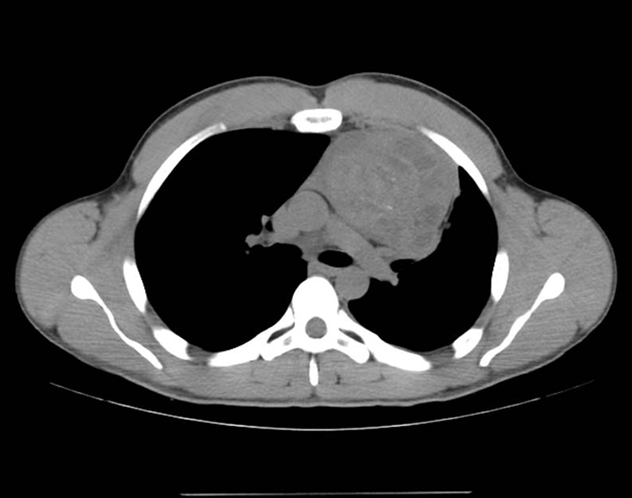
A 29-year-old male was referred to our hospital with complaints of chest pain and exercise-induced dyspnea. The results of physical examination were unremarkable. Chest X-ray imaging revealed a mass in the hilum of the left lung. Computed tomography (CT) scan demonstrated a 9x8 cm tumor in the left anterior mediastinum (Figure 1). Serum concentration of human chorionic gonadotropin (hCG) was 1.2 mIU/mL (normal range <0.7), the β subunit of hCG (β-hCG) was 0.4 ng/mL (<0.1), a-fetoprotein (AFP) was 111.9 ng/mL (<10.0), and serum lactate dehydrogenase (LDH) was 468 IU/l (115 to 245). Ultrasonography showed no lesions in the testes. A CT-guided biopsy was performed, and a few clusters of malignant tumor cells were obtained, with ambiguous histological features. Based on the tumor location (predominant midline distribution), relatively young age of the patient, male sex, and elevated serum β-hCG, AFP, and LDH levels, we diagnosed this condition as a primary mediastinal germ cell tumor; T1N0M0S2, Stage IIIB. The patient received four cycles of standard chemotherapy with cisplatin, etoposide, and bleomycin (BEP). The levels of tumor markers decreased as expected and normalized after two cycles of BEP chemotherapy. After the completion of four cycles of BEP chemotherapy, the tumor markers remained within the reference range, but a CT scan showed an increase in the tumor size. The patient underwent surgical resection of the tumor. Histopathological examination revealed viable nonseminomatous tumor cells in the resected specimen. The patient was then scheduled to receive two additional cycles of BEP chemotherapy. Approximately one month post-operatively, just when one of the additional cycles of the chemotherapy was initiated, the serum LDH level suddenly rose to 420 IU/L. HCG and AFP remained within their reference ranges. A CT scan showed no evidence of recurrence of germ cell tumors. There were no aberrations in the results of blood tests except for elevated LDH. Since the serum LDH kept increasing up to 1,270 IU/L for three weeks, we surmised hematopoietic abnormalities and performed a bone marrow aspiration; the result was a dry tap. We also performed a bone marrow biopsy, which resulted in the diagnosis of acute megakaryocytic leukemia (AML) M7 according to the French-American-British (FAB) classification. Eventually, large atypical cells appeared in peripheral blood (Figure 2); this change happened approximately a month after the serum LDH level started to increase. The patient referred to hematologist to receive induction chemotherapy (idarubicin plus cytarabine) for the leukemia. Later, the chromosome 12 abnormality was detected in repeated bone marrow test. | ||||||
| ||||||
| ||||||
|
Discussion
| ||||||
|
It is well known that somatic teratomatous component of GCT leads to aggressive non-germ cell malignancies, such as rhabdomyosarcoma, acute myeloid leukemia, carcinoma, and primitive neuroectodermal tumors [7]. WHO classification also defines GCT accompanied by leukemia or lymphoma as "germ cell tumors with somatic-type malignancy", which are synonyms of "teratoma with malignant transformation" [8]. The leukemic transformation has been exclusively observed in patients with nonseminomatous PMGCT except for a few cases [5]. In a large, international, database-based study, the incidence rate of hematologic malignancies was found to be 2.0% among patients with nonseminomatous PMGCT [6]. Those researchers also reported that these hematologic malignancies mostly affect the megakaryocyte lineage as AML M7, whereas it is a rare type of de novo AML. In patients with AML M7, a bone marrow aspiration frequently yields a dry tap, which is consistent with our case. Some cases showed elevated serum GCT markers (AFP and/or β-hCG), and others did not [8]. The presence of an isochromosome 12p (i(12p)), which is found in more than 80% of GCT, may suggest the clonal relationship between PMGCT and hematologic malignancies [3] [4] [5] [6] [7] [8]. In our case, it was challenging to detect AML M7 because the patient initially showed high levels of LDH only. The differential diagnosis is treatment-induced leukemia. A time to leukemia development from GCT diagnosis differs between leukemia associated with GCT and treatment-induced leukemia. Treatment-induced leukemia usually develops approximately 2–3 years after treatment with topoisomerase II inhibitors and approximately five years after treatment with alkylating agents, whereas leukemia associated GCT develops shorter from or simultaneously with diagnosis of GCT [6]. Chromosomal translocations involving 11q are also characteristic of etoposide-related acute leukemia [9] . The prognosis of hematologic malignancies associated with PMGCT is very poor, while some cases would survive after intensive treatment with allogenic hematopoietic stem-cell transplantation [10]. | ||||||
|
Conclusion
| ||||||
|
Oncologists should be aware of the association of primary mediastinal germ cell tumors (PMGCT) with hematologic malignancies and consider this phenomenon as a differential diagnosis when serum lactate dehydrogenase (LDH) elevation is present in patients with PMGCT. Periodic monitoring blood tests will help diagnosing this phenomenon as well as potential treatment-induced leukemia. | ||||||
|
References
| ||||||
| ||||||


|
[HTML Abstract]
[PDF Full Text]
|
|
Author Contributions
Emi Noguchi – Substantial contributions to conception and design, Acquisition of data, Analysis and interpretation of data, Drafting the article, Revising it critically for important intellectual content, Final approval of the version to be published Yasushi Omuro – Substantial contributions to conception and design, Acquisition of data, Analysis and interpretation of data, Drafting the article, Revising it critically for important intellectual content, Final approval of the version to be published Yoshiharu Maeda – Substantial contributions to conception and design, Acquisition of data, Analysis and interpretation of data, Drafting the article, Revising it critically for important intellectual content, Final approval of the version to be published Tsuneo Sasaki – Drafting the article, Revising it critically for important intellectual content, Final approval of the version to be published |
|
Guarantor of submission
The corresponding author is the guarantor of submission. |
|
Source of support
None |
|
Conflict of interest
Authors declare no conflict of interest. |
|
Copyright
© 2015 Emi Noguchi et al. This article is distributed under the terms of Creative Commons Attribution License which permits unrestricted use, distribution and reproduction in any medium provided the original author(s) and original publisher are properly credited. Please see the copyright policy on the journal website for more information. |
|
|