
  |

|
 |
|
Case Report
| ||||||
| Hypertrophic obstructive cardiomyopathy in the setting of systemic scleroderma | ||||||
| Robert Sogomonian1, Hassan Alkhawam1, Feras Zaiem2, Sunyoung Lee1, M. Umair Bakhsh3, Emma A. Moradoghli Haftevani4, Dennis Chang5 | ||||||
|
1Department of Medicine, Icahn School of Medicine at Mount Sinai, Elmhurst Hospital Center, New York, USA.
2Mayo Evidence Based Practice Center- Mayo Clinic, Rochester, MN. 3Department of Medicine, Mount Sinai St. Luke's Hospital, NYC, NY, USA. 4Ross University School of Medicine. 5Department of Medicine, Icahn School of Medicine at Mount Sinai, NYC, USA. | ||||||
| ||||||
|
[HTML Abstract]
[PDF Full Text]
[Print This Article]
[Similar article in Pumed] [Similar article in Google Scholar] 
|


| How to cite this article |
| Sogomonian R, Alkhawam H, Zaiem F, Lee S, Bakhsh MU, Haftevani EAM, Chang D. Hypertrophic obstructive cardiomyopathy in the setting of systemic scleroderma. Int J Case Rep Images 2015;6(11):717–719. |
|
Abstract
|
|
Introduction:
The association of systemic sclerosis (SS) with restrictive cardiomyopathy has well been established, but that with hypertrophic obstructive cardiomyopathy (HOCM) is not clearly understood. Herein, we report a case of a patient with SS, identified to have both HOCM and myocardial fibrosis.
Case Report: A 54-year-old female with systemic sclerosis, idiopathic lung disease with moderate pulmonary hypertension, presented with fatigue, decreased appetite and shortness of breath. Cardiac magnetic resonance imaging (CMRI) was significant for both hypertrophic and restrictive cardiomyopathy. Cardiac biopsy revealed evidence of diffuse fibrosis. Conclusion: Our case report describes an interesting association between SS and HOCM, as well as restrictive cardiomyopathy. However, more evidences are needed to clarify whether this unique affiliation is a coincidental random finding or a causative association. | |
|
Keywords:
Cardiac biopsy, Cardiomyopathy, Hypertrophic obstructive cardiomyopathy (HOCM), Lung disease, Pulmonary hypertension, Systemic sclerosis (SS)
| |
|
Introduction
| ||||||
|
Restrictive cardiomyopathy has been a common variant seen in systemic sclerosis (SS) with myocardial fibrosis. An uncommon entity of hypertrophic obstructive cardiomyopathy (HOCM) has been described previously in only a very few cases of patients with systemic sclerosis. The association of SS with restrictive cardiomyopathy has well been established, but that with HOCM is not clearly understood. Herein, we report a case of a patient with SS, identified to have both HOCM and myocardial fibrosis. This singular case suggests that SS could be associated with HOCM, as well as restrictive cardiomyopathy. | ||||||
|
Case Report
| ||||||
|
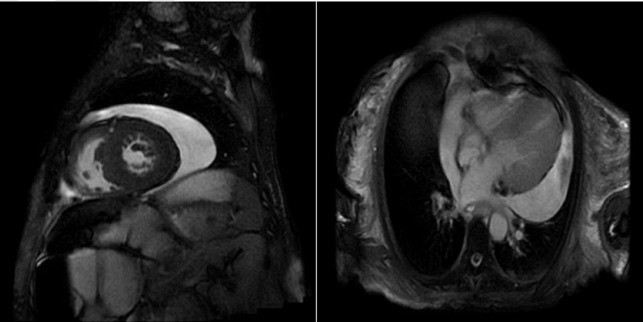
A 54-year-old female with systemic sclerosis, idiopathic lung disease with moderate pulmonary hypertension, presented with fatigue, decreased appetite and shortness of breath. On admission, the patient became hypoxic with O2 saturation of 86% on room air, tachycardic to 117 bpm, blood pressure of 110/53 mmHg. Physical examination was significant for diffuse rhonchi in all lung fields, systolic murmurs, malar rash and skin excoriation in bilateral lower extremities without edema. Laboratory studies were significant for fingerstick glucose of 20 mg/dL with normal serum glucose, indicative of pseudohypoglycemia due to Raynaud's phenomenon, and elevated brain natriuretic peptide (858 pg/mL). Transthoracic echocardiography revealed evidence of diastolic heart failure with a left ventricular ejection fraction of 78%. Electrocardiography illustrated left ventricular hypertrophy and sinus tachycardia. Cardiac magnetic resonance imaging (CMRI) was significant for severe left ventricular cardiac asymmetric septal hypertrophy with outflow obstruction caused by anterior motion of mitral valve and pericardial effusion (Figure 1). Cardiac biopsy revealed evidence of diffuse fibrosis, but did not show iron, glycogen, or amyloid deposition (Figure 2). She was initially treated for pneumonia and presumptive pulmonary embolism. She was aggressively diuresed with intravenous furosemide given clinical signs of hypervolemia followed by dehydration and hypotension to 89/54 mmHg. Intravenous normal saline hydration was provided with resolution of blood pressure. Subsequently, initiated bosentan for presumptive concerns of pulmonary hypertension causing the symptoms however, symptoms worsened as patient was preload dependent and HOCM was exacerbated. Methylprednisolone was initiated, yet patient developed severe proteinuria and renal crisis in the setting of scleroderma. Patient was maintained on mycophenolate mofetil, lower dose of methylprednisolone, morphine, clonazepam and transferred to hospice care with risks, benefits and prognosis of further treatment explained. | ||||||
| ||||||
|
| ||||||
|
Discussion
| ||||||
|
Hypertrophic obstructive cardiomyopathy (HOCM) is the most common cardiac genetic disorder with an autosomal dominant transmission pattern. It is characterized by asymmetric left ventricular hypertrophy (LVH) out of proportion of systemic after load. The most common cardiac involvement in systemic sclerosis (SS) is myocardial fibrosis [1] [2]. while HOCM is rarely seen in SS. Genetically, a predisposition for HOCM with human lymphocyte antigen (HLA)-DR3 has been reported, and this may provide a possible link with SS as reported [3]. A possible autoimmune mechanism might be a good explanation of the unique association between HOCM and SS supported by the fact that HOCM has also been reported in many chronic hepatitis C virus infection; a disease with multiple extra-hepatic autoimmune manifestations [4]. Although myocardial fibrosis is the hallmark of primary myocardial involvement in SS, few previous studies reported an increased incidence of LVH or septal hypertrophy in patients with SS [2] [5]. A study of serial echocardiography for thirty patients with SS and 48 control objects had concluded that patients with SS have an increased LV wall thickness with impaired diastolic dysfunction, which may attribute to myocardial fibrosis [5]. Another study correlated the findings of echocardiography, electrocardiography, and autopsy in 95 patients with SS, who were monitored up to eight years [2]. Three patients have septal hypertrophy on autopsies. Echocardiography along with electrocardiography detects septal hypertrophy in 12 patients, six of whom had asymmetric septal hypertrophy. Out of these 12, ten had limited cutaneous SS involvement and only two was noted in the diffuse cutaneous SS pattern. | ||||||
|
Conclusion
| ||||||
|
The association of systemic sclerosis (SS) with restrictive cardiomyopathy has been well established, but with hypertrophic obstructive cardiomyopathy (HOCM), is rarely reported. Our case report describes an interesting association between SS and HOCM, as well as restrictive cardiomyopathy. However, more evidences are needed to clarify whether this unique affiliation is a coincidental random finding or a causative association. | ||||||
|
References
| ||||||
| ||||||


|
[HTML Abstract]
[PDF Full Text]
|
|
Author Contributions
Robert Sogomonian – Substantial contributions to conception and design, Acquisition of data, Analysis and interpretation of data, Drafting the article, Revising it critically for important intellectual content, Final approval of the version to be published Hassan Alkhawam – Analysis and interpretation of data, Revising it critically for important intellectual content, Final approval of the version to be published Feras Zaiem – Analysis and interpretation of data, Revising it critically for important intellectual content, Final approval of the version to be published Sunyoung Lee – Analysis and interpretation of data, Revising it critically for important intellectual content, Final approval of the version to be published M. Umair Bakhsh – Analysis and interpretation of data, Revising it critically for important intellectual content, Final approval of the version to be published Emma A. Moradoghli Haftevani – Analysis and interpretation of data, Revising it critically for important intellectual content, Final approval of the version to be published Dennis Chang – Analysis and interpretation of data, Revising it critically for important intellectual content, Final approval of the version to be published |
|
Guarantor of submission
The corresponding author is the guarantor of submission. |
|
Source of support
None |
|
Conflict of interest
Authors declare no conflict of interest. |
|
Copyright
© 2015 Robert Sogomonian et al. This article is distributed under the terms of Creative Commons Attribution License which permits unrestricted use, distribution and reproduction in any medium provided the original author(s) and original publisher are properly credited. Please see the copyright policy on the journal website for more information. |
|
|