| |
|
|
|
Clinical Image
| ||||||
| Radiculomegaly of permanent canines and first premolars: Report of two cases in conjunction with oculo-facio-cardio-dental syndrome | ||||||
| Masayasu Iwase1, Hiroaki Nishijima2, Gen Kondo2, Michiko Ito3 | ||||||
|
1Department of Dentistry and Oral Surgery, Hakujikai Memorial General Hospital, 5-11-1 Shikahama, Adachi-ku, Tokyo, Tokyo, 123-0864, Japan.
2Department of Dentistry and Oral Surgery, Jinkokai Hospital, 3-8-11, Nakamachi, Atsugi, Kanagawa, 243-0018, Japan. 3Department of Oral and Maxillofacial Surgery, School of Dental Medicine, Tsurumi University, 2-1-3, Tsurumi, Tsurumi-ku, Yokohama, Kanagawa, 230-8501, Japan. | ||||||
| ||||||
|
[HTML Abstract]
[PDF Full Text]
[Print This Article]
[Similar article in Pumed] [Similar article in Google Scholar] 
|
| How to cite this article |
| Iwase M, Nishijima H, Kondo G, Ito M. Radiculomegaly of permanent canines and first premolars: Report of two cases in conjunction with oculo-facio-cardio-dental syndrome. Int J Case Rep Images 2015;6(3):189–192. |
|
Case Report
| ||||||
|
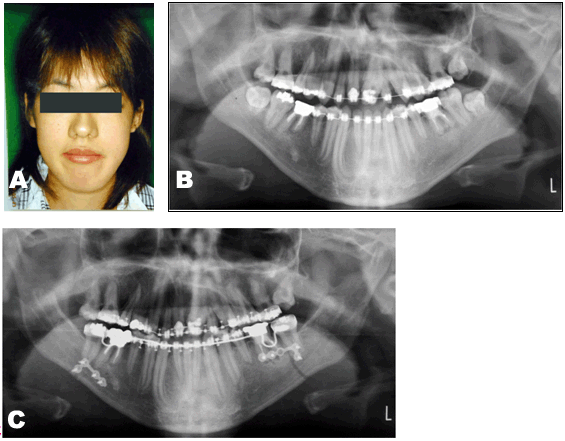
Case 1: An 18-year-old Japanese female was referred to us for the improvement of malocclusion (Figure 1A). The patient was born at 38 weeks by cesarean section; her birth weight was 2,990 g and she was 48 cm in length. At birth, she was noted to have multiple congenital anomalies, including bilateral cataracts, atrial septal defect, long narrow face, high nasal bridge, broad nasal tip with separated cartilages, and a long philtrum. Bilateral cataracts were surgically removed at 1 year. She, however, suffered resultant secondary glaucoma and her visual impairment still remained. At the age of 1 year 8 months, she received an operation for cleft palate. At the age of 18 years 6 months, an operation was undertaken for atrial septal defect. Facial findings showed a somewhat asymmetric face, bilateral strabismus, high nasal bridge, and broadness at the tip of the nose at the initial consultation. Her intelligence was not tested, but may have exceeded the average level. The intraoral aspects showed malocclusion, multiple dental caries, delayed eruption of permanent teeth, high palate, and narrow arched maxilla. On a panoramic radiograph, tooth length and radiculomegaly in the lower canines and first premolars had significantly increased (Figure 1B). The cephalogram analytical data showed marked craniofacial dysmorphology, characterized by an extremely decreased anterior and posterior cranial base and decreased midfacial depth with a short midfacial height. The mandible was characterized by a remarkably large gonial angle and small lower facial depth. Both the anterior maxillary and mandibular heights had increased. Malocclusion was characterized by a bimaxillary skeletal discrepancy with maxillary undergrowth and oligodontia. We planned to undertake orthognathic surgery and prosthodontic treatment for the improvement of the craniofacial dysmorphology and skeletal class III malocclusion. Subsequently, at the age of 19 years 10 months, she underwent sagittal split ramus osteotomy (Figure 1C). Furthermore, she received prosthodontic treatment because of impairment of tooth form. | ||||||
|
| ||||||
|
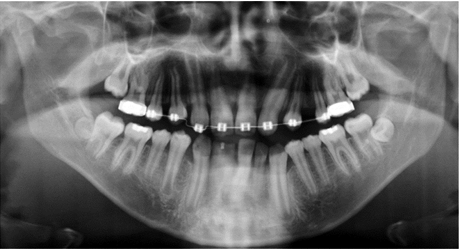
Case 2: A 6-year-old Japanese girl was referred to us for crossbite of the incisors. After a normal pregnancy, she was born at term with a birth weight of 3,040 g and length of 47 cm. At birth, the patient was noted to have multiple congenital anomalies. She had bilateral congenital cataracts and secondary glaucoma. A congenital heart defect was excluded by an echocardiographic examination and a ventricular septal defect has been monitored by a cardiologist since she was 12 years of age, with no further cardiac symptoms. Surgical correction for the cleft palate was performed at the age of 1 year 4 months. Her stature was small, below average for her age. The patient had a narrow face, high nasal bridge, separated cartilages of the nasal tip, broad chin, and mild ptosis at the initial consultation. Her intellectual development was mildly retarded. Delayed dental eruptions were evident. Agenesis of the permanent incisor teeth of the mandible was found by a panoramic radiograph at the age of six years (data not shown). In addition, conspicuously wide open root apices and root dilacerations were noticed in the teeth that later developed canine radiculomegaly (Figure 2). At the age of six years, she started orthodontic treatment and is at present continuing the treatment. Similar to Case 1, we intend to perform orthognathic surgery for the improvement of her jaw deformity in the near future. | ||||||
| ||||||
|
Discussion
| ||||||
|
Gorlin et al. have referred to a combination of congenital cataracts, facial characteristic appearance, cardiac anomalies, and typical dental findings as oculo-facio-cardio-dental (OFCD) syndrome [1]. A previous study reported that OFCD syndrome relates to an X-linked dominant trait [1]. X-linked dominant conditions with male hemizygosity can become lethal [2]. In this case report, although we could not obtain inherent evidence, the presented patients with OFCD syndrome were also females. Most affected patients have hallmark dental anomalies, including radiculomegaly with prolonged dental roots and widely open apices, most typically in the canine roots [3] [4] [5]. Additional dental anomalies include delayed eruption of both deciduous and permanent teeth, persistence of deciduous teeth, and oligodontia. Previous reports have pointed out that the most important criteria leading to the diagnosis of OFCD syndrome are dental abnormalities, in particular extreme elongation of the cuspids' roots [1]. Radiculomegaly of incisors, canines, and premolars is a typical finding of OFCD [3] [4] [5]. Even in adult patients, the affected teeth show vast extension of the root and open apices [1]. Although the average tooth lengths of the normal mandibular canine and first premolar in Japanese are about 24 mm and 21 mm, respectively [4], the lengths of these abnormal teeth are more than 50 mm in the presented cases. Diagnosis can only be confirmed between 15 and 20 years of age, when the radiculomegaly becomes evident [3]. Histological study of canines accompanied with radiculomegaly has shown dentine formation disorder and thin enamel [6]. Ng et al. clearly found that OFCD syndrome is caused by mutations in the BCL6 co-repressor (BCOR) gene [7]. A recent study has suggested that mutation of periodontal ligament cells in the BCOR may contribute to hypersensitive root formation [8]. Although ocular, facial, and cardiac findings are found at an early age, the dental findings cannot be expected to appear simultaneously. Therefore, it is difficult for clinicians to confirm the diagnosis of OFCD syndrome until the development of dental findings, including radiculomegaly, delayed dentition, oligodontia, root dilacerations, and open root apex. It is troublesome for OFCD syndrome patients to undergo proper dental treatment in endodontic treatment, tooth extraction, and orthodontic treatment [4] [5]. We only limited the orthodontic treatment to the improvement of malocclusion in these presented patients; we performed orthognathic surgery and prosthodontic treatment. | ||||||
|
Conclusion
| ||||||
|
We report two new cases of female patients with radiculomegaly of canines and premolars associated with oculo-facio-cardio-dental (OFCD) syndrome. | ||||||
|
References
| ||||||
| ||||||
|
[HTML Abstract]
[PDF Full Text]
|
|
Author Contributions
Masayasu Iwase – Substantial contributions to conception and design, Acquisition of data, Analysis and interpretation of data, Drafting the article, Revising it critically for important intellectual content, Final approval of the version to be published Hiroaki Nishijima – Analysis and interpretation of data, Revising it critically for important intellectual content, Final approval of the version to be published Gen Kondo – Analysis and interpretation of data, Revising it critically for important intellectual content, Final approval of the version to be published Michiko Ito – Analysis and interpretation of data, Revising it critically for important intellectual content, Final approval of the version to be published |
|
Guarantor of submission
The corresponding author is the guarantor of submission. |
|
Source of support
None |
|
Conflict of interest
Authors declare no conflict of interest. |
|
Copyright
© 2015 Masayasu Iwase et al et al. This article is distributed under the terms of Creative Commons Attribution License which permits unrestricted use, distribution and reproduction in any medium provided the original author(s) and original publisher are properly credited. Please see the copyright policy on the journal website for more information. |
|
|
|
About The Authors
| |||
| |||
| |||
| |||
| |||