
  |

|
 |
|
Case Report
| ||||||
| Incidental finding in a patient with trauma and hematuria | ||||||
| Shahnawaz Amdani1, Apeksha Sathyaprasad1, Aurea P Thomas1, Magda Mendez2, Elita Gose-Balakrishnan3, Shefali Khanna4 | ||||||
|
1Pediatric Resident, Lincoln Medical and Mental Health Center, 234E 149th Street, Bronx, New York - 10451, USA.
2Program Director, Pediatrics, Lincoln Medical and Mental Health Center, 234E 149th Street, Bronx, New York - 10451, USA. 3Pediatrician, Lincoln Medical and Mental Health Center, 234E 149th Street, Bronx, New York - 10451, USA. 4Chief of Service, Pediatrics, Lincoln Medical and Mental Health Center, 234E 149th Street, Bronx, New York - 10451, USA. | ||||||
| ||||||
|
[HTML Abstract]
[PDF Full Text]
[Print This Article]
[Similar article in Pumed] [Similar article in Google Scholar] 
|


| How to cite this article: |
| Amdani S, Sathyaprasad A, Thomas AP, Mendez M, Gose-Balakrishnan E, Khanna S. Incidental finding in a patient with trauma and hematuria. International Journal of Case Reports and Images 2012;3(10):24–27. |
|
Abstract
|
|
Introduction:
Schistosomiasis is the second (to malaria) most important human parasitic disease in tropical and subtropical regions infecting more than 100 million people in sub- Saharan Africa alone.
Case Report: We report a case of 17-year-old male who was brought to the Emergency room after being assaulted by his classmates. Apart from the facial injuries, patient had hematuria, which prompted the physicians to undertake additional testing revealing that the patient had Schistosoma hematobium infection. Conclusion: Microscopic examination of urine and stool samples for parasite eggs are currently the 'gold' standard field method of diagnosing schistosomiasis. Praziquantel (PZQ) has been available as an effective treatment of schistosomiasis for nearly 30 years. To date, there is no convincing clinical evidence for schistosome resistance to PZQ. Conclusion: Despite the public health prominence of schistosomiasis in Africa and the availability of a cheap and efficacious drug to treat infected people, less than 5% of the infected population is receiving treatment. An integrated strategy, which emphasizes health education, access to clean water and adequate sanitation, mechanization of agriculture, and fencing of water buffaloes, along with mass chemotherapy for both human and livestock, have been suggested to be carried out in parallel to control the infection sources and to stop schistosome transmission. | |
|
Key Words:
Schistosome, Hematuria, Praziquantel, Calcification
| |
|
Introduction
| ||||||
|
Schistosomiasis, commonly known as bilharzia or snail fever, is the second (to malaria) most important human parasitic disease in tropical and subtropical regions [1] infecting more than 100 million people in sub-Saharan Africa alone. [2] In Africa, Schistosoma hematobium, the causative agent of urogenital schistosomiasis, is the most prevalent species causing human disease and is responsible for most of the schistosoma-related disease in the region. [1] In affected populations, children carry the heaviest burden of infection; urogenital schistosomiasis causes hematuria, dysuria, nutritional deficiencies, anemia, growth retardation, decreased physical performance and impaired memory and cognition. [3] S. haematobium has a complex lifecycle, which includes free-living stages in the environment and asexual reproduction in intermediate freshwater snail hosts as well as maturation and sexual reproduction within mammalian hosts. Humans acquire infection through contact with water bodies containing the infective stages (cercariae). [2] | ||||||
|
Case Report
| ||||||
|
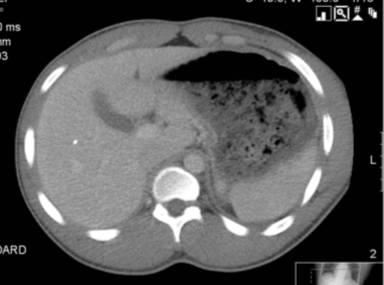
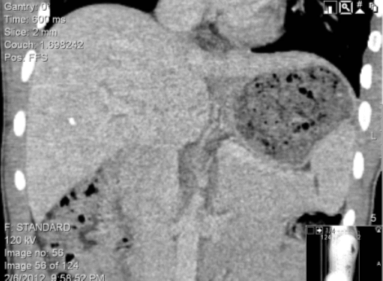
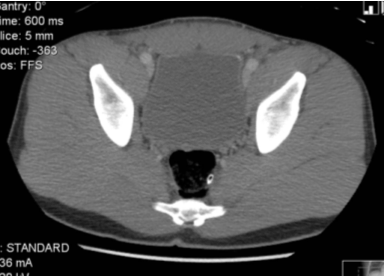
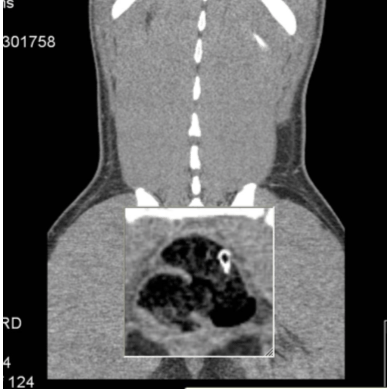
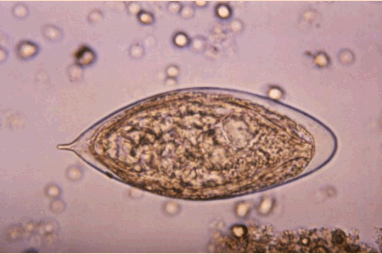
A 17-year-old male was brought to the emergency room (ER) after being assaulted by two of his classmates. He was reported to have been struck on the face with fists. On arrival to the ER, patient was hemodynamically stable. He was alert and oriented x 3. He had a Glasgow Coma Scale (GCS) of 15. He had one episode of vomiting of blood in the triage. Eye examination revealed right periorbital edema and ecchymosis. Also right subconjuctival hemorrhage and 1 cm horizontal complex laceration to the right eyelid without involvement of the eyebrow was noticed. There was tenderness to palpation on the site of swelling. There was no diplopia or loss of vision. CN II through XII was grossly intact. On examination of the nose, there was mild tenderness to palpation with bilateral epistaxis. CBC, BMP, LFT, Amylase, Lipase, UA, Brain CT, CXR and Facial bone CT were done. CBC showed eosinophils of 8.6%. LFT, Amylase, Lipase were normal. BMP was significant for high glucose (likely stress hyperglycemia). UA showed blood 3+ and RBC of 50–100. Further workup of hematuria revealed the cause. Diagnosis: Brain CT and CXR were normal. Facial CT revealed right medial orbital wall fracture and right orbital floor fracture. Also a minimally displaced fracture of the left nasal bone was seen. Since the patient had hematuria, the decision was made to get an Abdominal CT with contrast and Bilateral Renal USG to rule out trauma to the kidney. The Bilateral Renal USG was normal. An Abdominal CT revealed 5 mm calcifications in the right hepatic lobe and also in the bladder wall (Figures 1–4). Serial UAs done during the hospital day # 1 and 2 revealed blood 3+ and RBC 50–100. Considering the patient had hematuria, the decision was made to get Serum Calcium and PTH which were normal. Since the patient was a native of the Ivory Coast in Africa, further workup of urine for ova and parasites were done which revealed that the patient had Schistosoma haematobium infestation (Figure 5). Patient was treated with Praziquantel 40 mg/kg two times a day for two days. During the day of discharge UA of the patient showed blood 1+ and RBC of 15–30. No schistosome ova or parasites were detected in the urine. | ||||||
| ||||||
| ||||||
| ||||||
| ||||||
| ||||||
|
Discussion
| ||||||
|
The microscopic examination of urine and stool samples for parasite eggs are currently the 'gold' standard field method of diagnosing schistosomiasis. [3] It is unable to detect prepatent or single sex infections or reliably detect low levels of infection characteristically found in young children. In the case of Schistosoma hematobium, even these low infection levels are clinically relevant since the relationship between infection level and morbidity is not linear but a complex interaction between infection levels and the host's immune system. Thus, being able to accurately measure this is an important public health aspect. [1] Praziquantel has been available as an effective treatment for schistosome infection for nearly 30 years. [4] PZQ exhibits stage-specific functions in killing adult worms. Multiple doses of 40/60 mg/kg PZQ provide an enhanced efficacy in treating schistosomiasis compared to a single dose. To date, there is no convincing clinical evidence for schistosome resistance to PZQ used for human schistosomiasis treatment, although worrying low-cure rates have been reported in some studies. Adverse effects were dizziness, stomach discomfort or stomach ache, headache, nausea, debility, muscular and joint soreness, and diarrhea, which disappeared shortly after drug withdrawal. [5] | ||||||
|
Conclusion
| ||||||
|
Despite the public health prominence of schistosomiasis in Africa and the availability of a cheap and efficacious drug to treat infected people, less than 5% of the infected population are receiving treatment. [3] An integrated strategy, which emphasizes health education, access to clean water and adequate sanitation, mechanization of agriculture, and fencing of water buffaloes, along with mass chemotherapy for both human and livestock, have been suggested to be carried out in parallel to control the infection sources and to stop schistosome transmission. [5] Also, it is very important to ask about travel history in a patient with hematuria. | ||||||
|
References
| ||||||
| ||||||

|
[HTML Abstract]
[PDF Full Text]
|
|
Author Contributions:
Shahnawaz Amdani – Substantial contributions to conception and design, Acquisition of data, Analysis and interpretation of data, Drafting the article, Revising it critically for important intellectual content, Final approval of the version to be published Apeksha Sathyaprasad – Substantial contributions to conception and design, Acquisition of data, Analysis and interpretation of data, Drafting the article, Revising it critically for important intellectual content, Final approval of the version to be published Aurea P Thomas – Substantial contributions to conception and design, Acquisition of data, Analysis and interpretation of data, Drafting the article, Revising it critically for important intellectual content, Final approval of the version to be published Magda Mendez – Substantial contributions to conception and design, Acquisition of data, Analysis and interpretation of data, Drafting the article, Revising it critically for important intellectual content, Final approval of the version to be published Elita Gose-Balakrishnan – Substantial contributions to conception and design, Acquisition of data, Analysis and interpretation of data, Drafting the article, Revising it critically for important intellectual content, Final approval of the version to be published Shefali Khanna – Substantial contributions to conception and design, Acquisition of data, Analysis and interpretation of data, Drafting the article, Revising it critically for important intellectual content, Final approval of the version to be published |
|
Guarantor of submission:
The corresponding author is the guarantor of submission. |
|
Source of support:
None |
|
Conflict of interest:
Authors declare no conflict of interest. |
|
Copyright:
© Shahnawaz Amdani et al. 2012; This article is distributed the terms of Creative Commons Attribution License which permits unrestricted use, distribution and reproduction in any means provided the original authors and original publisher are properly credited. (Please see Copyright Policy for more information.) |
|
|