
  |

|
 |
|
Case Report
| ||||||
| A case of myocardial metastasis from lung adenocarcinoma presenting as cerebral infarction | ||||||
| Kentaro Suina1, Satoshi Hirano1, Junko Hirashima1, Kazutaka Shimizu2, Sosuke Takeuchi2, Miyako Morooka3, Kazuo Kubota3, Tateki Ito4, Yuichiro Takeda1, Haruhito Sugiyama1, Nobuyuki Kobayashi1, Koichiro Kudo1 | ||||||
|
1Departments of Respiratory Medicine and National Center for Global Health and Medicine.
2Departments of Neurology, National Center for Global Health and Medicine. 3Departments of Division of Nuclear Medicine, National Center for Global Health and Medicine. 4Departments of Pathology Division of Clinical Laboratory, National Center for Global Health and Medicine. | ||||||
| ||||||
|
[HTML Abstract]
[PDF Full Text]
[Print This Article]
[Similar article in Pumed] [Similar article in Google Scholar] 
|


| How to cite this article: |
| Suina K, Hirano S, Hirashima J, Shimizu K, Takeuchi S, Morooka M, Kubota K, Ito T, Takeda Y, Sugiyama H, Kobayashi N, Kudo K. A case of myocardial metastasis from lung adenocarcinoma presenting as cerebral infarction. International Journal of Case Reports and Images 2012;3(10):28–31. |
|
Abstract
|
|
Introduction:
Myocardial metastasis from lung cancer is rarely found in antemortem settings. Herein we present a case of myocardial metastasis from lung adenocarcinoma presenting as cerebral infarction.
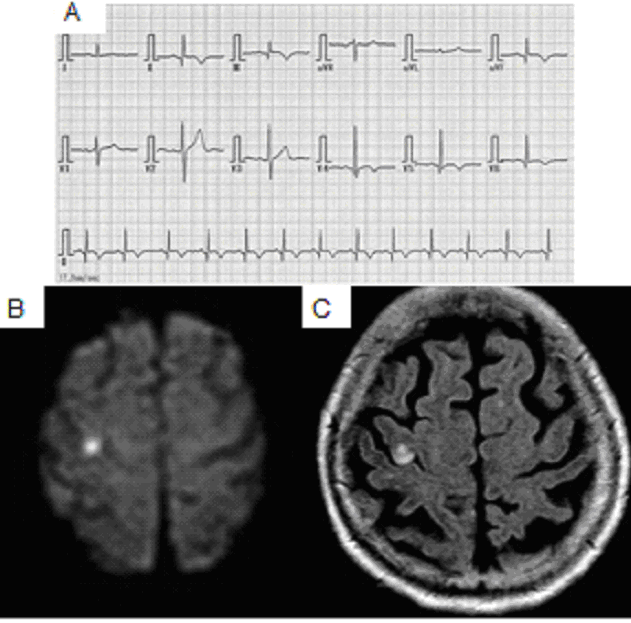
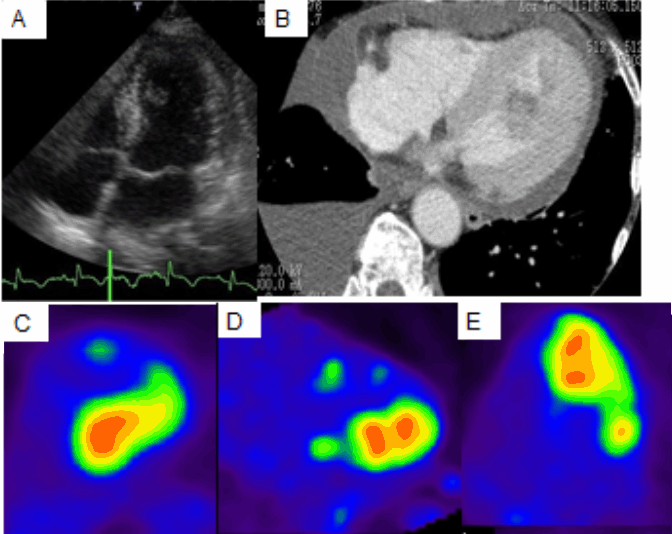
Case Report: A 78-year-old Japanese female (non-smoker) who had been diagnosed with poorly differentiated lung adenocarcinoma suddenly complained of weakness in the left hand on a regular follow-up visit. Brain non-contrast-enhanced computed tomography (CT) scan showed no abnormality. Electrocardiography (ECG) showed abnormal Q waves, ST-segment elevation, and inverted T waves in leads II, III, and aVF that had not been demonstrated previously. The results of brain CT scan and symptoms were strongly suggestive of cerebral infarction. Brain magnetic resonance imaging (MRI) with diffusion-weighted imaging performed 5 days after admission showed a small, acute infarct on a knob on the precentral gyrus. Transthoracic echocardiography performed to detect cardiac sources of embolism revealed an intracardiac mass. Cardiac 18F-fluoro-deoxy-glucose positron emission tomography (18F-FDG PET)/CT scan demonstrated increased uptake in the mass. After the patient died, autopsy revealed many metastatic lesions of various sizes accompanied by thrombi on the surface of the ventricular myocardium. Conclusion: Cardiac 18F-FDG PET/CT was useful for diagnosing myocardial metastasis in our patient. The possibility of cardiac metastases should be considered in patients with lung cancer in the event of sudden cerebral infarction. | |
|
Key Words:
Myocardial metastasis, Lung cancer, Cerebral infarction, Cardiac PET/CT
| |
|
Introduction
|
|
Myocardial metastasis from lung cancer is often clinically invisible, and is thus very difficult to diagnose antemortem. Positron emission tomography (PET)/computed tomography (CT) scan offer additional metabolic information resulting in increased sensitivity for the detection of malignant tumor compared to purely morphological modalities. [1] We present a case of myocardial metastasis from lung adenocarcinoma presenting as cerebral infarction. |
|
Case Report
|
|
Our patient was a 78-year-old Japanese female (non-smoker) who had been diagnosed with poorly differentiated lung adenocarcinoma staged as cT2aN2M0, stage IIIA, in October 2008. She had been treated with chemoradiotherapy comprising cisplatin and docetaxel, followed by gefitinib. In February 2009, gefitinib treatment was stopped after the appearance of ground glass opacities in the lung. In June 2009, stereotactic radiotherapy was performed for local recurrence. Follow-up screening for metastasis with CT of the whole body, magnetic resonance imaging (MRI) of the brain, and bone scintigraphy in September 2009 showed negative results. The patient suddenly complained of weakness in the left hand during a regular follow-up visit in October 2009. Neurological examination showed a positive Barré sign in the left upper extremity. No abnormalities were apparent on physical examination other than coarse crackles in the right lower lung field. Brain non-contrast-enhanced CT scan showed no abnormalities. Blood testing showed normocytic anemia with a hemoglobin level of 9.8 g/dL. Serum creatinine level was 1.07 mg/dL and C-reactive protein concentration was 0.20 mg/L. Congestive heart failure was suspected based on the increased cardiac brain natriuretic peptide (BNP) level of 257.0 pg/mL. Levels of fibrin degradation products (FDP) and D-dimer were 43.6 µg/mL and 13.7 µg/mL, respectively. All other results of biochemical testing were normal. Electrocardiography showed abnormal Q wave, ST-segment elevation, inverted T waves in leads II, III, and aVF that were not demonstrated in September 2009, but the patient reported no cardiac symptoms (Figure 1A). Results of brain CT and patient symptoms were strongly suggestive of cerebral infarction. Treatment was started with edaravon and argatroban and neurological symptoms gradually improved. Brain MRI with diffusion-weighted imaging performed five days after admission showed a small, acute infarct on a knob on the precentral gyrus (Figure 1B–C). Magnetic resonance angiography of the circle of Willis yielded normal results. Transthoracic echocardiography performed to detect cardiac sources of embolism revealed an intracardiac mass arising from the ventricular septum close to the apex (Figure 2A). Cardiac CT demonstrated a low-density mass located in the wall of the left ventricle (Figure 2B). Cardiac 18F-fluoro-deoxy-glucose (FDG) PET/CT demonstrated increased uptake in the mass in the inferior wall of the left ventricle close to the apex (Figure 2C–E). These findings were strongly suggestive of myocardial metastasis from lung adenocarcinoma. On the other hand, brain MRI with gadolinium-enhanced T1-weighted imaging performed 32 days after On the other hand, brain MRI with gadolinium-enhanced T1-weighted imaging performed 32 days after admission showed enhancement at the same site demonstrated previously on MRI. The patient was treated with erlotinib for recurrent lung adenocarcinoma, but died soon afterwards. Autopsy was performed, revealing many metastatic lesions of various sizes accompanied by thrombi on the surface of the ventricular myocardium (Figure 3). |
|
|
|
|
|
|
|
Discussion
|
|
Metastasis to the pericardium or heart is reportedly present in 30–45% of autopsies for lung cancer patients. [2] [3] Pericardium, including epicardium, is the most common location of cardiac involvement by secondary tumors, [4] with myocardial metastasis reportedly comprising only about 10% of metastases to the heart. [3] Myocardial metastasis from malignant tumor is often clinically invisible, and can be very difficult to diagnose antemortem. Indications of metastases to the heart are often described as a rapid increase in heart size due to pericardial effusion, new signs of heart failure or valve disease, conduction defects, and atrial or ventricular heart rhythm disturbances. [5] In our patient, abnormalities were seen on ECG but the patient reported no cardiac symptoms. Regarding the mechanisms of cardiac metastasis, it is reported that metastatic cells can reach the heart via the lymphatic or hematogenous route, or by direct or transvenous extension. In our patient, tumor cells seem to have attained to the heart mainly via hematogenous route considering the fact that hematogenous spread preferentially gives rise to myocardial metastasis. [5] Cerebral infarction has also been reported to result from obvious thromboembolism, probably from the surface of a metastatic tumor. [6] In this patient, cerebral infarction was the first presentation of cardiac metastasis from lung adenocarcinoma. Such embolic phenomena may be due to either tumor emboli or bland emboli that have dislodged from the tumor thrombus on the surface of the myocardial metastasis. The possibility of cardiac metastasis should be kept in mind for patients with lung cancer who suddenly present with cerebral infarction. To explain the mechanisms of unexpected cerebral infarction in a patient with malignant tumor, the possible presence of Trousseau's syndrome should be considered. Trousseau's syndrome represents unexplained thrombotic events that precede the diagnosis of an occult visceral malignancy or appear concomitantly with the tumor. This syndrome is considered to be mediated by multiple mechanisms such as tissue factors, tumor-associated cysteine proteinase, tumor hypoxia, carcinoma mucins, or an overlap of these as a cause of prothrombotic condition. [7] Besides the presence of myocardial metastasis, the influence of Trousseau's syndrome might be one cause of cerebral infarction. For the diagnosis of metastasis to the heart, echocardiography, enhanced CT, enhanced MRI, and the combination of these modalities may prove helpful. [5] The advantage of cardiac PET/CT scan for detecting myocardial metastasis has recently been reported. [8] Compared to purely morphological modalities, PET/CT scan offers additional metabolic information resulting in increased sensitivity for the detection of regional tumor growth and/or distant metastases, facilitating staging and follow-up of patients with malignancies. [1] In our patient, distinguishing metastatic cardiac tumor and thrombus was difficult using only echocardiography and contrast-enhanced CT scan. On the other hand, cardiac PET/CT scan demonstrated focally abnormal increases in the uptake of FDG in myocardium and correctly suggested metastatic tumor. Cardiac PET/CT scan is usually used for the detection of coronary artery disease (CAD), and is rapidly gaining popularity as a powerful and efficient alternative to conventional single-photon emission CT to evaluate regional myocardial perfusion and metabolism in patients with CAD. [9] With respect to cardiac tumors, cardiac PET/CT scan is useful not only for the detection of myocardial metastasis but also for specifying the exact location of the tumor compared with conventional PET/CT. In contrast, a case report has described a patient with underlying malignancy who was misdiagnosed with cardiac metastasis due to an imaging pitfall in PET/CT scan. Efforts should therefore always be made to rule out false-positive interpretations. [10] |
|
Conclusion
|
|
We report here on a case of myocardial metastasis from lung adenocarcinoma that presented as cerebral infarction. Cardiac PET/CT was a useful modality for diagnosing myocardial metastasis in our patient. The possibility of cardiac metastasis should be kept in mind for patients with lung cancer who develop sudden cerebral infarction. |
|
References
|
|


|
[HTML Abstract]
[PDF Full Text]
|
|
Author Contributions:
Kentaro Suina – Substantial contributions to conception and design, Acquisition of data, Drafting the article, revising it critically for important intellectual content, Final approval of the version to be published Satoshi Hirano – Substantial contributions to conception and design, Acquisition of data, Drafting the article, Revising it critically for important intellectual content, Final approval of the version to be published Junko Hirashima – Substantial contributions to conception and design, Acquisition of data, Drafting the article, Revising it critically for important intellectual content, Final approval of the version to be published Kazutaka Shimizu – Substantial contributions to conception and design, Acquisition of data, Drafting the article, Revising it critically for important intellectual content, Final approval of the version to be published Sosuke Takeuchi – Substantial contributions to conception and design, Acquisition of data, Drafting the article, Revising it critically for important intellectual content, Final approval of the version to be published Miyako Morooka – Substantial contributions to conception and design, Acquisition of data, Drafting the article, Revising it critically for important intellectual content, Final approval of the version to be published Kazuo Kubota – Substantial contributions to conception and design, Acquisition of data, Drafting the article, Revising it critically for important intellectual content, Final approval of the version to be published Tateki Ito – Substantial contributions to conception and design, acquisition of data, Drafting the article, Revising it critically for important intellectual content, Final approval of the version to be published Yuichiro Takeda – Substantial contributions to conception and design, Acquisition of data, Drafting the article, revising it critically for important intellectual content, Final approval of the version to be published Haruhito Sugiyama – Substantial contributions to conception and design, Acquisition of data, Drafting the article, Revising it critically for important intellectual content, Final approval of the version to be published Nobuyuki Kobayashi – Substantial contributions to conception and design, Acquisition of data, Drafting the article, Revising it critically for important intellectual content, Final approval of the version to be published Koichiro Kudo – Substantial contributions to conception and design, Acquisition of data, Drafting the article, Revising it critically for important intellectual content, Final approval of the version to be published |
|
Guarantor of submission:
The corresponding author is the guarantor of submission. |
|
Source of support:
None |
|
Conflict of interest:
Authors declare no conflict of interest. |
|
Copyright:
© Kentaro Suina et al. 2012; This article is distributed the terms of Creative Commons Attribution License which permits unrestricted use, distribution and reproduction in any means provided the original authors and original publisher are properly credited. (Please see Copyright Policy for more information.) |
|
|