
| Table of Contents |  |
|
Case Report
|
| Primary hyperparathyroidism presenting as paraneoplastic syndrome in a patient with renal cell carcinoma |
| Hannah Winter1, Melanie Field1, James McDaid1, Deepak Vishwanath1, Nicholas Inston1 |
|
1Renal Surgery Unit, Queen Elizabeth Hospital, Edgbaston, Birmingham B15 2TT.
|
|
doi:10.5348/ijcri-2012-4-108-CR-5
|
|
Address correspondence to: Miss Hannah Winter 48 West Street, Stourbridge West Midlands, DY8 1XN UK Phone: 07817765002, 01384361081 Email: hwinter@doctors.org.uk |
|
[HTML Abstract]
[PDF Full Text]
|
| How to cite this article: |
| Winter H, Field M, McDaid J, Vishwanath D, Inston N. Primary hyperparathyroidism presenting as paraneoplastic syndrome in a patient with renal cell carcinoma. International Journal of Case Reports and Images 2012;3(4):19–22. |
|
Abstract
|
|
Introduction:
Hypercalcaemia in the presence of malignancy is commonly attributed to paraneoplastic phenomenon, particularly when associated with renal cell carcinoma. However, other causes of hypercalcaemia should be sought which can be more easily treated.
Case Report: We report a case of a 54-year-old man presenting with resistant hypercalcaemia with an underlying diagnosis of renal cell carcinoma with brain metastases requiring multiple admissions for intravenous rehydration and bisphosphonates. On further investigation and surgical exploration, a parathyroid adenoma was identified, removed and confirmed on histology. His symptoms settled and biochemistry normalised, improving quality of life and reducing hospital admissions. Conclusion: This case emphasises the importance of considering primary hyperparathyroidism as a cause of hypercalcaemia in the presence of malignancy. Surgery for primary hyperparathyroidism can offer curative treatment and enhance quality of life in a palliative patient. | |
|
Key Words:
Hypercalcaemia, Parathyroid adenoma, Paraneoplastic, Renal cell carcinoma
| |
|
Introduction
| ||||||
|
Hypercalcaemia is the most common paraneoplastic syndrome in patients with renal cell carcinoma, affecting 13–20% of patients. [1] [2] We report a case of a patient with metastatic clear cell renal carcinoma who presented with resistant hypercalcaemia presumed to be secondary to paraneoplastic syndrome. On imaging and surgical exploration, however, a parathyroid adenoma was identified and removed resulting in subsequent normocalcaemia. | ||||||
|
Case Report
| ||||||
|
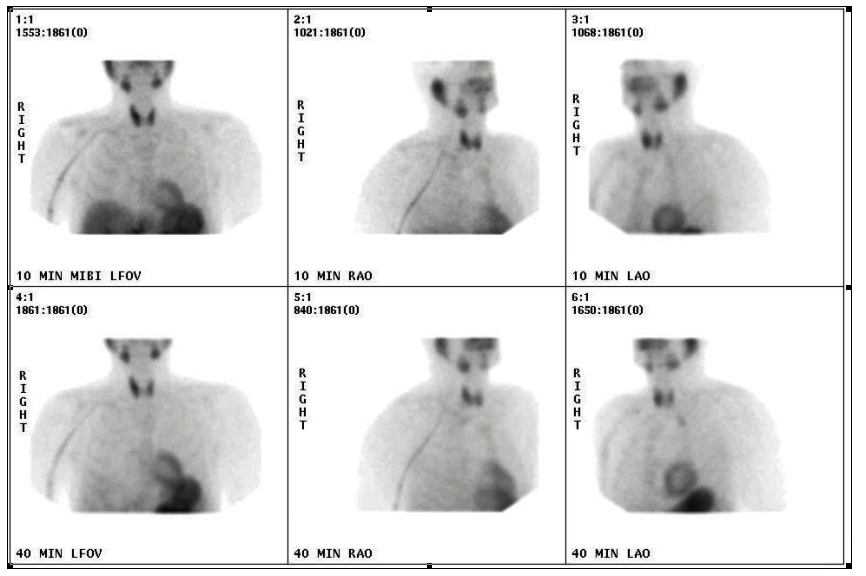
A 54-year-old male was referred to the endocrine surgical unit with hypercalcaemia on a background of renal clear cell carcinoma. He had presented to the physicians three months previously with neurological symptoms. On CT head and subsequent full body imaging he was identified to have a renal cell carcinoma with metastases to his brain. The patient was a smoker with no other medical history to note. Shortly after diagnosis, the patient developed abdominal pain and bone pain and was found to have an elevated serum calcium level of 3.2 mmol/L (normal range 2.2–2.6 mmol/L). A bone scan did not identify any bony metastases. Thyroid function tests were normal. This hypercalaemia was treated aggressively as an in-patient with intravenous rehydration and bisphosphonates, initially presumed to be due to paraneoplastic syndrome. However, symptoms failed to resolve and a serum parathyroid hormone level was elevated at 298.5 ng/L (normal range 15–65 ng/L) raising suspicion of primary parathyroid disease. A sestamibi nuclear medicine scan was subsequently performed and was inconclusive (Figure 1). Following a further two months of medical treatment and recurrent hospital admissions, ultrasound was performed which demonstrated a five mm hypoechoic area towards the base of the right lobe of the thyroid gland suggestive of a parathyroid adenoma (Figure 2). Conventional surgical exploration was performed and an enlarged parathyroid gland identified adjacent to the upper aspect of the right lobe of the thyroid gland. This was excised, measuring 10x6x6 mm and histologically confirmed as a parathyroid adenoma. The patient's calcium levels rapidly settled to normal and his symptoms resolved, requiring no further medical treatment. The renal cell carcinoma was managed medically with sunitinib and ultimately palliatively. He survived 17 months following surgery for primary hyperparathyroidism. | ||||||
| ||||||
| ||||||
|
Discussion
| ||||||
|
Hypercalcaemia is a frequently recognised complication following a diagnosis of metastatic renal cell carcinoma and carries a poor prognosis. [3] It commonly occurs as a paraneoplastic process with tumour secretion of parathyroid-hormone related peptide (PTHrP) mimicking the effects of parathyroid hormone itself by elevating serum calcium levels and lowering phosphate. It can also occur with bony metastases with an increase in bone turnover and release of calcium. Other explanations of this phenomenon include the release of prostaglandin and interleukin-6 from tumours which appear to stimulate a rise in serum calcium. [4] In a previous case report of a patient with renal cell carcinoma, progressive hypercalcaemia, hypophosphataemia and elevated circulating levels of parathyroid hormone the patient was identified at post mortem to have hyperplasia of all four parathyroid glands and no bony metastases, suggesting that the tumour was releasing a parathyroid-stimulating hormone. [5] It has been suggested that tumours may secrete both PTH and PTHrP1. It is common practice and indeed recommended, to treat hypercalcaemia in the presence of metastatic renal cell carcinoma with volume restoration, bisphosphonates [6] and the consideration of nephrectomy, which has been of proven benefit in refractory hypercalcaemia. [7] A series of patients with urological malignancies and hypercalcaemia was described in 1986 by Ramsay and Henry. [4] Two of the eight patients reviewed, had elevated levels of parathyroid hormone. One patient with adenocarcinoma of the prostate gland had an incidental parathyroid adenoma, which was treated surgically and resulted in normocalcaemia. The other patient with transitional cell renal carcinoma did not demonstrate any parathyroid pathology. This demonstrates the importance of imaging patients with elevated parathyroid hormone to identify and treat any primary parathyroid pathology. | ||||||
|
Conclusion
| ||||||
|
Although it is rare for concomitant pathologies to occur with hypercalcaemia, this case illustrates that in the presence of metastatic renal cell carcinoma it cannot be assumed that the cause is due to either bony metastases or paraneoplastic syndrome. The importance of eliminating a correctable cause, such as a primary parathyroid adenoma, is highlighted. Whilst the prognosis of this patient was poor, surgery for primary hyperparathyroidism has demonstrated improvements in quality of life, [8] and as such, may have improved the end of life process for this patient by reducing hospital admissions and minimising treatments. | ||||||
|
References
| ||||||
| ||||||


|
[HTML Abstract]
[PDF Full Text]
|
|
Author Contributions:
Hannah Winter - Substantial contributions to conception and design, Acquisition of data, Analysis and interpretation of data, Drafting the article, Revising it critically for important intellectual content, Final approval of the version to be published Melanie Field - Substantial contributions to conception and design, Acquisition of data, Analysis and interpretation of data, Drafting the article, Revising it critically for important intellectual content, Final approval of the version to be published James McDaid - Substantial contributions to conception and design, Acquisition of data, Analysis and interpretation of data, Drafting the article, Revising it critically for important intellectual content, Final approval of the version to be published Deepak Vishwanath - Substantial contributions to conception and design, Acquisition of data, Analysis and interpretation of data, Drafting the article, Revising it critically for important intellectual content, Final approval of the version to be published Nicholas Inston - Substantial contributions to conception and design, Acquisition of data, Analysis and interpretation of data, Drafting the article, Revising it critically for important intellectual content, Final approval of the version to be published |
|
Guarantor of submission:
The corresponding author is the guarantor of submission. |
|
Source of support:
None |
|
Conflict of interest:
Authors declare no conflict of interest. |
|
Copyright:
© Hannah Winter et. al. 2012; This article is distributed the terms of Creative Commons Attribution License which permits unrestricted use, distribution and reproduction in any means provided the original authors and original publisher are properly credited. (Please see Copyright Policy for more information.) |
|
|