
| Table of Contents |  |
|
CASE REPORT
|
| Abnormal dynamics of growth hormone after thyrotropin-releasing hormone loading test, gonadotropin-releasing hormone loading test, and oral glucose tolerance test in mixed gonadal dysgenesis with a pituitary lesion |
| Akira Matsuno1, So Yamada1, Shoko M. Yamada1, Hiroshi Nakaguchi1, Katsumi Hoya1, Mineko Murakami1 |
|
1Department of Neurosurgery, Teikyo University Chiba Medical Center, 3426-3 Anesaki, Ichihara City, Chiba 299-0111, Japan.
|
|
doi:10.5348/ijcri-2011-01-15-CR-3
|
|
Address correspondence to: Akira Matsuno Department of Neurosurgery Teikyo University Chiba Medical Center 3426-3 Anesaki, Ichihara City, Chiba 299-0111, Japan Phone: 81-436-62-1211 ext. 2621 Fax: 81-436-62-1357 E-mail: akirakun@med.teikyo-u.ac.jp |
|
[HTML Abstract]
[PDF Full Text]
|
| How to cite this article: |
| Matsuno A, Yamada S, Yamada SM, Nakaguchi H, Hoya K, Murakami M. Abnormal dynamics of growth hormone after thyrotropin-releasing hormone loading test, gonadotropin-releasing hormone loading test, and oral glucose tolerance test in mixed gonadal dysgenesis with a pituitary lesion. International Journal of Case Reports and Images 2011;2(1):12-14. |
|
Abstract
|
|
Introduction: In mixed gonadal dysgenesis or X/XY gonadal dysplasia, the axis of hypothalamus-pituitary-reproductive organ is usually maintained. Case Report: We report a 29-year-old woman of mixed gonadal dysgenesis with abnormal growth hormone (GH) dynamics after thyrotropin-releasing hormone loading test, gonadotropin-releasing hormone loading test, and oral glucose tolerance test and a pituitary lesion. Conclusion: The abnormal dynamics of pituitary hormone, especially GH, and the existence of a pituitary lesion in mixed gonadal dysgenesis is a rare event. | |
|
Key Words:
Mixed gonadal dysgenesis, X/XY gonadal dysplasia, Growth hormone, Amenorrhea, Silent pituitary somatotroph adenoma
| |
|
Introduction
|
|
The mixed gonadal dysgenesis or X/XY gonadal dysplasia in a woman is one of the major issues related to primary amenorrhea. The axis of hypothalamus-pituitary-reproductive organ is usually maintained in this disease. An abnormal dynamics of growth hormone (GH), and the existence of a pituitary lesion in mixed gonadal dysgenesis has not been reported previously. We present the endocrinological characteristics of a patient with mixed gonadal dysgenesis who had a pituitary lesion and abnormal dynamics of GH. |
|
Case Report
|
|
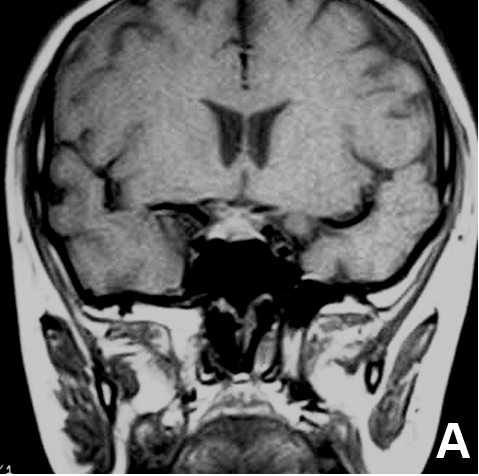
A 29-year-old woman was admitted to Teikyo University Chiba Medical Center with a complaint of amenorrhea. Physical examination revealed neither acromegaloid nor Cushingoid features. Basal levels of serum GH on admission were elevated, ranging from 0.81 to 7.26 ng/ml (normal range: 0.66-3.68), whereas basal levels of prolactin (PRL) were within normal ranges, being 12.7-17.5 ng/ml (normal range: 6.12-30.5). Insulin-like growth factor (IGF-1) level ranged from 320 to 370 ng/ml (normal range: 119-389 for woman of this age). The thyroid function was normal with free triiodothyronine (T3) 3.05 pg/ml (normal range: 2.30-4.30), free thyroxine (T4) 1.07 ng/dl (normal range: 0.90-1.70) and thyroid hormone stimulating hormone (TSH) 4.60 mIU/ml (normal range: 0.50-5.00). An oral glucose tolerance test (OGTT) showed no apparent suppression of GH, being 7.17, 6.38, 7.09, 6.03, 4.20 and 0.77 ng/ml at 0, 15, 30, 60, 90 and 120 min after loading. Thyrotropin-releasing hormone (TRH) provocation test showed paradoxical rise of serum GH, being 2.13, 3.51, 4.06, 11.7, 3.14 and 1.94 ng/ml at 0, 15, 30, 60, 90 and 120 min after loading. Gonadotropin-releasing hormone (GnRH) stimulation test showed paradoxical rise of serum GH, being 0.39, 3.32, 12.5, 9.91, 3.21 and 0.75 ng/ml at 0, 15, 30, 60, 90 and 120 min after loading. Growth hormone releasing hormone (GHRH) provocation test showed no reactive secretion of GH. The serum GH level was not suppressed by 2.5 mg of bromocriptine, being 0.22, 0.52, 13.2, 7.89, 1.96, 4.96 and 7.96 ng/ml after 0, 1, 2, 4, 8, 12 and 24 hrs after loading, whereas serum PRL was suppressed by 2.5 mg of bromocriptine, being 17.5, 7.35, 3.04, 1.50, 1.09, 1.43 and 4.24 ng/ml after 0, 1, 2, 4, 8, 12 and 24 hrs after loading. Serum follicle-stimulating hormone (FSH) and luteinizing hormone (LH) were elevated to 77.2 IU/ml (normal range: 5.2-14.4), and 34.7 mIU/ml (normal range: 1.8-7.6), respectively. GnRH provocation test revealed no reactive rises of FSH, being 77.2, 83.5, 96.1, 96.5, 97.2 and 97.8 mIU/ml at 0, 15, 30, 60, 90 and 120 min after loading, whereas LH was slightly elevated, being 34.7, 81.4, 86.0, 86.6, 76.8 and 73.9 mIU/ml at 0, 15, 30, 60, 90 and 120 min after loading. Magnetic resonance imaging (MRI) revealed a low signal intensity lesion that was less enhanced by gadolinium diethylenetriamine pentaacetic acid (Gd-DTPA) in pituitary gland, which suggested the presence of a pituitary adenoma (Figure 1). These studies suggested that the patient had primary amenorrhea with abnormal dynamics of GH and a pituitary lesion. Gynecological studies revealed bilateral fibrous ovaries. Chromosomal analysis of peripheral white blood cell (G-banding) disclosed mosaic chromosomes of 47XXY and 45X, which suggested that the patient had X/XY gonadal dysplasia. The fibrous ovaries were surgically removed for prophylaxis of gonadal tumors. |
|
|
|
|
|
Discussion |
|
Mixed gonadal dysgenesis or X/XY gonadal dysplasia in a woman is one of the major issues related to primary amenorrhea. The first step of differential diagnosis of patients with amenorrhea is the discrimination of primary or secondary amenorrhea. The elevated serum FSH and LH levels suggest that the patient has primary amenorrhea. However, when the patient has abnormality in pituitary hormone secretion, as shown in the present case, this condition may be somewhat confusing, because hyper-prolactinemia, abnormal dynamics of GH, and the presence of pituitary lesion may derange menstrual rhythm. In mixed gonadal dysgenesis or X/XY gonadal dysplasia, the axis of hypothalamus-pituitary-reproductive organ is usually maintained. The cause of the abnormal dynamics of GH in this case cannot be determined. Nevertheless, it may be evoked by a GH-secreting adenoma, although the pathology of pituitary lesion is not verified. Clinically silent somatotroph adenoma has been reported by several investigators, and this condition frequently has menstrual disorder.[1] [2] [3] [4] [5] [6] [7] [8] [9] [10] |
|
Conclusion
|
|
The abnormal dynamics of pituitary hormone, especially GH, and the existence of a pituitary lesion in mixed gonadal dysgenesis or X/XY gonadal dysplasia is a rare event. |
|
References
|
|


| [HTML Abstract] [PDF Full Text] |
|
Author Contributions:
Akira Matsuno - Conception and design, Acquisition of data, Analysis and interpretation of data, Drafting the article, Critical revision of the article, Final approval of the version to be published So Yamada - Conception and design, Acquisition of data, Analysis and interpretation of data, Critical revision of the article, Final approval of the version to be published Shoko M. Yamada - Conception and design, Acquisition of data, Analysis and interpretation of data, Drafting the article, Critical revision of the article, Final approval of the version to be published Hiroshi Nakaguchi - Conception and design, Acquisition of data, Analysis and interpretation of data, Critical revision of the article, Final approval of the version to be published Katsumi Hoya - Conception and design, Acquisition of data, Analysis and interpretation of data, Drafting the article, Critical revision of the article, Final approval of the version to be published Mineko Murakami - Conception and design, Acquisition of data, Analysis and interpretation of data, Critical revision of the article, Final approval of the version to be published |
|
Guarantor of submission:
The corresponding author is the guarantor of submission. |
|
Source of support:
None |
|
Conflict of interest:
The author(s) declare no conflict of interests. |
|
Copyright:
© Akira Matsuno et. al. 2011; This article is distributed the terms of Creative Commons Attribution License which permits unrestricted use, distribution and reproduction in any means provided the original authors and original publisher are properly credited. (Please see Copyright Policy for more information.) |
|
|