
  |

|
 |
|
Clinical Image
| ||||||
| Varied presentations of epithelial cysts | ||||||
| Ashok Kumar Bolbandi1, Pramod Krishnappa1, Arunchandra Bennehalli1 | ||||||
|
1Department of General Surgery, M.V.J. Medical College and Research Hospital, Bangalore, India.
| ||||||
| ||||||
|
[HTML Abstract]
[PDF Full Text]
[Print This Article]
[Similar article in Pumed] [Similar article in Google Scholar] 
|


| How to cite this article: |
| Bolbandi AK, Krishnappa P, Bennehalli A. Varied presentations of epithelial cyst. International Journal of Case Reports and Images 2012;3(10):65–67. |
|
Case Report
| ||||||
|
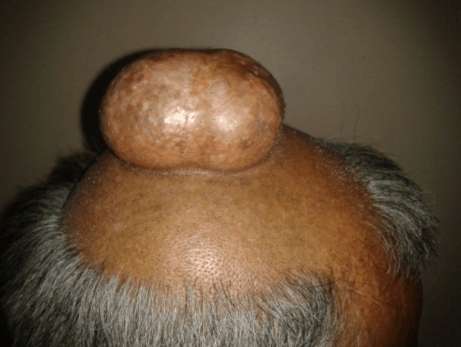
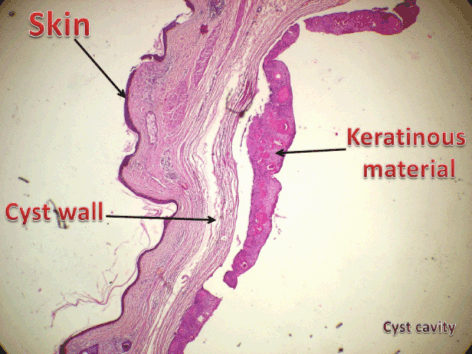
Case 1: A 55-year-old male patient presented with a swelling over the scalp since three years gradually increased in size (Figure 1). On examination, a nontender fluctuant swelling of size 7x6 cm was found over the scalp with smooth surface and well defined borders. Plain radiograph of the skull was normal. Elliptical skin incision was made and the entire cyst and its wall was excised. Histopathological diagnosis was epidermal inclusion cyst (Figure 2). | ||||||
| ||||||
|
| ||||||
| ||||||
|
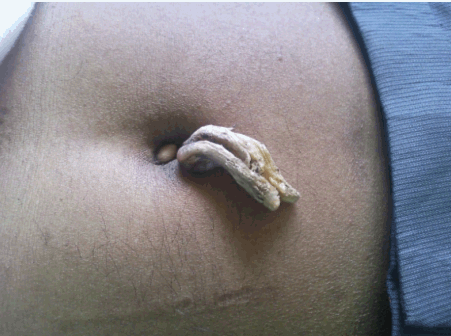
Case 2: A 60-year-old male patient presented to us with a swelling protruding from the umbilicus since four years gradually increasing in length. On examination, 8x1 cm swelling was found arising from the inferior aspect of umbilicus and lying over the skin surface (Figure 3). A diagnosis of sebaceous horn was made and excision was done. Microscopically the horn consisted of a mixture of squamous epithelial cells and keratinized debris. | ||||||
| ||||||
|
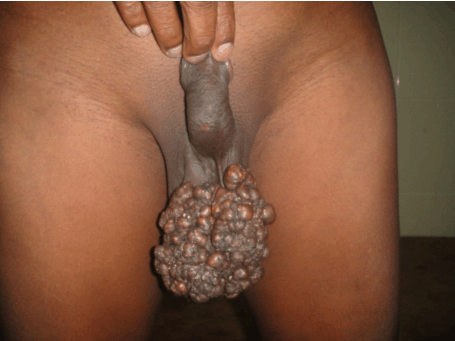
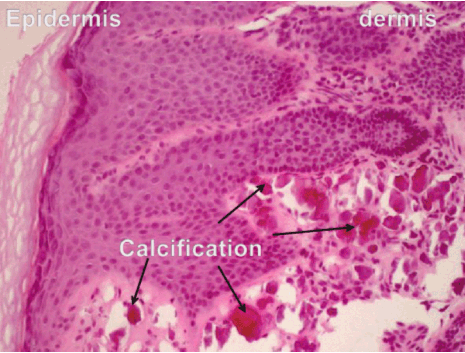
Case 3: A 47-year-old male patient presented with multiple painless swellings over the anterior, lateral and posterior wall of the scrotum gradually increasing in number and size since 20 years (Figure 4). There was no lymphadenopathy. Serum and urinary levels of calcium and phosphates were normal. Subtotal excision of the scrotal wall containing the nodules was done, and primary closure of the scrotum was done which could accommodate both the testes without tension. Histopathological examination revealed idiopathic scrotal calcinosis (Figure 5). | ||||||
| ||||||
| ||||||
|
Discussion
| ||||||
|
Epithelial cysts are common lesions formed by the invagination and cystic expansion of the epidermis or of the epithelium forming the hair follicle. The epidermal inclusion cyst, pilar cyst (trichilemmal cyst), dermoid cyst and steatocystoma are the different types of epithelial cysts. Each has a wide range of presentation varying from a size of a pea to a very large mass. We have described a few rare presentations of epithelial cysts. Epithelial cysts are divided into several types according to the structural components of their walls. They are epidermal inclusion cyst, pilar or trichilemmal cyst, dermoid cyst and steatocystoma. The epidermal inclusion cyst has a wall nearly identical to the epidermis and is filled with laminated strands of keratin. Pilar cysts have a wall that resembles follicular epithelium, without a granular cell layer and filled by a more homogenous mixture of keratin and lipid. The dermoid cyst is similar to the epidermal inclusion cyst, but it also shows multiple appendages (such as small hair follicles) budding outward from its wall. Finally, steatocystoma are the true sebaceous cysts with a wall resembling the sebaceous gland duct, if multiple, called steatocystoma multiplex. [1] Complications of longstanding epithelial cysts are infection, abscess formation, cutaneous horn, cock's peculiar tumour and squamous cell carcinoma. Cock's peculiar tumour was described by Cock in 1852. When the sebaceous cyst of the scalp ulcerates, excessive granulation tissue forms resembling fungating epithelioma. This is called the Cock's peculiar tumour. [2] Total excision of the cyst is the treatment of choice. Different techniques have been proposed for excision of a epithelial cyst: (i) Conventional elliptical incision and dissection technique, (ii) Squeeze eversion technique, and (iii) Minimal excision technique/Punch biopsy technique. The conventional elliptical incision and dissection technique includes making an elliptical incision on the skin. The cyst is gradually dissected using artery forceps from the surrounding skin till the entire cyst can be removed intact. It must be remembered that the whole of the cyst wall must be removed, otherwise recurrence is common. Squeeze eversion technique can be applied successfully to small cysts (<2 cm) without much fibrous attachment to the capsule. Make an elliptical incision, then dissection is carried out with curved scissors. The capsule should not be picked up with instruments. One should lift the skin edges rather than the capsule to facilitate dissection. Once the superficial aspect of the cyst is freed, then gently squeeze the cyst from the sides and base to evert the cyst. The main idea is to avoid handling the capsule [3]. The punch technique allows for extrusion of the cyst contents through a 3–4 mm skin and cyst opening created by a punch biopsy tool. The deflated cyst can then be pulled through the skin aperture and excised; this technique carries a recurrence rate of approximately 6 %. [4] The minimal excision technique utilizes a 2–3 mm incision to excise the cyst following extrusion of contents in a similar manner to the punch technique. [5] [6] The pathogenesis of scrotal calcinosis (SC) is still controversial. Some authors think that SC is the result of dystrophic calcification of pre-existing structures such as sebaceous cysts. It may also be due to the degeneration of the dartoic muscles. Some authors did not find any evidence of pre-existing cystic structures and think that this condition is idiopathic. [7] Scrotal calcinosis may require partial/total scrotectomy and placing the testes in the thigh pouch. Cutaneous horn is a clinical diagnosis referring to a conical projection above the surface of the skin that resembles a miniature horn. Although often benign, they can also be malignant or premalignant. [8] The horn is composed of compacted keratin. Various histologic lesions have been documented at the base of the keratin mound, and histologic confirmation is often necessary to rule out malignant changes. Malignant lesions at the base of the horn usually are squamous cell carcinoma, although basal cell carcinoma has been rarely reported. Benign idiopathic causes are frequent and include seborrheic keratosis, epidermal nevus, trichilemmal cyst, trichilemmoma, prurigo nodule, and intradermal nevus. | ||||||
|
Conclusion
| ||||||
|
Epithelial cysts have various presentations in different parts of the body. Other conditions simulating an epithelial cyst should be excluded before the surgery to avoid complications. Postoperatively, the diagnosis should be confirmed by histopathology to exclude malignany. | ||||||
|
References
| ||||||
| ||||||

|
[HTML Abstract]
[PDF Full Text]
|
|
Author Contributions:
Ashok Kumar Bolbandi – Substantial contributions to conception and design, Acquisition of data, Drafting the article, Revising it critically for important intellectual content, Final approval of the version to be published Pramod Krishnappa – Substantial contributions to conception and design, Acquisition of data, Drafting the article, Revising it critically for important intellectual content, final approval of the version to be published Arun Bennehalli – Substantial contributions to conception and design, Acquisition of data, drafting the article, Revising it critically for important intellectual content, Final approval of the version to be published |
|
Guarantor of submission:
The corresponding author is the guarantor of Submission. |
|
Source of support:
None |
|
Conflict of interest:
The authors declare no conflict of interest. |
|
Copyright:
© Ashok Kumar Bolbandi et al. 2012; This article is distributed the terms of Creative Commons Attribution License which permits unrestricted use, distribution and reproduction in any means provided the original authors and original publisher are properly credited. (Please see Copyright Policy for more information.) |
|
|