
  |

|
 |
|
Clinical Image
| ||||||
| Iodide mumps | ||||||
| Ping Chen1 | ||||||
|
1Anaesthetic CT2 Trainee Doctor, Anaesthetic Department, Guy's and St Thomas' Hospital NHS Trust, London, U.K.
| ||||||
| ||||||
|
[HTML Abstract]
[PDF Full Text]
[Print This Article]
[Similar article in Pumed] [Similar article in Google Scholar] 
|


| How to cite this article: |
| Chen P. Iodide mumps. International Journal of Case Reports and Images 2012;3(10):63–64. |
|
Case Report
| ||||||
|
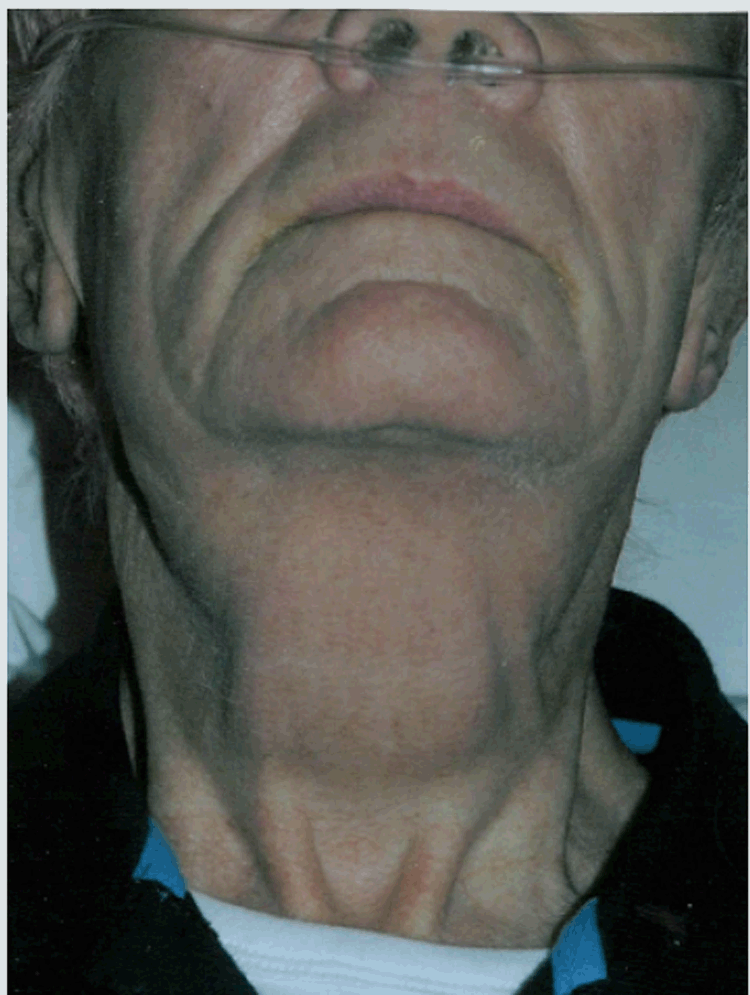
A 74-year-old normally fit and well gentleman was presented with hemoptysis and altered mental status, and underwent a chest and brain CT scan with contrast. The patient received total of 75 mL of Ultravist 370 during the procedure. After a few hours undergoing CT scan, the patient complained of swelling and pain in the upper neck, and slight shortness of breath. He was apyrexial, respiratory rate 15/min, regular heart rate of 76 bpm and blood pressure 146/67 mmHg. Bilateral, diffuse submandibular enlarged glands were noted (Figure 1). They were tender to touch. His thyroid function test was normal, thyroid peroxidase antibody was negative. Contrast induced acute sialadenitis (iodide mumps) was suspected on the basis of clinical presentation. The patient was treated with simple analgesics. The submandibular gland swelling was completely resolved after 24 hours. | ||||||
| ||||||
|
Discussion
| ||||||
|
Acute sialadenitis features swelling of saliva glands after exposure to contrast media. It is a very rare adverse reaction. Onset time can be from minutes to five days. The condition is usually self-limiting. Other associated adverse reactions include facial nerve paralysis, enlarged thyroid/lacrimal glands. [1] There are no life threatening cases reported. In this case, the patient was given Ultravist 370, which is iodinated contrast containing mainly organically-bound iodine, and a tiny amount of inorganic iodide. 1 mL Ultravist contains 769 mg of iopromide, which is equivalent to 370 mg iodine. The exact causes of iodide mumps are unclear. They are thought to be idiosyncratic. Possible toxic accumulation in the ductal system and high concentration of non-organic iodine induce inflammation changes leading to obstruction. [2] | ||||||
|
Conclusion
| ||||||
|
Contrast media are frequently used, estimated at 70 million administrations worldwide per year. [3] Often, large volumes are required, so reactions are an important problem. Exposure to iodinated contrast media may elicit a variety of adverse reactions. Iodide mumps or acute sialadenitis after contrast media imaging is a rare adverse effect to iodine. | ||||||
|
References
| ||||||
| ||||||

|
[HTML Abstract]
[PDF Full Text]
|
|
Author Contributions:
Ping Chen – Conception and design, Acquisition of data, Analysis and interpretation of data, Conception and design, Acquisition of data, Analysis and interpretation of data, Drafting the article, Critical revision of the article, Final approval of the version to be published |
|
Guarantor of submission:
The corresponding author is the guarantor of submission. |
|
Source of support:
None |
|
Conflict of interest:
Authors declare no conflict of interest. |
|
Copyright:
© Ping Chen 2012; This article is distributed the terms of Creative Commons Attribution License which permits unrestricted use, distribution and reproduction in any means provided the original authors and original publisher are properly credited. (Please see Copyright Policy for more information.) |
|
|