|
Case Report
Epithelioid hemangioma of the skull: Rare case report
1 Student, Interdisciplinary Faculty of Health Sciences, University of Ottawa, Ottawa, Ontario, Canada
2 Student, Medical Science, Western University, London, Ontario, Canada
3 Clinical Researcher, Department of Pathology, Children’s Hospital of Eastern Ontario, Canada
4 Pathologist, Department of Pathology, Children’s Hospital of Eastern Ontario, Ottawa, Ontario, Canada
5 Oncologist, Division of Hematology/Oncology, Children’s Hospital of Eastern Ontario, University of Ottawa, Ottawa, Ontario, Canada
6 Radiologist, Department of Diagnostic Imaging, Children’s Hospital of Eastern Ontario Research Institute, Ottawa, Ontario, Canada
Address correspondence to:
Nagwa Wilson
401 Smyth Rd, Ottawa, Ontario K1H 8L1,
Canada
Message to Corresponding Author
Article ID: 100084Z11AR2025
Access full text article on other devices

Access PDF of article on other devices

How to cite this article
Rashwan A, Riarh C, Tristani L, de Nanassy J, Ramphal R, Wilson N. Epithelioid hemangioma of the skull: Rare case report. J Case Rep Images Pathol 2025;11(1):1–7.ABSTRACT
Introduction: Epithelioid hemangiomas (EH) are benign vascular tumors that commonly occur in the skin, subcutis, and bone—most typically arising as nodules in the neck and head region. Pediatric cases with atypical presentations remain rare and challenging.
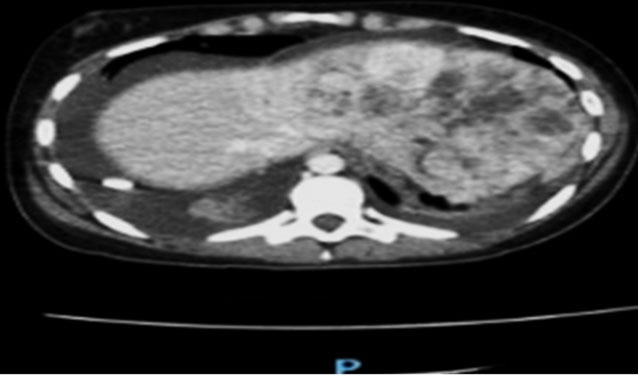
Case Report: The following outlines the case of a 2-year-old male who presented with a bump and swelling on the left side of his head. Imaging tests identified multiple, hyperdense, and focally ring-enhancing intra-axial lesions located mainly at the gray-white matter junction of bilateral frontal left-sided parietal, left-sided occipital, and left-sided temporal lobes. In addition, multiple lytic lesions were seen in the calvarium. Pathology confirmed EH. While one lesion required surgical resection, the remaining lesions showed spontaneous regression during follow-up.
Conclusion: This case highlights the diagnostic and management challenges associated with pediatric EH involving the head, including intracranial involvement. The patient’s unique presentation, age, and lesion involution expand the understanding of EH beyond its typical manifestation.
Keywords: Epithelioid hemangioma, Pediatric, Skull
SUPPORTING INFORMATION
Author Contributions
Ayah Rashwan - Substantial contributions to conception and design, Acquisition of data, Analysis of data, Interpretation of data, Drafting the article, Revising it critically for important intellectual content, Final approval of the version to be published
Chanpreet Riarh - Interpretation of data, Revising it critically for important intellectual content, Final approval of the version to be published
Lauren Tristani - Substantial contributions to conception and design, Acquisition of data, Analysis of data, Interpretation of data, Revising it critically for important intellectual content, Final approval of the version to be published
Joseph de Nanassy - Interpretation of data, Revising it critically for important intellectual content, Final approval of the version to be published
Raveena Ramphal - Interpretation of data, Revising it critically for important intellectual content, Final approval of the version to be published
Nagwa Wilson - Acquisition of data, Interpretation of data, Revising it critically for important intellectual content, Final approval of the version to be published
Guarantor of SubmissionThe corresponding author is the guarantor of submission.
Source of SupportNone
Consent StatementWritten informed consent was obtained from the patient for publication of this article.
Data AvailabilityAll relevant data are within the paper and its Supporting Information files.
Conflict of InterestAuthors declare no conflict of interest.
Copyright© 2025 Ayah Rashwan et al. This article is distributed under the terms of Creative Commons Attribution License which permits unrestricted use, distribution and reproduction in any medium provided the original author(s) and original publisher are properly credited. Please see the copyright policy on the journal website for more information.