|
|
|
|
Clinical Image
| ||||||
| Purple bag syndrome: A red flag? | ||||||
| Josephine Catherine Weaver1 Rajesh Kumar Rajakunjaram2 Indunil Achala Akmimana Gunawardena3 | ||||||
|
1MBChB, HMO2, Palliative Medicine, St Vincent’s Melbourne, Fitzroy, Victoria, Australia 2MBBS, MRCP, Consultant, Stroke and Care of the Elderly, Queen Elizabeth Hospital, King’s Lynn, Norfolk, UK 3MBBS, MRCP, Consultant, Older People’s Medicine, Norfolk and Norwich University Hospital NHS Foundation Trust, Norwich, Norfolk, UK | ||||||
| ||||||
|
[Abstract HTML]
[Full Text HTML]
[Full Text PDF]
[Print This Article] [Similar article in Pumed] [Similar article in Google Scholar] |
| How to cite this article |
| Weaver JC, Rajakunjaram RK, Gunawardena IAA. Purple bag syndrome: A red flag? Int J Case Rep Images 2018;9(1):63–65. |
|
CASE REPORT
| ||||||
|
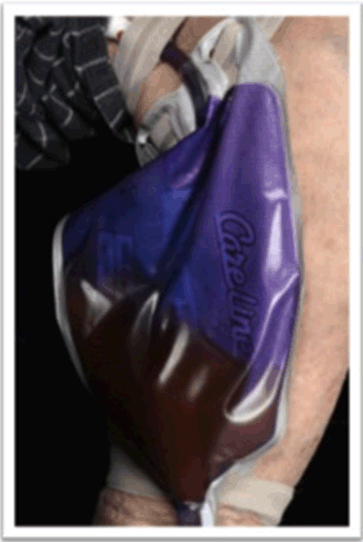
A 91-year-old was male presented to the emergency department following a fall from a chair. He was unable to identify any significant symptoms preceding the fall. He sustained no significant injuries and basic physiological observations were within normal limits. Past medical history revealed he was known to have a long-term catheter (LTC) for benign prostate hyperplasia (BPH). The only notable finding on initial investigations was moderately elevated inflammatory markers. He was admitted under the medical team for further assessment. On re-examination his urine appeared to have a purple discoloration in the leg bag (Figure 1). His genital hygiene was poor. Microscopy, culture and sensitivity of the catheter urine sample grew heavy mixed bacterial growth. The patient made a full recovery following empirical intravenous broad-spectrum antibiotics then focused oral antibiotics in accordance with the sensitivities. This was combined with replacement of the LTC under aseptic non-touch technique. | ||||||
| ||||||
|
DISCUSSION
| ||||||
|
Purple bag syndrome (PBS), also known as purple urine bag syndrome (PUBS), is a reasonably rare syndrome [1] of urinary tract infection associated with several bacterial pathogens [2][3]. Providencia stuartii, Providencia rettgeri, Klebsiella pneumoniae, Proteus mirabilis, Escherichia coli, Morganella morganii, and Pseudomonas aeruginosa have all been linked to purple bag syndrome. It is believed that the purple color is created through a metabolic cascade that begins with tryptophan in food reacting with gut bacteria. Through the portal circulation and interaction with alkaline urine, there is production of the red indirubin and blue indigo pigments. The two react with the polyvinyl chloride of the catheter bag and produce the purple coloration [1][2][3]. | ||||||
|
CONCLUSION
| ||||||
|
Purple bag syndrome appears alarming. It can range from being an innocuous incidental finding to representing significant urinary tract infection and even a precursor to urosepsis. Clinical correlation must be made. Treatment however is no different to other catheter associated urinary tract infections– suitable antimicrobial therapy should be administered in accordance with relevant microbiology results and the catheter replaced. Keywords: Urinary tract infection, Catheter, Purple bag syndrome, Purple urine bag syndrome | ||||||
|
REFERENCES
| ||||||
| ||||||
|
[Abstract HTML]
[Full Text HTML]
[Full Text PDF]
|
|
Author Contributions
Josephine Catherine Weaver – Substantial contributions to conception and design, Acquisition of data, Analysis and interpretation of data, Drafting the article, Revising it critically for important intellectual content, Final approval of the version to be published Rajesh Kumar Rajakunjaram – Substantial contributions to conception and design, Acquisition of data, Analysis and interpretation of data, Drafting the article, Revising it critically for important intellectual content, Final approval of the version to be published Indunil Achala Akmimana Gunawardena – Substantial contributions to conception and design, Acquisition of data, Analysis and interpretation of data, Drafting the article, Revising it critically for important intellectual content, Final approval of the version to be published |
|
Guarantor of Submission
The corresponding author is the guarantor of submission. |
|
Source of Support
None |
|
Conflict of Interest
Author declares no conflict of interest. |
|
Copyright
© 2018 Josephine Catherine Weaver et al. This article is distributed under the terms of Creative Commons Attribution License which permits unrestricted use, distribution and reproduction in any medium provided the original author(s) and original publisher are properly credited. Please see the copyright policy on the journal website for more information. |
|
|