|
|
|
|
Case Report
| ||||||
| Cardiac tamponade as a life-threatening complication after laparoscopic mesh hiatal hernia repair | ||||||
| Dimitar Penchev1, Georgi Kotashev1, Georgi Popivanov1, Ventsislav Mutafchiyski1 | ||||||
|
1Clinic of Endoscopic, Endocrine surgery and Coloproctology, Military Medical Academy, Sofia, Bulgaria
| ||||||
| ||||||
|
[HTML Abstract]
[PDF Full Text]
[Print This Article] [Similar article in Pumed] [Similar article in Google Scholar] 
|
| How to cite this article |
| Penchev D, Kotashev G, Popivanov G, Mutafchiyski V. Cardiac tamponade as a life-threatening complication after laparoscopic mesh hiatal hernia repair. Int J Case Rep Images 2017;8(8):528–532. |
|
ABSTRACT
| ||||||
|
Introduction:
Anti-reflux surgery becomes one of the most common laparoscopic procedures during the last decade, with perioperative morbidity rates up to 19% and mortality around 0.1%. The increasing usage of prosthetic mesh in large hiatal hernias led to a new type of complications such as mesh migration or infection, rejection and life-threatening cardiac tamponade. As of today, only few cases with cardiac tamponade after laparoscopic hiatal hernia repair are reported in the English literature. Here we present a case with cardiac tamponade after laparoscopic mesh-repair in order to increase the awareness of this rare complication. Keywords: Cardiac tamponade, Hiatal hernia, Laparoscopic fundoplication, Mesh repair | ||||||
|
INTRODUCTION
| ||||||
|
Surgical treatment of gastroesophageal reflux disease (GERD) is an alternative second line therapy after failed conservative treatment. Anti-reflux surgery becomes one of the most common laparoscopic procedures during the last decade, with perioperative morbidity rates up to 19% and mortality around 0.1% [1]. Most of the complications after anti-reflux surgery are minor, without any need of surgical intervention. Nevertheless, serious complications may occur such as spontaneous pneumothorax, spleen injury, severe bleeding and esophageal perforation or as wittily wrote Prof. Swanström “the only way to die from GERD is to be operated on for it”. The increasing usage of prosthetic mesh-reinforcement for prevention of recurrence leads to a new type of complications such as mesh migration, rejection reaction, mesh infection and cardiac tamponade [2]. The cardiac tamponade is a rare but life-threatening complication associated with significant mortality. As of today, there are only few cases reported in the English literature [3]. Here we present a case report of patient with cardiac tamponade after mesh-repair of large hiatal hernia in order to increase the awareness of this rare complication. | ||||||
|
CASE REPORT
| ||||||
|
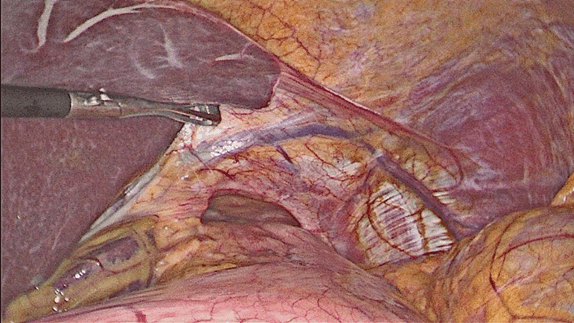
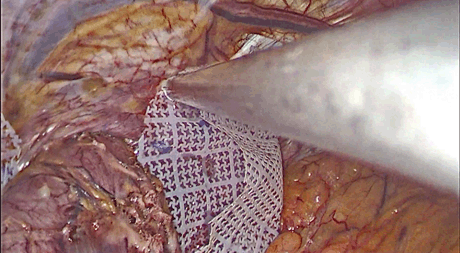
A 72-year-old female was admitted in our institution for surgical repair of GERD with a large symptomatic hiatal hernia. Conservative treatment, for more the one year, did not show any significant improvement of the regurgitation, dysphagia, chronic cough and oral intake limitations. She had a past history of arterial hypertension, thrombocytosis, chronic heart failure and osteoporosis. Endoscopic and contrast X-ray examinations showed multiple duodenal diverticula and a large, type II hiatal hernia containing 1/3 of the stomach into mediastinum, with diameter of 10 cm and reflux disease Grade II by Savary-Miler classification. Laparoscopy confirmed large hiatal hernia with diastasis and sclerosis of the diaphragmatic crus (Figure 1). Nissen’s fundoplication was performed along with relaxing incision of the left crus. Omiramesh® (Ethicon) 10x15 cm mesh was placed with Secure strap® (Ethicon, Norderstedt, Germany) to the diaphragm (Figure 2) and (Figure 3). After surgery patient was transferred to intensive care unit for postoperative monitoring. Several hours after procedure patient complained of mild dyspnea, anxiety and retrosternal chest pain. Desaturation, atrial fibrillation on ECG and pleural effusion on X-ray were noted and acute heart failure, pulmonary embolism and myocardial infarction were suspected. Due to normal troponin levels, significant pericardial effusion on echocardiography and hemodynamic instability the patient was consulted with thoracic surgeon and pericardial puncture with evacuation of 120 ml blood was performed. The patient was transferred immediately to the operative room for thoracotomy and pericardial fenestration because of lack of effect. Unfortunately, she died before the thoracic procedure. | ||||||
| ||||||
| ||||||
| ||||||
|
DISCUSSION
| ||||||
|
Treatment of large hiatal hernia is required, because of the potential for significant complications such as volvulus, anemia, obstruction, strangulation or perforation. Cardiac tamponade is a rare, but life-threatening complication after anti-reflux surgery. The awareness about possible complications, which can occur in postoperative period, is crucial for early diagnosis and successful management. McClellan et al. reported a case with cardiac injury managed successfully [1]. Most of the studies analyzing the possible complications are retrospective reporting morbidity rate up to 19%. Most complications occur are minor; grade 1–2 according to Clavien–Dindo classification. Only few retrospective trials took into account the severe life-threatening complications, such as injuries to the esophagus, stomach, spleen, pleura, aorta and heart [3]. Lundell published a review with mortality rate 0.15%, which was related to pneumothorax, hemorrhage, perforations, and splenectomy [4]. The most common cause of lethal outcome was pneumothorax. Mesh-related complications are a quite new area in hiatal hernia management. Almost 10% of surgeons use mesh in hiatal hernia and 45% of them are for large ones. Several reports reported the possible aortic and cardiac injury during procedures, related to laparoscopic tacks, sutures or dissection around the hiatus [1][3][5][6][7][8]. The understanding of mechanism of cardiac tamponade after hiatal hernia repair with mesh has a significant practical importance. The thickness of the diaphragm ranges from 1.5–5.4 mm. The central tendon averages from 2.9–3 mm [3]. Secure strap® tacks are 7.2 mm in length and even angled tacks have more than 4 mm length. The pressure on the instrument against the tissue thin down the tissues thus additionally contributing to this complication (Figure 3). Perforated ventricular marginal branch vessel and tearing myocardium are possible sources of bleeding. In most of the reported cases spiral tacks were used, but there are reports after mesh fixation with angle tacks and sutures. The review of Frantzides et al. reported 15 cases –two with sutures, eleven with spiral tackers and one with angle tacker– with 66% mortality [3]. Other possible mechanism is by compressing hematoma around the heart [5]. The main cause of hematoma is extensive dissection and postoperative mediastinal bleeding. Usual symptoms of cardiac tamponade are hypotension, tachycardia, desaturation, anxiety, dyspnea, tachycardia, atrial fibrillation, distended neck veins and muffled heart sounds. They can be easily confused by other common postoperative complications, such as bleeding, pulmonary embolism, acute heart failure, pneumothorax, atelectasis and myocardial infarction. Some authors reported a case with cardiac tamponade which was primarily wrongly diagnosed with inferior myocardial infarction, because of ECG findings and elevated troponin levels [6]. Clinical manifestation may occur at any time in the postoperative course. Sugumar et al. reported two cases with cardiac tamponade on fifth week and on 37th day after surgery, respectively [7]. Usually, symptoms occur from few hours after operation up to 14 days. The most accurate method for diagnosis is transesophageal echocardiography, but in most cases, especially in non-cardiac surgery centers, standard postoperative monitoring includes ECG, echocardiography and serum troponin levels. The early and accurate diagnosis needs to be followed by a proper management by an experienced cardio-thoracic surgeon. Generally, there are three options to manage cardiac tamponade – the first one is conservatively to put a suction drain in pericardium to evacuate the blood. McClellan et al. reported a case with successful management of patient, using 6 French suction drain in pericardium with 370 ml blood evacuation for one day and resolving the symptoms immediately after drainage [1]. In our case, we tried the similar approach without success, because the symptoms still remained and the patient became unstable. The second treatment option is laparotomy with creating of subxiphoid window and drainage of pericardium into abdominal cavity with or without drain placement such in the case of Stich et al. [7]. The third and most aggressive approach is thoracotomy with pericardial fenestration and drainage. Surgical approaches are more preferable, because they allow making a definitive hemostasis if necessary. Recently, several surgeons use glue for mesh fixation to evade the potential risk of injuries [9]. The fear of complications or negative experience does not preclude the mesh reinforcement in large hiatal hernia repair [10]. | ||||||
|
CONCLUSION
| ||||||
|
Severe life-threatening complications are underestimated and need more discussion and recommendation for risk assessment, diagnosis and management. Early diagnosis and proper management are crucial in case of cardiac tamponade. The understanding of mechanism of cardiac tamponade and proper fixation of prosthetic material only to the diaphragmatic crus are of crucial importance to evade this type of complication. Using glue is a safe alternative to staples. | ||||||
|
REFERENCES
| ||||||
| ||||||
|
[HTML Abstract]
[PDF Full Text]
|
|
Author Contributions
Dimitar Penchev – Substantial contributions to conception and design, Acquisition of data, Analysis and interpretation of data, Drafting the article, Revising it critically for important intellectual content, Final approval of the version to be published Georgi Kotashev – Analysis and interpretation of data, Revising it critically for important intellectual content, Final approval of the version to be published Georgi Popivanov – Analysis and interpretation of data, Revising it critically for important intellectual content, Final approval of the version to be published Ventsislav Mutafchiyski – Analysis and interpretation of data, Revising it critically for important intellectual content, Final approval of the version to be published |
|
Guarantor
The corresponding author is the guarantor of submission. |
|
Source of support
None |
|
Conflict of interest
Authors declare no conflict of interest. |
|
Copyright
© 2017 Dimitar Penchev et al. This article is distributed under the terms of Creative Commons Attribution License which permits unrestricted use, distribution and reproduction in any medium provided the original author(s) and original publisher are properly credited. Please see the copyright policy on the journal website for more information. |
|
ABOUT THE AUTHORS
| ||||||||||||
| ||||||||||||
|
|