

|
 |
|
Case Report
| ||||||
| Extracorporeal membrane oxygenator venovenous in treatment of a fulminant varicella pneumonia in an adult | ||||||
| Rita Rei Neto1, Sara Ferraz2, Petra Monteiro1, Margarida Correia1, Carla Nogueira3, Paula Castelões4 | ||||||
|
1Department of Internal Medicine of Centro Hospitalar Vila Nova de Gaia e Espinho, Vila Nova de Gaia, Portugal
2Department of Anesthesiology of Centro Hospitalar Vila Nova de Gaia e Espinho, Vila Nova de Gaia, Portugal 3Department of Pneumology of Centro Hospitalar Vila Nova de Gaia e Espinho, Vila Nova de Gaia, Portugal 4Director of Intensive Unit Care of Centro Hospitalar Vila Nova de Gaia e Espinho, Vila Nova de Gaia, Portugal | ||||||
| ||||||
|
[HTML Abstract]
[PDF Full Text]
[Print This Article] [Similar article in Pumed] [Similar article in Google Scholar] 
|


| How to cite this article |
| Neto RR, Ferraz S, Monteiro P, Correia M, Nogueira C, Castelões P. Extracorporeal membrane oxygenator venovenous in treatment of a fulminant varicella pneumonia in an adult. Int J Case Rep Images 2017;8(7):466–469. |
|
ABSTRACT
| ||||||
|
Introduction:
Varicella pneumonia is the most frequent and severe complication of varicella infection in adults, associated with a mortality of 30%. Keywords: Acute respiratory distress syndrome, Acyclovir, Pneumonia, Varicella | ||||||
|
INTRODUCTION
| ||||||
|
Varicella pneumonia is the most frequent and severe complication of varicella infection in adults [1][2][3][4]. Benign but highly contagious childhood disease, in adults is uncommon but potentially life-threatening [5], associated with an mortality of 30% even higher (50%) in those with mechanical ventilation [2][3]. Transmission occurs via respiratory droplets or direct contact with lesions [2]. Respiratory symptoms usually start 3–5 days after the onset of rash but in 10% precede cutaneous manifestations [3]. | ||||||
|
CASE REPORT
| ||||||
|
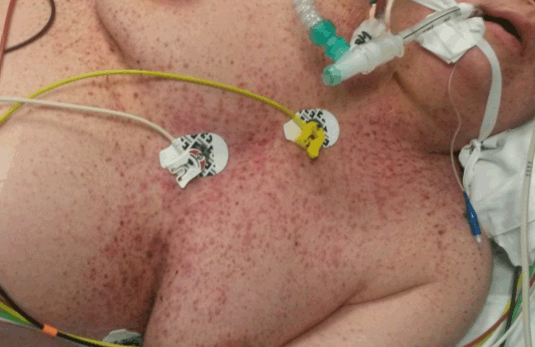
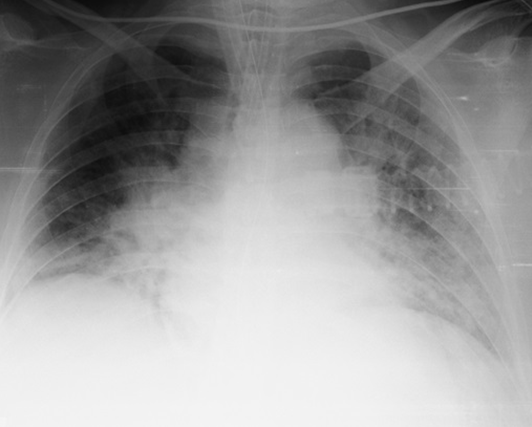
A 46-year-old female, non-smoking, admitted with a suspect of acute intestinal ischemia, confirmed by exploratory laparotomy without intestinal resection. Her medical history was significant for ulcerative colitis receiving 5 mg/day prednisolone at time of admission and had no history with contact with children recently. In second day after admission, patient starts fever, increasing dyspnea and a generalized rash with some vesicles. Laboratory tests showed renal impairment, acute hepatitis, a highly inflammatory state and chest radiography shows bilateral shadows. She starts antibiotic and intravenous acyclovir because of immunosuppression and rapid clinical deteriorating. Despite the anticipated treatment, she remains with hypoxemic insufficiency, was intubated and was admitted to the intensive unit care (APACHE II 20, SAPS II 38 and SOFA 11 at first day). Physical examination of the patient revealed systemic vesicular rash with lesions at various stage of progression and few crusts (Figure 1) and (Figure 2). 24-hours after the first symptoms, she remains hypoxemic, with bilateral infiltrates and under the diagnosis of acute respiratory distress syndrome (ARDS), she required treatment with protective lung ventilation. Despite treatment and ventilator strategy, she maintained severe hypoxemia and need to started extracorporeal membrane oxygenator venovenous (ECMO-vv). The polymerase-chain reaction in lavage fluid and vesicular liquid returned highly positive for varicella zoster virus (VZV). A hydrocortisone stress scheme was started because of chronic steroid treatment. Acyclovir was administered for seven days and the vesicles gradually formed clusters that were improved after 10 days. The patient maintained ECMO-vv during nine days, was extubated after 13 days of mechanical ventilation, with all dysfunctions resolved. She was transferred 16 days later and was discharged home at 21st day. Although his serum VZV-specific IgM levels were not elevated, the IgG levels were found to be elevated for three weeks. | ||||||
| ||||||
| ||||||
|
DISCUSSION
| ||||||
|
Incidence of varicella pneumonia is one in 400 cases of varicella [1] and well recognized risk factors have been identified such as smoking, male gender, pregnancy, immunosuppression, pulmonary obstructive lung disease and the severity of rash (> 100 spots) [1][2][4]. Systemic VZV infection should be considered when an immunocompromised patient develops pulmonary symptoms, even in the absence of cutaneous lesions [3] . Varicella pneumonia can progress to hypoxemic acute insufficiency or ARDS [1][2]. The pulmonary lesions caused by VZV consist in focal hemorrhagic necrosis, mononuclear infiltration of alveolar walls and fibrinous exudates [1][4], causing an interstitial pneumonitis with alveolar hemorragae [1] and some bronchial vesicles can be found. Acyclovir has become standard therapy for patients with complications of Varicella infection and should be used early because reduces mortality [1]. The effect of corticosteroids in varicella pneumonia is unknown. In adult patients who progress to pneumonia or ARDS, corticosteroid therapy combined with acyclovir demonstrated a significant clinical response and had been shown to reduce the duration of hospital and ICU stay [2][4]. It is possible that action of corticosteroids in varicella pneumonia is similar to that in pneumocystis pneumonia and military tuberculosis, both infections triggering T cell mediated responses [4]. The use of extracorporeal membrane oxygenation (ECMO) has been shown to be beneficial when patients have severe life-threatening refractory hypoxemia and they didn’t respond to conventional rescue therapies, such as recruitment maneuvers, inhaled nitric oxide, prone positioning, high frequency oscillatory ventilation or extra-corporeal membrane oxygenation (ECMO) [1][6]. Since the H1N1 influenza A pandemic in 2009 we saw a worldwide expansion in the use of ECMO. Several studies have reported that ECMO may improve survival in severe ARDS [6] but there have been few studies to review long-term survival and quality of life of this patients. In this case, our patient was a survival that not have profound muscle weakness and wasting because she starts early rehabilitation during the ICU period and she was discharge from ECMO as soon as possible. A long-term morbidity shows that varicella pneumonia had effect on respiratory function, with a temporary reduction in forced vital capacity and forced expiratory volume in one second and may be associated with a restrictive lung disease pattern in the acute and recovery phase [1]. The prevention with immunoglobulin has proved to be effective and its use is recommended for all adults who have no evidence of immunity (history of chickenpox, being born before 1980 or having positive titers) and should be emphasized for those who come in contact with patients at high risk of severe disease and in individuals with a high risk of personal exposure [7] and to susceptible immunosuppressed patients and pregnant women who have been in contact with a proven source of Varicella infection [1]. | ||||||
|
CONCLUSION
| ||||||
|
Systemic varicella zoster virus (VZV) infection, although rare, can cause serious and fatal complications. Early detection and proper treatment is mandatory for minimizing mortality and controlling infection, but often difficult because typical dermatological findings and the elevation of specific antibodies can be absent in immunosuppressed patients. Varicella zoster virus prophylaxis may be required in some of immunosuppressed ICU patients to prevent fatal VZV infection. | ||||||
|
REFERENCES
| ||||||
| ||||||

|
[HTML Abstract]
[PDF Full Text]
|
|
Author Contributions
Rita Rei Neto – Substantial contributions to conception and design, Acquisiton of data, Drafting the article, Revising it critically for important intellectual content, Final approval of the version to be published Sara Ferraz – Substantial contributions to conception and design, Acquisition of data, Drafting the article, Revising it critically for important intellectual content, Final approval of the version to be published Petra Monteiro – Substantial contributions to conception and design, Acquisition of data, Drafting the article, Revising it critically for important intellectual content, Final approval of the version to be published Margarida Correia – Substantial contributions to conception and design, Acquisition of data, Drafting the article, Revising it critically for important intellectual content, Final approval of the version to be published Carla Nogueira – Substantial contributions to conception and design, Acquisition of data, Drafting the article, Revising it critically for important intellectual content, Final approval of the version to be published Paula Castelões – Substantial contributions to conception and design, Acquisition of data, Drafting the article, Revising it critically for important intellectual content, Final approval of the version to be published |
|
Guarantor
The corresponding author is the guarantor of submission. |
|
Source of support
None |
|
Conflict of interest
Authors declare no conflict of interest. |
|
Copyright
© 2017 Rita Rei Neto et al. This article is distributed under the terms of Creative Commons Attribution License which permits unrestricted use, distribution and reproduction in any medium provided the original author(s) and original publisher are properly credited. Please see the copyright policy on the journal website for more information. |
|
|