|
|
|
|
Case Report
| ||||||
| Unusual gastric submucosal perforation following multiple magnetic bead ingestion in an infant | ||||||
| Ghassan Nakib1, Valeria Calcaterra2, Balaji Krishnamurthy3, Gloria Pelizzo4 | ||||||
|
1MD, Department of Pediatric Surgery, Medclinic Middle East, Mediclinic City Hospital Dubai, UAE
2MD, Pediatric Unit, Department of Maternal and Children’s Health, Fondazione IRCCS Policlinico San Matteo and Department of Internal Medicine, University of Pavia, Pavia, Italy 3MD, Pediatric Department, Gastroenterology, Mediclinic ME, Mediclinic city Hospital Dubai, UAE 4MD, Pediatric Surgery Unit, Children’s Hospital, Istituto Mediterraneo di Eccellenza Pediatrica, Palermo, Italy | ||||||
| ||||||
|
[HTML Abstract]
[PDF Full Text]
[Print This Article] [Similar article in Pumed] [Similar article in Google Scholar] 
|
| How to cite this article |
| Nakib G, Calcaterra V, Krishnamurthy B, Pelizzo G. Unusual gastric submucosal perforation following multiple magnetic bead ingestion in an infant. Int J Case Rep Images 2017;8(7):451–453. |
|
ABSTRACT
|
|
Introduction:
Magnetic beads are hazardous, having potentially lethal consequences if ingested. Keywords: Children, Ingestion, Magnetic beads, Perforation |
|
INTRODUCTION
|
|
Accidental ingestion of foreign bodies is a common problem in children [1][2]. The majority of ingested foreign bodies pass spontaneously without treatment. Magnetic beads are hazardous, having potentially lethal consequences if ingested [3] [4][5][6]. |
|
CASE REPORT
|
|
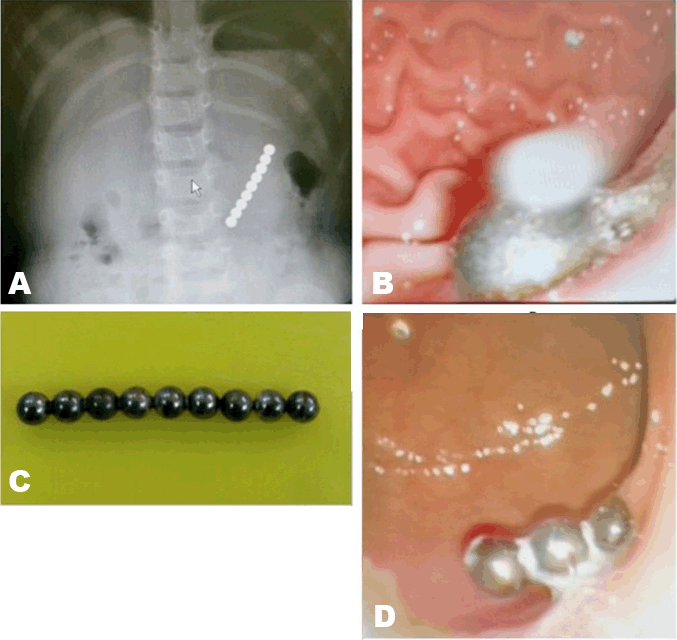
A two-year-old girl, weight 19 kg presented to the pediatric emergency department with an eight hour history of worsening abdominal pain, nausea and alimentary vomiting. The patient appeared pale with dry mucous membranes and in moderate distress. Vitals signs were as follows: temperature 36.7°C, heart rate 156 bpm, SPO2 100%, respiratory rate 26 rpm, blood pressure 90/72 mmHg. Physical examination revealed abdominal tenderness with guarding and rigidity. The intravenous infusion of crystalloid fluids was started in pediatric emergency department. On abdominal X-ray examination, there was no free air or dilated bowel loops; however, nine opaque foreign bodies (magnetic beads) were seen in the left hypochondrium (Figure 1A). Explorative gastroscopy was performed and two hypochondrium (Figure 1B), but not the remaining seven. These were pulled out and another gastroscopic attempt showed appearance of another two of the remaining ones. Removing these, the remaining five were all attached as seen on the X-ray (Figure 1C). Gastric perforation was suspected. Laparoscopic assisted enterolysis from the Treitz to terminal ileum was performed and no perforation was seen. Stomach anterior wall was free of any perforations. The magnets must have caused pressure necrosis on a gastric mucosa fold with subsequent limited submucosal perforation making a pouch were the spheres were logged (Figure 1D). The postoperative period was uneventful and the patient was discharged on the second postoperative day. |
|
|
|
DISCUSSION
|
|
Complications from foreign body ingestion in children are uncommon but the ingestion of multiple magnets may require urgent surgical intervention and early removal because of very high risk of gastrointestinal perforation [1][2][3]. |
|
CONCLUSION
|
|
Prevention campaigns from health authorities should start about the hazards of magnetic toys to prevent the appearance of new similar cases. |
|
REFERENCES
|
|
|
SUGGESTED READING
|
|
Kramer RE, Lerner DG, Lin T, Manfredi M, Shah M, Stephen TC. Management of ingested foreign bodies in children: A clinical report of the NASPGHAN Endoscopy Committee. J Pediatr Gastroenterol Nutr 2015; 60:562–74. |
|
[HTML Abstract]
[PDF Full Text]
|
|
Author Contributions
Ghassan Nakib – Substantial contributions to conception and design, Acquisition of data, Drafting the article, Revising it critically for important content, Final approval of the version to be published Valeria Calcaterra – Substantial contributions to conception and design of data, Drafting the article, Revising it critically for important content, Final approval of the version to be published Balaji Krishnamurthy – Substantial contributions to conception and design, Acquisition of data, Drafting the article, Revising it critically for important content, Final approval of the version to be published Gloria Pelizzo – Substantial contributions to conception and design of data, Drafting the article, Revising it critically for important content, Final approval of the version to be published |
|
Guarantor
The corresponding author is the guarantor of submission. |
|
Source of support
None |
|
Conflict of interest
Authors declare no conflict of interest. |
|
Copyright
© 2017 Ghassan Nakib et al. This article is distributed under the terms of Creative Commons Attribution License which permits unrestricted use, distribution and reproduction in any medium provided the original author(s) and original publisher are properly credited. Please see the copyright policy on the journal website for more information. |
|
|