|
|
|
|
Case Report
| ||||||
| Upper airway injury caused by gum elastic bougie | ||||||
| Ayça Tuba Dumanli Özcan1, Cemile Altin Balci2, Semsi Mustafa Aksoy2, Gökçer Ugur1, Orhan Kanbak1, Togay Müderrris3 | ||||||
|
1Ankara Atatürk Research and Training Hospital, Department of Anesthesiology and Reanimation
2Yildirim Beyazit University Faculty of Medicine, Department of Anesthesiology and Reanimation 3Yildirim Beyazit University Faculty of Medicine, Department of Otorhinolaryngology | ||||||
| ||||||
|
[HTML Abstract]
[PDF Full Text]
[Print This Article] [Similar article in Pumed] [Similar article in Google Scholar] 
|
| How to cite this article |
| Özcan ATD, Balci CA, Aksoy SM, Ugur G, Kanbak O, Müderrris T. Upper airway injury caused by gum elastic bougie. Int J Case Rep Images 2017;8(7):439–443. |
|
ABSTRACT
| ||||||
|
Introduction:
Difficulties and complications associated with intubation are among the leading causes of surgery-related mortality in patients with obesity and obstructive sleep apnea. It is known that during perioperative intubations, the progression of the bougie may lead to serious injury and even rupturing in the trachea. Keywords: Difficult intubation, Gum elastic bougie, Obstructive sleep apnea syndrome, Upper airway injury | ||||||
|
INTRODUCTION
| ||||||
|
Elastic gum bougies are commonly employed during the intubation of the trachea, particularly in cases where the glottic opening is difficult to visualize due to obstruction. Previous studies have shown a success rate of more than 94%, when elastic gum bougies are applied using direct laryngoscopy with the aid of a Cormack–Lehane 3 laryngeal view. Intubation can be further facilitated adjusting the shape of the bougie prior to the procedure. It was indicated that use of bougie along with lubricant, advancing it gently and withdrawing it a few centimeters or asking for help to stabilize it while placing tracheal tube could reduce airway injury associated with bougie. However the use of intubation may cause airway trauma in case of difficult airway. Herein, we present a male case of difficult intubation and challenging airway management [1][2][3]. | ||||||
|
CASE REPORT
| ||||||
|
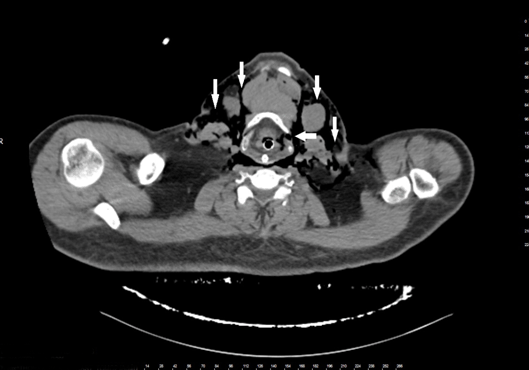
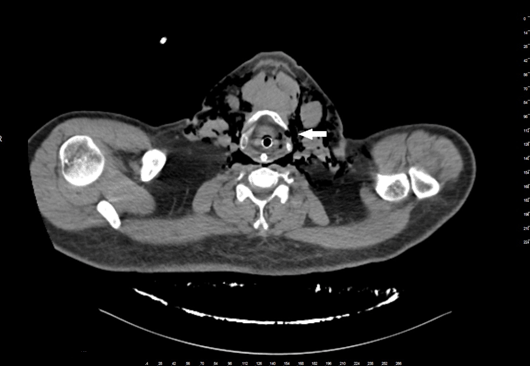
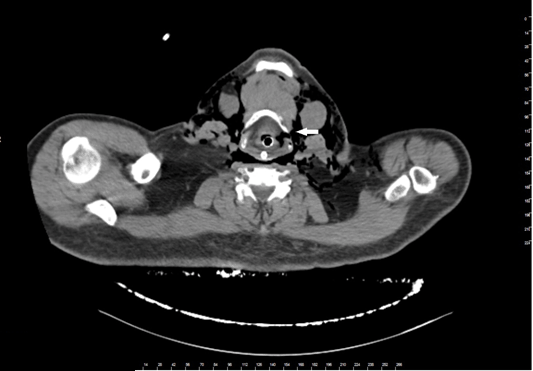
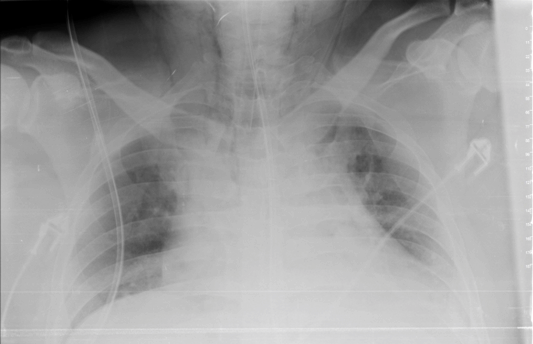
A 46-year-old male with the American Society of Anesthesiologists (ASA) Class II patient was admitted for uvuloplasty and evaluated before surgery. His medical history revealed diabetes mellitus with a smoking history of seven pack-years. His Mallampati score was II, neck movements were intact, and mouth opening was 5 cm. The patient was scheduled for uvuloplasty procedure due to obstructive sleep apnea syndrome (OSAS) by the ear, nose, and throat (ENT) specialist. At baseline, his blood pressure was 150/95 mmHg, pulse rate was 85 bpm, and oxygen saturation was 93%. The body mass index was 34.7 kg/m2 and his ideal body weight was 84 kg. A written informed consent was obtained from the patient. Midazolam 2 mg was used in premedication, and anesthesia was induced with thiopental 500 mg, rocuronium bromide 60 mg, and remifentanil 60 µg. The patient was intubated at the second attempt using direct laryngoscope and a bougie. Respiratory sounds were equal bilaterally after intubation and harsh in the left upper zone, particularly. The anesthesia was maintained with sevoflurane 2% and remifentanil infusion with a starting dose of 0.125 µg/kg/min. Tidal volume was set to 475 mL and respiratory rate was set to 16/min on mechanical ventilator. Blood pressure ranged from 110/80 to 130/90, pulse rate was 70–75 bpm, end-tidal CO2 was 33–34 mmHg, and oxygen saturation was 96–98%. Peak pressures had an elevated course after intubation. There were also harsh bilateral respiratory sounds on auscultation during inspiration and expiration in the right hemithorax, particularly. Harsh sounds were considered to be caused by bronchoconstriction for which the patient was administered as an intravenous bolus dose of methylprednisolone 250 mg and H2 receptor blocker, and aminophylline 240 mg for an half an hour infusion. Respiratory sounds during control examination at 45 min improved, and the procedure continued for three hours. The patient was administered sugammadex sodium 200 mg to reverse the effects of muscle relaxant, and the patient was extubated without any complication once he re-gained his muscle strength and consciousness. The patient was transferred to the post-anesthesia care unit and he was administered anti-edema therapy including cold vapor and subcutaneous adrenalin due to hoarseness and mild stridor which were considered to be due to mild edema in the upper airway. Edema resolved at 45 min of follow-up and swelling occurred in the right eye which spread to the whole face within 10 min. There was crepitation on palpation and the patient was re-intubated without any difficulty using a video-assisted laryngoscope to investigate the cause of subcutaneous emphysema. Fiberoptic examination performed by an ENT specialist revealed a 0.5-cm rupture in the cricothyroid membrane and mechanical ventilator support was considered to be appropriate due to risk of upper airway obstruction. On the day of admission to intensive care unit, computed tomography scan revealed free air under the skin and between muscle planes of the submandibular and supraclavicular areas and also around the larynx and trachea in the mediastinum and intraluminal air of the left lateral wall of trachea following the cricoid cartilage extending linearly to the emphysema site at the left side of the neck (Figure 1) (Figure 2) (Figure 3). The fistula line was thought to be the left lateral wall following the cricoid cartilage and the two bronchi were found to be normal. Mediastinum was enlarged on chest X-ray and there was an increase in radiolucency due to emphysema in the subcutaneous and soft tissue (Figure 4). The patient was hospitalized for spontaneous recovery and he remained intubated for soft tissue repair and wound healing for two days. On day-3, the endotracheal tube was removed and no difficulty or complication was seen during follow-up. The patient was discharged with full recovery in the postoperative first week. | ||||||
| ||||||
| ||||||
| ||||||
| ||||||
|
DISCUSSION
| ||||||
|
Difficulties during airway management and intubation can be encountered in obese patients. The risk of intubation difficulty is two-fold higher in the obese patients [4]. Fat deposition around the neck and large tongue in obese patients complicate laryngoscopic view and intubation [5]. It is three times more difficult to perform mask ventilation in patients with a BMI of >26 kg/m2 [6]. Preoxygenation is less effective in these patients than normal-weight patients due to reduced expiratory reserve volume (ERV), and the fact that ERV is the primary back-up oxygen source during apnea [7]. In such cases, 25° head-up position and continuous positive airway pressure can be used for an effective preoxygenation [8]. To facilitate intubation with a laryngoscope, head can be placed in the ramp position by placing a pad under the patient’s head [9]. Difficult airway equipment including a laryngeal mask airway and fiberoptic bronchoscope must be kept available due to risk of intubation difficulty [10]. The use of stylet/guidewire or bougie intubation in Grade 2–3 views of larynx provides 90% success rate in the management of a difficult airway using direct laryngoscopy [11]. These instruments are chosen due to their low cost and complication rate and ease of use. The tube is blindly inserted into the trachea or using the Seldinger technique using the tracheal click or distal hold-up signs [12]. The endotracheal tube is, then, slided over the bougie, which is removed after accurate positioning of the tube [13]. Advancing the bougie into the bronchi produces hold-up signs, which bring the risk of possible perforation or trauma [14]. Trauma has been mostly reported with disposable bougies [15][16][17]. Even 0.8 Newton power has been reported to be sufficient to induce a trauma [16]. While the bougie is placed in the trachea, intubation without withdrawing the laryngoscope increases the chance of intubation [18]. Bougies or stylets need to be pre-shaped under the guidance of a video-assisted laryngoscope [19]. The tube must be advanced to the oropharynx under direct vision to reduce the chance of trauma [20]. As blind advancement of the bougie causes trauma, it is not recommended in patients with Grade 3b and 4b views of larynx, in particular [21]. Trauma is rare with bougies and is always associated with intubation difficulty [22]. Most bougie-related complications, particularly perforations, occur during aggressive placement or pushing the tube against resistance, while sliding the tube over the bougie [23]. In addition, such complications can be related to proximal airways at a lesser extent. There are also reports of pharyngeal perforation [24], bleeding in the right main bronchus [25], laceration in the posterior tracheal mucosa below glottis [26], and tracheal abrasion diagnosed with hemopneumothorax on chest X-ray [27]. In the present case, there was a fistula tract extending from the cricoid cartilage to the left lateral wall of the trachea. Furthermore, disposable bougies were manufactured in 1997 due to risk of infection [28]. Reusable bougies are coated with polyester-based resin, while disposable bougies are coated with plastic. Therefore, sliding the tube over the bougie may cause resistance, if not lubricated. Zwall and Gupta [29] reported a failed attempt of advancing endotracheal tube over the disposable bougie without using lubricant. Manufacturers also recommend the use of lubricants [30]. It has been previously described that applying lubrication on the bougie moving it forward cautiously and drawing the bougie slightly by several centimeters or stabilizing it with the assistance of other clinical staff during tracheal intubation may help prevent bougies from causing airway injuries [16]. In the present case, we were alert for a difficult intubation, as he was obese, however, intubation with a bougie was attempted due to Grade 2–3 view of larynx under direct laryngoscopy. The use of lubricant facilitated sliding the tube over bougie; however, injury occurred due to excessive force on the bougie. In addition, emphysema developed at 45 min of follow-up and, therefore, we suspected that the patient had suffered an airway injury from the bougie. | ||||||
|
CONCLUSION
| ||||||
|
In conclusion, given the possibility of such bougie-related injuries, long-term postoperative follow-up is of utmost importance for patients in whom intubation is difficult with bougies with several attempts. | ||||||
|
REFERENCES
| ||||||
| ||||||
|
[HTML Abstract]
[PDF Full Text]
|
|
Author Contributions
Ayça Tuba Dumanli Özcan – Substantial contributions to conception and design, Acquisition of data, Analysis and interpretation of data, Drafting the article, Revising it critically for important intellectual content, Final approval of the version to be published Cemile Altin Balci – Analysis and interpretation of data, Revising it critically for important intellectual content, Final approval of the version to be published Semsi Mustafa Aksoy – Analysis and interpretation of data, Revising it critically for important intellectual content, Final approval of the version to be published Gökçer Ugur – Analysis and interpretation of data, Revising it critically for important intellectual content, Final approval of the version to be published Orhan Kanbak – Analysis and interpretation of data, Revising it critically for important intellectual content, Final approval of the version to be published Togay Müderrris – Analysis and interpretation of data, Revising it critically for important intellectual content, Final approval of the version to be published |
|
Guarantor
The corresponding author is the guarantor of submission. |
|
Source of support
None |
|
Conflict of interest
Authors declare no conflict of interest. |
|
Copyright
© 2017 Ayça Tuba Dumanli Özcan et al. This article is distributed under the terms of Creative Commons Attribution License which permits unrestricted use, distribution and reproduction in any medium provided the original author(s) and original publisher are properly credited. Please see the copyright policy on the journal website for more information. |
|
|