|
Article ID: Z01201706LE10027IS doi:10.5348/ijcri-201711-LE-10027 | ||||
|
Address correspondence to: Ingo Schmidt SRH Poliklinik Gera GmbH, Straße des Friedens 122 07548, Gera (Germany) |
|


[Similar article in Pumed] [Similar article in Google Scholar]

|
Letters to the Editor
| ||||||
| Kienböck’s disease mimicing gouty monoarthritis of the wrist | ||||||
| Ingo Schmidt | ||||||
|
SRH Poliklinik Gera GmbH, Straße des Friedens 122, 07548 Gera, Germany
| ||||||
| ||||||
|
[HTML Abstract]
[PDF Full Text]
[Print This Article] [Similar article in Pumed] [Similar article in Google Scholar]
|
| How to cite this article |
| Schmidt I. Kienböck’s disease mimicing gouty monoarthritis of the wrist. Int J Case Rep Images 2017;8(6):423–426. |
|
To the Editors,
|
|
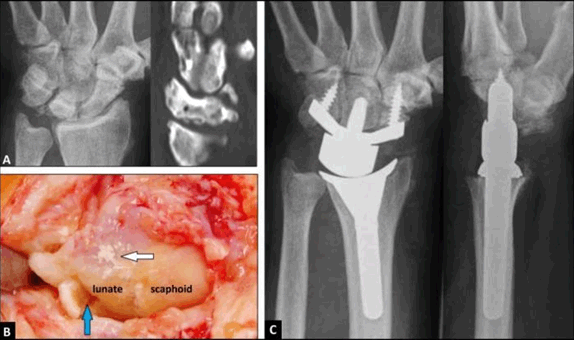
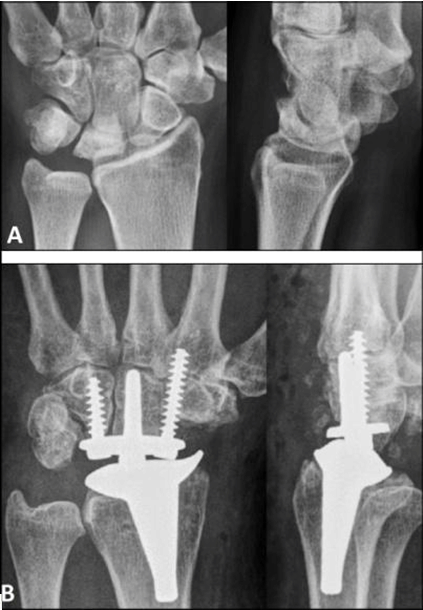
A 57-year-old male presented with increasing pain and swelling in his left wrist over a period of two years. There was no history of any trauma, and additionally, a systemic inflammatory disease was unknown to the patient. On examination, there were no inflammatory clinical signs locally, and all (non-)specific serum inflammatory markers (including uric acid) were not increased. With the use of radiographs and computed tomography (CT) scans, an advanced stage of Kienböck’s disease with peripheral stress fractures of the lunate bone and secondary arthritic signs of articular surface in the lunate fossa was primarily diagnosed (Figure 1A), that was confirmed by the radiologist as stage IIIB in magnetic resonance imaging. The motion-preserving total wrist arthroplasty (TWA) using the relatively new angle-stable Maestro™ Wrist Reconstructive System (WRS, Biomet, Warsaw, Indiana / USA) was indicated. Intraoperatively, there were multiple calcification deposits on and around the lunate, associated with the primarily diagnosed peripheral ‘stress fractures’ of the lunate (Figure 1B). Gouty monoarthritis of the wrist involving the lunate was confirmed on histological examination by the pathologist. Two years postoperatively, there was unchanged correct positioning of TWA without any signs of loosening or subsidence (Figure 1C). Pain in visual analogue score (0-10 points) and function in patient-rated wrist evaluation score (0–100 points) with 8 and 73 preoperatively had improved to 2 and 19. The patient reported that he would have the same procedure again if it would be necessary. Kienböck’s disease is defined as avascular osteonecrosis of part or all of the lunate, which progresses through several stages if not treated or treated with preservation of the lunate [1][2]. It was first described in 1843 by Peste [3]; and in 1910, Kienböck [4] was the first who recommended to use the term lunatomalacia, and correctly hypothesized that the disease was precipitated by an interruption of the nutrition of the bone as a result of a traumatic insult. However, the etiology is still widely unknown, and many risk factors are discussed such as anatomical features (shape of lunate or distal radius, difference between distal end of radius and ulna, coverage of lunate by radius, arterial factors) and/or repetitive microtrauma potentially leading to subchondral stress fracture [1][5]. Lichtman et al. [6] introduced in 1977 a modified classification with four broad stages which remains the most commonly used today, and stage IIIB, such as in our primarily suggested diagnosis in case presentation, is associated with lunate collapse and fixed scaphoid rotation. The secondary effects of the collapsing lunate are ‘compromised’ wrists including deformity and collapse of the central column, degeneration of the perilunate articulations, proximal row instability, and degeneration of the radial column [5]. For surgical treatment of stage IIIB, the preferred procedures are proximal row carpectomy with a portion ranging from 42–62%, followed by intercarpal fusions with a portion ranging from 11–19%, total wrist fusion with a portion ranging from 2–16%, radial shortening osteotomy with a portion of 12%, vascularized bone grafting with a portion of 6%, trial of splinting with a portion of 4%, and lunate arthroplasty with a portion of 1% [7][8]. An option for surgical treatment of stage IIIA (lunate collapse without scaphoid rotation) is callotasis lengthening of the capitate bone [9]. Another option for treatment of advanced stage of Kienböck’s disease is motion-preserving TWA (Figure 2A– B)with a portion of 2% of all TWAs performed by surgeons who have published their experiences with this procedure [10], and the relatively new angle-stable MaestroTM WRS that was used in our case presentation, is one of the modern biaxial-anatomical third generation type that is currently in use [11][12][13][14]. Gout (i.e., hyperuricemia) is a systemic disease often firstly presented as a monoarthritis. Its prevalence in western population was reported to be 1.4% in the 90th, associated with a overall male-to-female ratio of 3.6:1, and the prevalence peaked in men between the ages of 75 and 84 years (7.3%), while in women its prevalence continued to rise beyond the age of 85 years (being about 2.8%) [15][16]. Gouty monoarthritis, caused by crystal induced synovitis, is usually associated with agonizing pain, swelling, erythema, warmth, tenderness of the affected joint, fever and increased (non-)specific serum inflammatory markers [17], however, these local and/or systemic inflammatory clinical signs were not all present in our case presentation preoperatively. Such as in our case presentation, it can be a diagnostic challenge in the wrist if gout is unknown in the history and only pain and swelling are present preoperatively[17]. When gouty arthritis of wrist and hand is primarily diagnosed, 5% of patients may not respond to medical treatment and surgical treatment become necessary [16]. In literature, it has been reported only in few cases that Kienböck’s disease can mimic a giant cell tumor of the lunate preoperatively [18], and the preoperative finding of scapholunate ligament disruption with or without erosions of carpal bones also can mimic a gouty monoarthritis of the wrist [19][20] [21]. Additionally, first presentation of gouty arthritis of the wrist can be in 0.6% of cases a carpal tunnel syndrome [22]. |
|
|
|
Keywords:Gouty monoarthritis wrist, Kienböck’s disease, Total wrist arthroplasty |
|
REFERENCES
|
|
|
[HTML Abstract]
[PDF Full Text]
|
|
Author Contributions
Ingo Schmidt – Substantial contributions to conception and design, Acquisition of data, Analysis and interpretation of data, Drafting the article, Revising it critically for important intellectual content, Final approval of the version to be published |
|
Guarantor
The corresponding author is the guarantor of submission. |
|
Source of support
None |
|
Conflict of interest
Authors declare no conflict of interest. |
|
Copyright
© 2017 Ingo Schmidt. This article is distributed under the terms of Creative Commons Attribution License which permits unrestricted use, distribution and reproduction in any medium provided the original author(s) and original publisher are properly credited. Please see the copyright policy on the journal website for more information. |
|
|
|
About the Author
| |||
| |||
|
|