
  |

|
 |
|
Case Report
| ||||||
| Complete urogenital and colonic duplication: An extremely rare developmental anomaly in an adult female | ||||||
| Aarti Deenadayal Tolani1, Deenadayal Mamta2, Kadambari3, Nori Vijay Bhasker4 | ||||||
|
1M.S, Infertility specialist and embryologist, Infertility Institute and Research Centre, Hyderabad, Telangana, India
2MD, DGO, Clinical director, Infertility Institute and Research Centre, Hyderabad, Telangana, India 3MD, DGO, FICOG, Obstetrician and Gynaecologist, Micro surgeon, Infertility Institute and Research Centre, Hyderabad, Telangana, India 4MD, Chief Radiologist, Vista imaging centre, Hyderabad, Telangana, India | ||||||
| ||||||
|
[HTML Abstract]
[PDF Full Text]
[Print This Article]
[Similar article in Pumed] [Similar article in Google Scholar] 
|


| How to cite this article |
| Tolani AD, Mamta D, Kadambari, Bhasker NV. Complete urogenital and colonic duplication: An extremely rare developmental anomaly in an adult female. Int J Case Rep Images 2017;8(5):344–347. |
|
ABSTRACT
|
|
Introduction:Complete urogenital duplication is an extremely rare congenital syndrome, where the etiology is unambiguously not explained. Misexpression of certain genes and teratogenic factors are presumed to have a prominent effect on duplications and malformations at various stages during embryogenesis. Several cases have been reported on gastrointestinal and genitourinary duplication. However, no two cases described in literature are alike and they differ with the level of duplication and the associated anomalies. Interestingly, most of the cases reported are at infancy and adult caudal duplication syndrome (CDS) cases are exceptional. Herein, we report a case of a 36-year-old unmarried female with duplication of external genitalia associated with duplication of the genitourinary and colonic system. Imaging revealed associated skeletal and spinal anomalies. Patient did not have any reconstruction surgeries previously and consulted us regarding the possibility of intercourse and fertility. The extent of urogenital duplication and associated anomalies was delineated with help of X-ray, abdominal and trans-perennial ultrasound and magnetic resonance imaging (MRI).
Keywords: Caudal duplication syndrome (CDS), Developmental anomalies, Duplication of external genitalia, Genitourinary and colonic duplication |
|
INTRODUCTION
|
|
Caudal duplication syndrome (CDS) is a very rare congenital abnormality that is associated with duplication and malformation of caudal structures comprising of the spine, the spinal cord, gastrointestinal and urogenital systems [1]. The etiology of CDS is not completely understood. However, it is assumed that misexpression of HOX genes encoding for the transcription factors that regulate the developmental process may have a prominent role in it [2]. The prevalence of this syndrome is less than 1 in 100,000 births and adulthood CDS reports are extremely rare. In this article, we present an adult female with caudal duplication syndrome. |
|
CASE REPORT
|
|
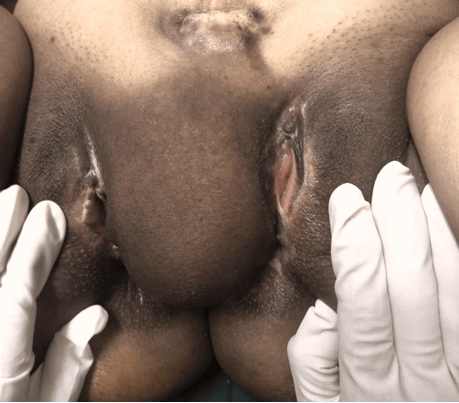
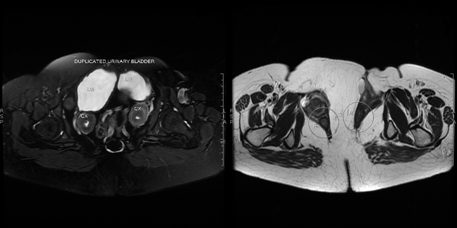
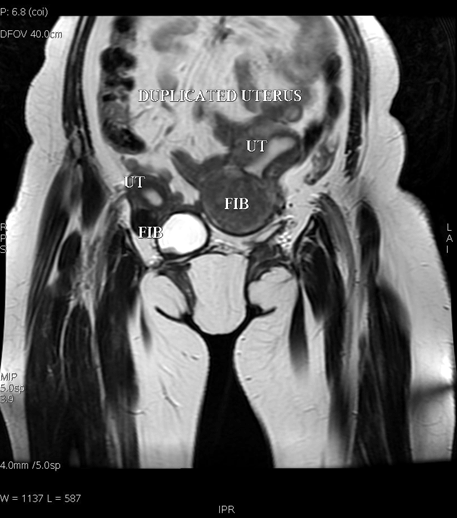
A 36-year old unmarried woman approached our clinic for evaluation of external genital malformation and possibility of intercourse in the future. A detailed physical examination revealed a double vulva with a 15-cm intervening area comprising of a pad of fat covered by hairless skin. Each vulva had pubic hair, a separate clitoris, urethra, vagina and anal orifice (Figure 1). The patient gave a history of passing two separate streams of urine during micturition, dual passage of feces from both anal orifices and menstruating through both the vaginas. She had an absent pubic symphysis and a non-surgical irregular scar on her lower abdomen (Figure 1) and there was no umbilicus. Trans-abdominal pelvic sonography showed the presence of two separate bladders, two uteri and multiple follicles in both the ovaries. Two kidneys and two ureters along with colonic duplication with two separate rectums were observed. Normal levels of FSH, TSH and prolactin were noted during the blood workup. Renal function test was normal. |
| ||||||
| ||||||
| ||||||
|
DISCUSSION
| ||||||
|
Caudal duplication syndrome typically consists of a combination of several rare malformations and duplications of the distal organs derived from the hindgut, neural tube and caudal mesoderm. Although the specific reasons for caudal duplication are not well-known, it is presumed that an incomplete separation of monovular twins would be the one of the reasons. It is also believed that the impact of genetic, environmental and teratogenic factors influence the duplication of the embryonic cloaca and notochord at various levels during embryogenesis. Even though caudal duplication syndrome is a rare condition, majority of the cases reported are soon after the birth. Reports on asymptomatic urogenital duplication in adulthood are uncommon. Early detection of malformation and duplication of organs may increase the chances of successful corrections, especially in cases of urogeneital duplications. A study by Greenberg et al. (1997) [3] showed successful vaginal delivery of a patient where the cloacal malformation was repaired at infant stage. Very few cases of complete urogenital duplication in an adult are reported all around the world till date [4]. In this repot, we presented a 36-year-old unmarried female with non-symptomatic complete external and internal duplication of the urogenital system with fibroids developing in both the uterus. We delineated the extent of the colonic, genitourinary and skeletal anomalies by using multimodal imaging. Duplication of the external genitalia in this particular case is highly unique with internal urogenital doubling and skeletal anomalies. While reconstructive genitourinary surgeries are performed to prevent complication and address the fertility. In this particular case, although the reproductive physiology, menstruation and gonadotropin levels are normal, due to the abnormal urogenital anatomy it is difficult to anticipate normal coitus. However, there has been case report published of successful cesarean delivery of an adult woman with duplication of the urogenital system [5][6]. As the fibroids are asymptomatic patient was not advised any treatment. Since both the uterus has fibroids, this case raises the interesting possibilities of an association of the development of fibroids in anomalous uterus. | ||||||
|
CONCLUSION
| ||||||
|
It is beneficial to diagnose of malformations and duplications of caudal structures in infancy to allow possible early surgical correction. Improved non-invasive imaging as seen here has opened an era of new possibilities for diagnosing, delineating and monitoring such complex anomalies both in childhood and adulthood for better treatment strategies in the future. | ||||||
|
REFERENCES
| ||||||
| ||||||

|
[HTML Abstract]
[PDF Full Text]
|
|
Acknowledgements
We would like to acknowledge Suhasini Donthi for her assistance in draft preparation. We acknowledge the technicians at IIRC and Vista imaging technologies for their assistance |
|
Author Contributions
Aarthi Deenadayal Tolani – Substantial contributions to conception and design, Acquisition of data, Analysis and interpretation of data, Drafting the article, Revising it critically for important intellectual content, Final approval of the version to be published Dr. Mamta Deenadayal – Substantial contributions to conception and design, Acquisition of data, Analysis and interpretation of data, Revising it critically for important intellectual content, Final approval of the version to be published Kadambari – Substantial contributions to conception and design, Drafting the article, Revising it critically for important intellectual content, Final approval of the version to be published Vijay Bhasker – Substantial contributions to conception and design, Acquisition of data, Analysis and interpretation of data, Revising it critically for important intellectual content, Final approval of the version to be published |
|
Guarantor
The corresponding author is the guarantor of submission. |
|
Source of support
None |
|
Conflict of interest
Authors declare no conflict of interest. |
|
Copyright
© 2017 Aarthi Deenadayal Tolani et al. This article is distributed under the terms of Creative Commons Attribution License which permits unrestricted use, distribution and reproduction in any medium provided the original author(s) and original publisher are properly credited. Please see the copyright policy on the journal website for more information. |
|
|