| |
|
|
|
Case Report
| ||||||
| Pseudo-Meigs syndrome: A case report | ||||||
| Divya Kallarackal1, Dharampal Singh2 | ||||||
|
1MS OBGY, Consultant Gynaecologist, Department of Obstetrics and Gynaecology, Lethsolathebe II Memorial Hospital, Maun, Botswana
2MD Anaesthesiology, Consultant Anaesthesiologist, Department of Anaesthesiology, Lethsolathebe II Memorial, Hospital, Maun, Botswana | ||||||
| ||||||
|
[HTML Abstract]
[PDF Full Text]
[Print This Article]
[Similar article in Pumed] [Similar article in Google Scholar] 
|
| How to cite this article |
| Kallarackal D, Singh D. Pseudo-Meigs syndrome: A case report. Int J Case Rep Images 2017;8(5):331–334. |
|
ABSTRACT
| |||||||||||||||||||||||||||||||||||
|
Introduction:Meigs syndrome and pseudo-Meigs syndrome both presents with hydrothorax and ascites. Meigs syndrome is characteristically associated with ovarian fibroma whereas pseudo-Meigs syndrome is associated with any ovarian or pelvic tumors, other than ovarian fibroma. Case Report: A 48-year-old perimenopausal woman presented with a long history of 8–10 years of abdominal distension. Her examination revealed a right pleural effusion, massive ascites and large heterogeneous pelvic tumor, measuring 42x31 cm. After a preoperative ascitic tapping, the patient underwent an exploratory laparotomy with excision of the tumor, uterus and the right ovary. The tumor was diagnosed histologically as an ovarian mucinous cystadenoma. The postoperative resolution of hydrothorax and ascites confirmed the diagnosis of pseudo-Meigs syndrome. The patient remains in good condition 12 months after surgery. Conclusion: pseudo-Meigs syndrome being a rare syndrome, with a good prognosis should be included in differential diagnosis in women presenting with unexplained hydrothorax and ascites. Keywords: Ascites, Hydrothorax, Ovarian tumor, Pseudo-Meigs syndrome | |||||||||||||||||||||||||||||||||||
|
INTRODUCTION
| |||||||||||||||||||||||||||||||||||
|
Meigs syndrome is a rare condition, defined as the co-existence of benign ovarian fibroma, pleural effusion and ascites. While, pseudo-Meigs syndrome is characterized by the co-existence of pleural effusion, ascites and other ovarian or pelvic tumors. It was Meigs and Cass who brought out the significance of pleural effusion and ascites in ovarian fibroma. These syndromes should be considered in otherwise healthy postmenopausal women, who present with either hydrothorax or ascites. For both these syndromes, surgical resection of the tumor is the only therapeutic choice, resulting in resolution of fluid accumulations [1]. | |||||||||||||||||||||||||||||||||||
|
CASE REPORT
| |||||||||||||||||||||||||||||||||||
|
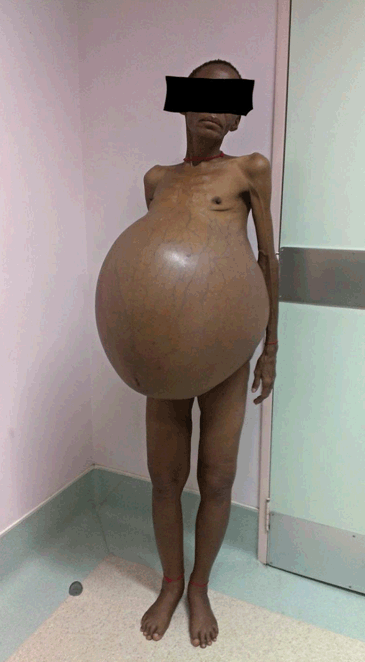
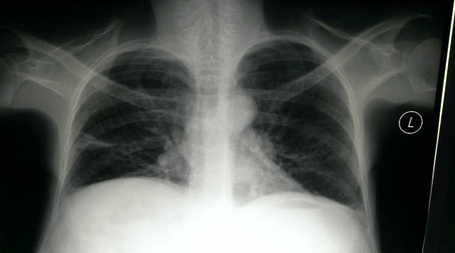
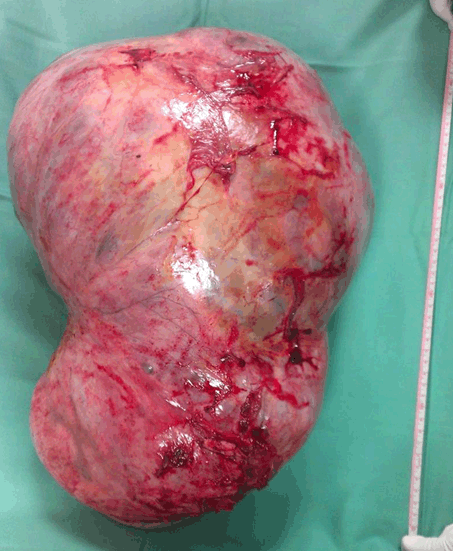
A 48-year-old perimenopausal woman came with history of abdominal distension since last 8–10 years, difficulty in breathing with increasing intensity over the past few months. She became very uncomfortable in supine position. She had no medical or surgical history of note. She is para 3 with uneventful vaginal deliveries. She took no regular medication and had no family medical history of note (Figure 1). Auscultation revealed absence of breath sounds at the right lower hemithorax and normal heart sounds. On abdominal examination massive ascites was noted. The mass was not palpable because of the tense ascites. Chest X-ray revealed mild right sided pleural effusion (Figure 2). Electrocardiography was within normal limits. On ultrasound of abdomen, a massive multi septate cystic mass with suspected ovarian origin, with massive ascites was noted. Computed tomography scan revealed a huge multiseptate mass with solid and cystic components measuring 42x31 cm arising from the pelvis. Left side ovary was not visualized and uterus was normal sized. Massive ascites was noted. No obvious lymphadenopathy was seen. Her serum CA 125 was 49 U/ml (normal <35U/ml). AFP was within normal limits while b-hCG was not detectable. Her serum proteins were slightly below normal. Routine blood investigations, including LFT’s and RFT’s were within normal limits. Ascitic tap fluid cytology revealed low cellular fluid comprising of lymphocytes and mesothelial cells. No evidence of malignancy was noted. A preoperative diagnosis of left ovarian tumor was made and nearly 6 L of ascitic fluid was drained in two settings in ward three days before surgery and the day before surgery. In operation theatre, under epidural anesthesia, a wide bore silicone catheter was inserted and nearly 18 L of ascitic fluid was tapped slowly over a period of 60 minutes in lateral position. Then in supine position, through a midline incision from pubic symphysis to 2 cm above umbilicus, a mass measuring 42x31 cm, weighing 9 kg was removed, originating from left ovary. There was no any evidence of metastasis or lymphadenopathy. Omental and peritoneal biopsy were taken. Hysterectomy with bilateral salpingo-oophorectomy was done. Grossly uterus with cervix measured 9x6 cm, right ovary measured 2.5x1.3 cm, both unremarkable (Figure 3). On histopathology report, the mass was diagnosed as an ovarian mucinous cystadenoma. The pleural effusion resolved by postoperative day-10. The patient remains in good condition 12 months after surgery.
| |||||||||||||||||||||||||||||||||||