
 |

|
 |
|
Clinical Images
| ||||||
| Acute thyromegaly in Hashimoto’s thyroiditis mimicking lymphoma | ||||||
| Derick Adams | ||||||
|
D.O, Assistant Professor of Medicine, Department of Internal Medicine, Division of Endocrinology, University of Kentucky, Lexington, Kentucky, United States
| ||||||
| ||||||
|
[HTML Abstract]
[PDF Full Text]
[Print This Article]
[Similar article in Pumed] [Similar article in Google Scholar] 
|


| How to cite this article |
| Adams D. Acute thyromegaly in Hashimoto’s thyroiditis mimicking lymphoma. Int J Case Rep Images 2017;8(5):355–357. |
|
CASE REPORT
| ||||||
|
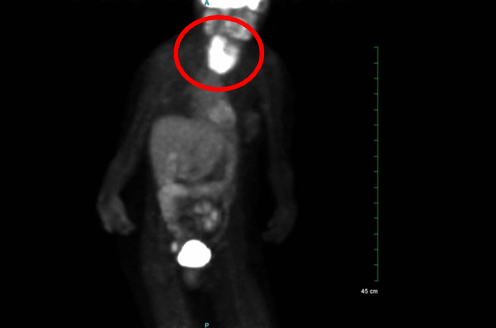
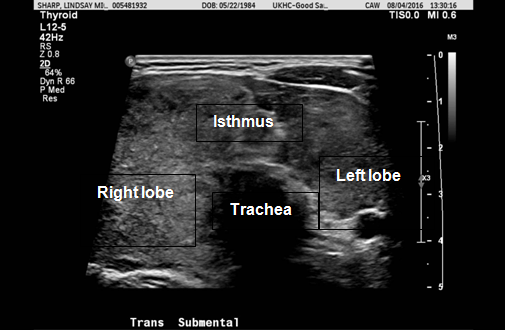
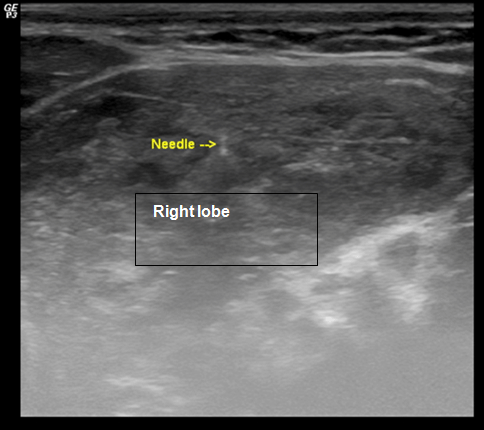
A 32-year-old female with a history of Hodgkin’s lymphoma presented with a two week history of thyromegaly. Hodgkin’s lymphoma was diagnosed at the age of 29 years and was treated with two cycles of ABVD (doxorubicin, bleomycin, vinblastine, and dacarbazine) chemotherapy and radiation therapy which was 2000 cGy in 10 fractions to the left lower cervical and supraclavicular nodal regions. One year after her diagnosis of lymphoma, she was considered to be in remission. She was also diagnosed with hypothyroidism with elevated anti-thyroid peroxidase antibody levels at the age of 29 years and treated with levothyroxine. At the age of 32 years , she developed thyromegaly causing dysphagia and hoarseness over a two-week interval. Physical examination revealed thyromegaly but no cervical lymphadenopathy. Due to her history of lymphoma positron emission tomography (PET) imaging was performed and demonstrated increased, diffuse fluorodeoxyglucose (FDG) uptake in the thyroid with right lobe being larger than the left (Figure 1). Ultrasound was also performed and showed thyromegaly especially on the right side but no thyroid nodules (Figure 2). Fine needle aspiration (FNA) of the right lobe was performed with flow cytometry of the needle washings (Figure 3). Flow cytometry of the needle washings did not show any clonal or aberrant populations of lymphocytes making lymphoma unlikely. Cytologic examination showed a background of lymphocytes and lymphoid stroma consistent with Hashimoto’s thyroiditis. Over the next two months the patient’s thyromegaly, dysphagia, and hoarseness gradually resolved. She continued to be treated with levothyroxine for her hypothyroidism related to Hashimoto’s thyroiditis. | ||||||
| ||||||
| ||||||
| ||||||
|
DISCUSSION
| ||||||
|
This case illustrates how an atypical presentation of Hashimoto’s thyroiditis can mimic thyroid lymphoma. Lymphoma of the thyroid classically presents as the acute onset of significant thyromegaly often with dysphagia or hoarseness. The risk of lymphoma of the thyroid is also increased by a factor of 67 in patients with Hashimoto’s thyroiditis [1]. Clinicians should be aware that Hashimoto’s thyroiditis may also present as acute thyromegaly. Due to this patients past history of lymphoma PET imaging was performed. Given the widespread use of PET imaging in some countries, clinicians should also be aware that up to 9% of patients with Hashimoto’s thyroiditis can also have diffuse FDG uptake of the thyroid [2]. Therefore, FDG uptake in the thyroid must be interpreted with caution because this finding can represent both a benign and malignant process. | ||||||
|
CONCLUSION
| ||||||
|
Hashimoto’s thyroiditis may result in acute thyromegaly and increased fluorodeoxyglucose uptake on positron emission tomography imaging which may mimic the presentation of lymphoma of the thyroid. Fine needle aspiration of the thyroid with flow cytometry of needle washings can be used to distinguish lymphoma of the thyroid from Hashimoto’s thyroiditis. | ||||||
|
REFERENCES
| ||||||
| ||||||

|
[HTML Abstract]
[PDF Full Text]
|
|
Author Contributions
Derick Adams ” Substantial contributions to conception and design, Acquisition of data, Analysis and interpretation of data, Drafting the article, Revising it critically for important intellectual content, Final approval of the version to be published |
|
Guarantor
The corresponding author is the guarantor of submission. |
|
Source of support
None |
|
Conflict of interest
Authors declare no conflict of interest. |
|
Copyright
© 2017 Derick Adams et al. This article is distributed under the terms of Creative Commons Attribution License which permits unrestricted use, distribution and reproduction in any medium provided the original author(s) and original publisher are properly credited. Please see the copyright policy on the journal website for more information. |
|
|