| |
|
|
|
Letters to the Editor
| ||||||
| A 20-year follow-up after replantation of the right midfoot in an eight-year-old child | ||||||
| Ingo Schmidt | ||||||
|
SRH Poliklinik Gera GmbH, Straße des Friedens 122, 07548 Gera (Germany)
| ||||||
| ||||||
|
[HTML Abstract]
[PDF Full Text]
[Print This Article]
[Similar article in Pumed] [Similar article in Google Scholar] |
| How to cite this article |
| Schmidt I. A 20-year follow-up after replantation of the right midfoot in an eight-year-old child. Int J Case Rep Images 2017;8(4):292–294. |
| To the Editors, | ||||||
|
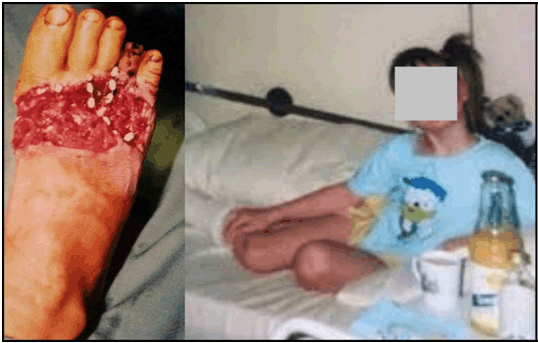
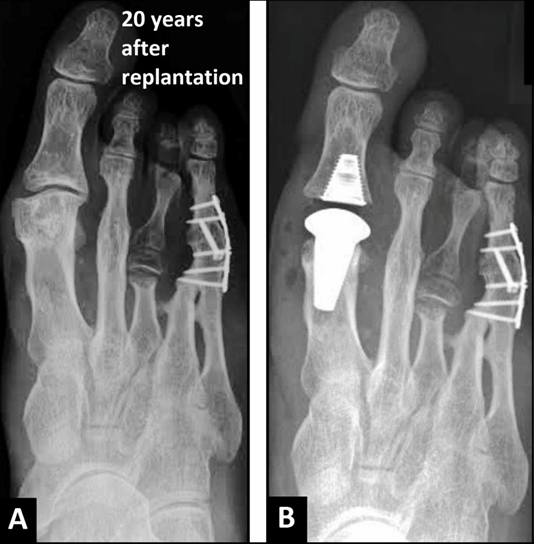
An eight-year-old girl sustained a traumatic amputation of her right foot in the metatarsal level due to a crush injury with an agriculture machine. The midfoot was replanted that was associated with distinctive debridements of soft tissue and metatarsal bones II–IV followed by temporary bony stabilization with the use of Kirschner wires. After that, multiple soft-tissue debridements on the dorsal aspect of midfoot were required (Figure 1), and the soft tissue defect was finally covered with split-thickness skin grafts. Four weeks after replantation, the fourth toe had to be surgically amputated due to a progredient avascular necrosis. Six months after replantation, the medial column of foot was stabilized with reconstruction of the second metatarsal bone loss using a 5-cm long non-vascularized autologous fibular graft that was subperiosteally harvested from her right distal lower leg. The defect of donor site showed completely bony regeneration six months after harvesting, and the fibular graft was completely osseointegrated (Figure 2). Due to a progredient deviation of the fifth toe in medial direction, a fusion of the fifth metatarsophalangeal joint with use of a 2.0 mm titanium compression screw and a 2-mm titanium plate (Synthes) was required seven years after replantation, and the fusion was completely unioned without any complications (Figure 2A). Twenty years after replantation, a distinctive painful posttraumatic osteoarthritis of the first metatarsophalangeal joint was present, and a total joint replacement using the non-cemented TOEFIT-PLUSTM implant (Smith & Nephew) was performed (Figure 2B). Finally, despite posttraumatic decrease in length of the right foot due to growth disturbance there was a good functional and aesthetic result (Figure 3A), and the 28-year-old female is able to perform high-demand activities such as rock walking and alpine skiing in her leisure (Figure 3A). Traumatic amputation injuries of the foot represent a challenging problem, and the success of replantation depends on duration of ischemia, microsurgical expertise, and quality in management of soft tissue complications in the presence of severe crushed wounds[1][2]. In literature, only some case reports could be found in which successful replantations of the forefoot in adults or children have been described [3][4]. In children, replantation of traumatically amputated forefoot should be always tried because the functional loss is low due to the extrinsically-related retaining of ankle functionality. The main problem after forefoot replantations in children is development of growth disturbance resulting in decrease of foot length that was observed in nearly all reported cases, however, this complication is well tolerated. To our knowledge, this is the first case report that describes a successful midfoot replantation in a child with a 20-year follow-up. The use of non-vascularized autologous fibular grafts for reconstruction of bony defects was first reported in 1911 [5], and has proven to be a suitable and reliable option. The main advantage is that this procedure does not need microsurgical expertise. It is important that during fibular harvest, the proximal and distal 5 cm are preserved to prevent injury to the common peroneal nerve and to retain the stability of the ankle joint [6][7], and bony defects with an average length of 7 cm and maximum length up to 15 cm can be reconstructed [8][9]. When the fibular graft is harvested subperiosteally in children, complete bony regeneration of the donor site is always observed [10]. For treatment of metatarsophalangeal joint osteoarthritis, total joint replacement is the motion-preserving alternative to total joint fusion. The non-cemented TOEFIT-PLUSTM is one implant that is currently in use, but still controversial, and should be indicated restrictively in particular in cases when first ray insufficiency is present [11]. When using this implant, it must be noted that there is high surgical revision rate with 24% at a mean of 33 months postoperatively [12]. For failed metatarsophalangeal joint replacement, metatarsophalangeal joint fusion or an excisional arthroplasty are the salvage options [13]. | ||||||
| ||||||
|
| ||||||
|
| ||||||
|
Keywords: Metatarsophalangeal joint osteoarthritis, Non-vascularized autologous fibular bone graft, Replantation, Total joint replacement, Traumatic midfoot amputation | ||||||
|
References
| ||||||
| ||||||
|
[HTML Abstract]
[PDF Full Text]
|
|
Author Contributions
Ingo Schmidt – Substantial contributions to conception and design, Acquisition of data, Analysis and interpretation of data, Drafting the article, Revising it critically for important intellectual content, Final approval of the version to be published |
|
Guarantor of submission
The corresponding author is the guarantor of submission. |
|
Source of support
None |
|
Conflict of interest
Authors declare no conflict of interest. |
|
Copyright
© 2017 Ingo Schmidt. This article is distributed under the terms of Creative Commons Attribution License which permits unrestricted use, distribution and reproduction in any medium provided the original author(s) and original publisher are properly credited. Please see the copyright policy on the journal website for more information. |
|
|
|
About the Author
| |||
| |||