
  |

|
 |
|
Case Report
| ||||||
| Giant granuloma pyogenicum of scalp: A rare presentation | ||||||
| Bhavinder Arora1, Sunita Singh2 | ||||||
|
1MS FIAMS FAIS, Professor, Department of Surgery, Pt B D Sharma University of Health Sciences, PGIMS, Rohtak.
2MD, Professor, Department of Pathology, Pt BD Sharma PGIMS Rohtak. | ||||||
| ||||||
|
[HTML Abstract]
[PDF Full Text]
[Print This Article]
[Similar article in Pumed] [Similar article in Google Scholar] 
|


| How to cite this article |
| Arora B, Singh S. Giant granuloma pyogenicum of scalp: A rare presentation. Int J Case Rep Images 2017;8(3):217–221. |
|
Abstract
|
|
Introduction:
Granuloma pyogenicum or pyogenic granuloma is common benign vascular lesion of oral cavity mucous membrane and skin particularly in children and young adult fingers. Most of granuloma pyogenicum achieve a size of about 2 cm but giant variant can achieve a size of more than 4–5 cm. Giant granuloma pyogenicum of scalp is a occasionally reported. Giant and multiple granuloma pyogenicum are reported in immunocompromised patient.
Case Report: A giant granuloma pyogenicum of scalp is reported here in a healthy child. This giant variant of granuloma of scalp was treated by excision with a small margin of normal skin and primary closure with sutures. Conclusion: Giant variant of granuloma pyogenicum on scalp is uncommon. | |
|
Keywords:
Giant granuloma pyogenicum, Giant pyogenic granuloma, Granuloma telangiectaticum, Lobular capillary hemangioma, Vascular tumors
| |
|
Introduction
| ||||||
|
The granuloma pyogenicum is a variety of benign vascular tumor called lobular capillary hemangioma. It is also known by other names like pyogenic granuloma, and granuloma telangiectaticum. The most commonly used terminology pyogenic granuloma is a misnomer as neither it is not granuloma nor it contains pus. In 1897, Poncet and Dor gave the hypothesis that granuloma pyogenicum is a reaction to bacteria giving rise to florid granulation tissue, however, no bacterium could be isolated. In 1980 based on histology of this lesion the term granuloma pyogenicum was replaced by lobular capillary hemangioma, a vascular proliferative disorder [1]. Exact cause is not known but predisposing factors are trauma, chronic irritation, chronic inflammation, pregnancy, vascular malformation, drugs e.g., retinoid, mitozantrone, indinavir and erythropoietin [2]. Granuloma pyogenicum may present as solitary red glistening benign lesion that bleed spontaneously or with minor trauma. Granuloma pyogenicum is commonly a solitary lesion but multiple lesions are known in immunocompromised patients [3]. The most common site is oral cavity (marginal gingiva, palate, buccal mucosa, tongue and lips) in females due its relation with pregnancy. External sites commonly involve the skin of face, eyes, neck, upper and lower extremities in children and young adults [4]. Granuloma pyogenicum usually presents as a solitary, red rapidly growing papule or a nodule. Most of these lesions are less than 2 cm in size. The giant variety is a rare variant of granuloma pyogenicum. The giant variety can acquire a huge size of more than 4–5 cm [5]. The giant granuloma pyogenicum has been reported from different sites like fingers, arms and thighs. Giant granuloma pyogenicum is a rare presentation on scalp. Only some cases of giant pyogenic granuloma of scalp have been described in literature [6]. We are presenting this rare giant variant of granuloma pyogenicum on scalp in a child. | ||||||
|
Case Report
| ||||||
|
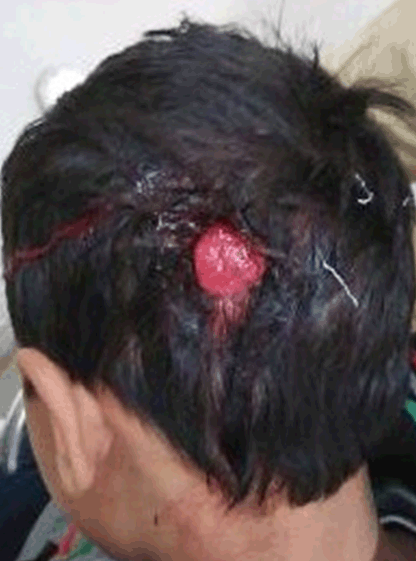
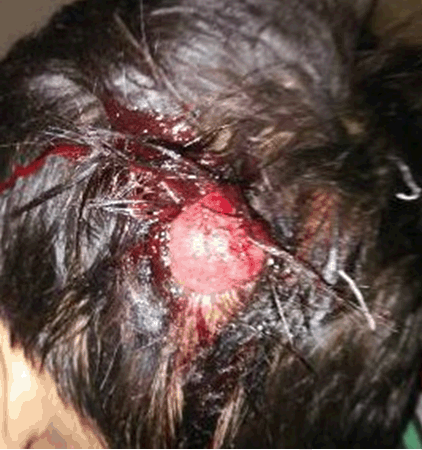
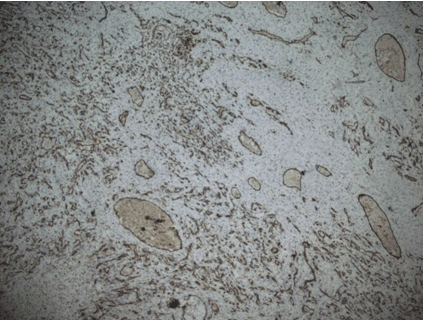
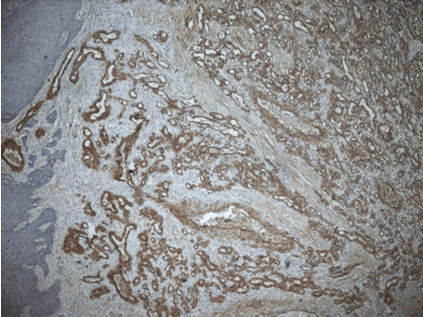
An 11-year-old boy presented with a globular swelling which was red color in the vertex of scalp (Figure 1). There was no history of injury. It started as painless small swelling and grew to a large exuberant growth in about 20 days. It started bleeding spontaneously many times a day for last one day. On examination, there was a 4.5x4.0 cm spherical, sessile, firm, painless and raspberry like red color swelling in vertex of scalp. This ulcerated swelling started bleeding in the outpatient department (Figure 2). The hemoglobin value, bleeding time, clotting time, total and differential leucocytes counts were normal. The HIV test was negative. The surgical excision of this giant granuloma pyogenicum was done taking a margin 0.5 cm of healthy skin. The electrocautery was used for excision and hemostasis. The primary closure of the resultant elliptical defect was done using 2-0 polypropylene interrupted sutures. This excised swelling from the scalp was histopathology. Histopathology of this giant granuloma pyogenicum in H&E stain revealed stratified squamous epithelial lining with ulceration. Subepithelium revealed lobular accentuation comprising of chronic inflammatory granulation tissue with embedded dilated vascular channels separated by fibrous septae (Figure 3). Immunohistochemistry CD 31 revealed positive staining for vascular channels lined by endothelial cells (Figure 4) and SMA was positive for smooth muscle cells (Figure 5). This histopathological report confirmed the diagnosis of a giant granuloma pyogenicum. In the postoperative period, wound healed primarily without any infection or disruption. The sutures were removed on ninth postoperative day | ||||||
| ||||||
| ||||||
| ||||||
| ||||||
| ||||||
|
Discussion
| ||||||
|
Granuloma pyogenicum can present clinically as a smooth or lobulated exophytic lesion with a sessile or pedunculated base. Mucosal lesions in oral cavity and cutaneous lesions in upper trunk and extremities are the common sites. McClintock et al. described two types of vascularized lesions as pyogenic and pseudopyogenic granulomas considering them partially neoplastic and inflammatory with little clinical differences between these two types. However, pyogenic granuloma is based on extremities while pseudopyogenic granuloma occurs on scalp and ears. There is no difference in treatment of these two histological types [7]. There are number of predisposing causes which can act as initiating cause. Trivial trauma particularly on fingers is the most common cause. Infection, drugs, pregnancy and oral contraceptive are other causes [8]. There was no apparent initiating cause in this child, but poor hygiene and hair care was thought to cause the granuloma pyogenicum in this child. Only some cases of giant granuloma pyogenicum of scalp have been reported in literature [9]. In this case, the size of granuloma pyogenicum was 4.5x4.0 cm which exceeds the standard size of less than 2 cm, hence labeled as giant granuloma pyogenicum. This size of giant granuloma pyogenicum is comparable to other case reports of giant pyogenic granuloma of scalp [10]. Giant granuloma pyogenicum are painless as nervous tissue proliferation is not there in the proliferating vascular tissue. So, even the giant sized granuloma pyogenicum is painless. Differential diagnosis of granuloma pyogenicum should include conventional granulation tissue, foreign body granuloma, hemangioma, angioendothelioma and angiosarcoma. Differentiation can be done on clinical basis and if suggestive biopsy should be done to rule out malignancy. Giant granuloma pyogenicum of scalp can be easily treated with proper diagnosis. Millsop et al. have described current therapeutic modalities which include cryotherapy, electrodessication, curettage, excision, laser therapy, sclerotherapy, topical imiquimod and microembolization [11]. They reported a recalcitrant case pyogenic granuloma unresponsive to conventional surgical and nonsurgical treatment; and a complete resolution was achieved in this case by aggressive laser therapy, intralesional triamcinolone injection and topical application of timolol [11][12][13]. Lee et al. in an extensive retrospective review of treatment options and recurrence rates for pyogenic granuloma in 1162 patients observed surgical excision with lowest recurrence rate of 2.94% and cryotherapy in medical management with the lowest recurrence rate of 1.62%. They concluded that surgical excision and primary closure should be treatment of choice for small cutaneous pyogenic granulomas in non-cosmetic areas [14]. Patrice et al. in a study of 178 patients with pyogenic granuloma; 149 patients were treated by full thickness skin excision and linear closure with no recurrence, and 23 patients were treated shave excision or intradermal excision using cautery with a high recurrence rate [15]. Dissemond and Grabbe reported a case of giant pyogenic granuloma and its treatment. They observed that nonsurgical treatment that laser therapy or cryosurgery is associated with 50% recurrence rate so complete surgical excision as the first choice therapy [16]. The feeding vessels extend into surrounding skin in a cone like manner, so excision with surrounding margin of skin and primary closure is the best way to prevent recurrence of granuloma pyogenicum. Rapid healing can be observed within a few days of treatment and as blood vessels are sealed, there is improvement, hemostasis and coagulation compared with surgical excision. Postoperative pain, discomfort, edema and bleeding are notably reduced. Complete surgical excision with a margin of normal skin is best with minimum recurrence, however if recurrence does occur re-excision may be required. | ||||||
|
Conclusion
| ||||||
|
It is concluded that scalp is an uncommon site for giant granuloma pyogenicum which are generally small size. Huge or giant granuloma pyogenicum of scalp is a rare variant of pyogenic granuloma. This has tendency to bleed profusely. Giant cell granuloma pyogenicum can be diagnosed clinically. Proper treatment can be done by marginal excision using electrocautery. This leads to complete healing with no recurrence. | ||||||
|
References
| ||||||
| ||||||


|
[HTML Abstract]
[PDF Full Text]
|
|
Author Contributions
Bhavinder Arora – Substantial contributions to conception and design, Acquisition of data, Analysis and interpretation of data, Drafting the article, Revising it critically for important intellectual content, Final approval of the version to be published Sunita Singh – Analysis and interpretation of data, Revising it critically for important intellectual content, Final approval of the version to be published |
|
Guarantor of submission
The corresponding author is the guarantor of submission. |
|
Source of support
None |
|
Conflict of interest
Authors declare no conflict of interest. |
|
Copyright
© 2017 Bhavinder Arora et al. This article is distributed under the terms of Creative Commons Attribution License which permits unrestricted use, distribution and reproduction in any medium provided the original author(s) and original publisher are properly credited. Please see the copyright policy on the journal website for more information. |
|
|