| |
|
|
|
Case Report
| ||||||
| Hypoxemia in minimally invasive esophagectomy for squamous cell carcinoma of lower esophagus | ||||||
| Pak Lun Lam1, Lam Viet Trung2 | ||||||
|
1Medical Student, Li Ka Shing Faculty of Medicine, The University of Hong Kong, Hong Kong, China.
2Chief of Service, Department of Digestive Surgery, Cho Ray Hospital, Ho Chi Minh City, Vietnam. | ||||||
| ||||||
|
[HTML Abstract]
[PDF Full Text]
[Print This Article]
[Similar article in Pumed] [Similar article in Google Scholar] 
|
| How to cite this article |
| Lam PL, Trung LV. Hypoxemia in minimally invasive esophagectomy for squamous cell carcinoma of lower esophagus. Int J Case Rep Images 2017;8(3):213–216. |
|
Abstract
|
|
Introduction:
Minimally invasive esophage-ctomy for esophageal cancer is the surgical treatment-of-choice, and comprises both thoracoscopy and laparoscopy. The risk of hypoxemia arises during one-lung ventilation in the thoracoscopy stage, especially for patients with reduced lung function, and thus poses significant threat to the surgical outcome. This case report aims to demonstrate one possible solution to minimize hypoxemia in minimally invasive esophagectomy.
Case Report: A 55-year-old Southeast-Asian male, with a history of chronic smoking, was presented with dysphagia. Diagnosis of squamous cell carcinoma was made, and minimally invasive esophagectomy was performed. Hypoxemia occurred during the thoracoscopic stage, and the oxygen saturation was stabilized with introduction of positive end-expiratory pressure of 5 cmH2O to reduce atelectasis, and tilting the operating table to the ventilated lung to improve perfusion by gravity. Conclusion: Minimally invasive esophagectomy may be complicated by hypoxemia during one-lung ventilation. One possible solution, as demonstrated in this case report, is the provision of a 5 cmH2O positive end-expiratory pressure, and approaching the thoracoscopic stage in a lateral decubitus position with the operating table tilted to the ventilated lung. | |
|
Keywords:
End-expiratory pressure, Esophagectomy, Hypoxemia
| |
|
Introduction
| ||||||
|
Esophageal cancer is the seventh common cause of cancer death globally [1]. The mainstay of treatment for esophageal cancer is esophagectomy. Minimally invasive esophagectomy has become more commonly practiced due to a more rapid recovery and shorter hospital stay [2]. However, the thoracoscopic approach to esophagectomy requires one-lung ventilation, and this leads to a risk of hypoxemia during operation [3]. This case report aims to demonstrate one possible solution to minimize hypoxemia in minimally invasive esophagectomy, which is the provision a 5 cmH2O positive end-expiratory pressure, and approaching the thoracoscopic stage in a lateral decubitus position with the operating table tilted to the ventilated lung. | ||||||
|
Case Report
| ||||||
|
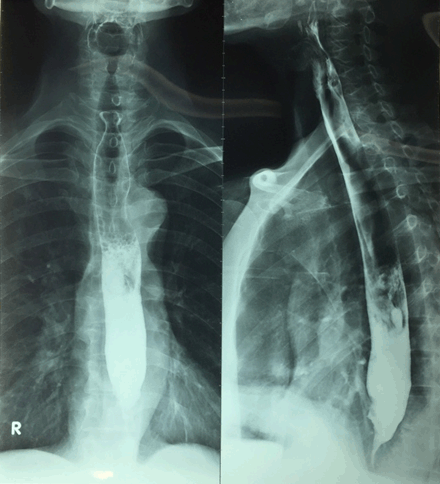
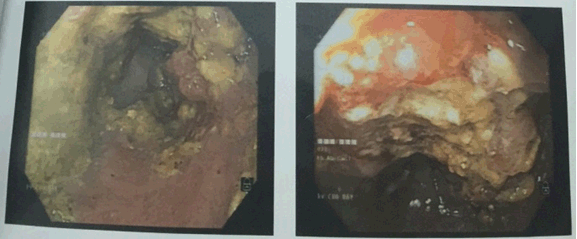
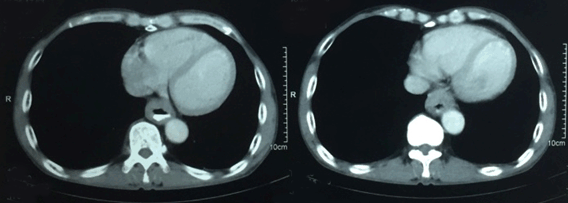
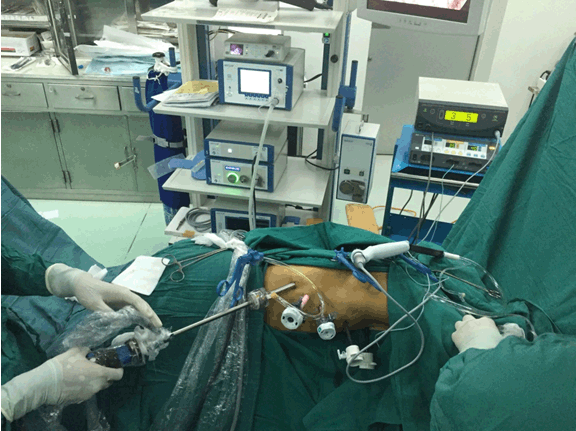
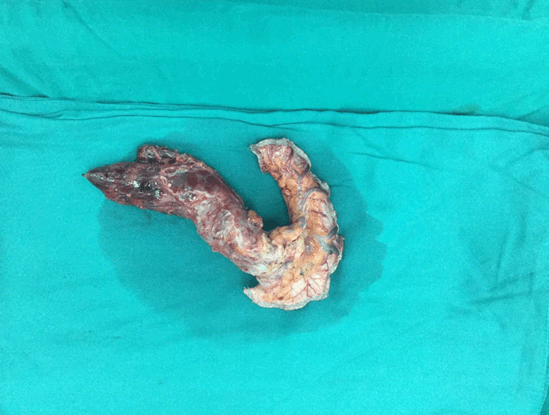
A 55-year-old Southeast-Asian male presented with progressive dysphagia and significant weight loss over the last six months. The patient was a chronic chain smoker and occasional social drinker. There was unremarkable past medical, family history and physical examination findings. Initial barium swallow demonstrated a stricture in the lower third of the esophagus with irregular outline (Figure 1). Esophagogastroduodenoscopy showed fungating lesion 32 cm from the upper incisor teeth, and 1 cm from the Z-line (Figure 2). Biopsy confirmed poorly differentiated squamous cell carcinoma of the lower third of the esophagus (Histologic Grade 3). At the aforementioned thoracic esophageal level, contrast-enhanced circumferential lesion was found (Figure 3). There was no apparent lymph node or distant organ metastasis. Minimally invasive esophagectomy was the recommended treatment of choice, and an informed consent was obtained from the patient. The thoracoscopic and laparoscopic esophagectomy approach was adopted. Prior to operation, investigations were performed which deemed the patient fit for minimally invasive esophagectomy. Complete blood picture, clotting and electrolyte profile were normal. Liver, renal function tests and electrocardiogram were normal. Chest X-ray was unremarkable. Anesthesia was given, and ventilation was provided at tidal volume of 5 ml/kg and oxygen flow rate of 3 L/min in preparation for possible longer duration of one-lung ventilation during the thoracoscopic stage. Thoracoscopic mobilization was first performed with the patient in semi-lateral position. Five trocars were placed in respective locations to allow dissection (Figure 4). The surgery had been uneventful up to this stage. The operation continued with localization of the central diaphragmatic tendon. However, the oxygen saturation of the patient dropped suddenly from above 95% to around 65%. The double-lumen tube for one-lung ventilation was immediately checked for misplacement, but this was not the case. The oxygen flow rate was increased from 3 L/min to 5 L/min, yet the oxygen saturation did not improve. Re-expansion of the nonventilated lung was performed to correct the situation. The oxygen saturation returned to above 95% after re-expansion, and the operation was attempted again with one-lung ventilation after the condition stabilized. However, the oxygen saturation fell again after brief dissection. Introducing a positive end-expiratory pressure of 5 cmH2O and tilting the operating table around 15 degrees to the ventilated lung was the solution to maintain the oxygen saturation at above 95%. The operative was subsequently carried out with esophageal mobilization through dissection of the lateral pleura. In the laparoscopic stage, the patient was placed in a supine position. The gastro-hepatic ligament and gastroesophageal attachments were dissected to achieve gastric mobilization. The less curvature portion of the stomach was stapled in preparation to form a gastric conduit 40 cm in length and 3 cm in width. The resected esophagus and stomach was removed and examined (Figure 5). The cervical esophagus was then exposed through a horizontal neck incision above the clavicle. The stomach was guided through the posterior mediastinum and brought to cervical esophagus for end-to-side stapled anastomosis. Suture of all port sites completed the minimally invasive esophagectomy. Postoperative care was provided for the patient, and there was no complication. | ||||||
| ||||||
| ||||||
| ||||||
| ||||||
| ||||||
|
Discussion
| ||||||
|
In Western countries, such as the United States, esophageal cancer more commonly presented as adenocarcinoma of the lower thoracic esophagus, with Barrett's esophagus as a major risk factor. Whereas in other parts of the world specially in Southeast Asia squamous cell carcinoma was the predominant form [4]. In this case, computed tomography and bronchoscopy revealed a lack of adventitial involvement, as well as the absence of lymph node and distant metastasis. Surgical resection of the esophagus would be the treatment of choice. Traditionally, open transthoracic esophagectomy or transhiatal esophagectomy would be adopted. However, a minimally invasive approach was performed, as recent studies had indicated the use of thoracoscopic and laparoscopic approach in squamous cell esophageal carcinoma having similar morbidity and mortality rate. At the same time, this technique provided faster recovery and shorter hospital stay when compared to open surgery [5]. One issue with minimally invasive esophagectomy was the risk of hypoxemia, as demonstrated in this case. The underlying cause could be attributed to one-lung ventilation. In addition, smoking which was a major risk factor in squamous cell esophageal cancer, may also played a role in hypoxemia during operation. Despite a normal chest X-ray and computed tomography scan, reduced lung function would arise from chronic smoking, and hypoxemia might be exacerbated especially when stressed during surgery [6]. It is suggested that pulmonary function tests, such as lung volume, capacity, peak flow rate and perfusion scans, could be performed for high risk patients to better assess the risk of hypoxemia during surgery. In incidence of hypoxemia during the thoracoscopic stage of esophagectomy, mechanical causes like double-lumen tube misplacement should be checked immediately. This was shown to be a common and easily correctable cause of hypoxemia in one-lung ventilation [7]. When mechanical causes were excluded, the oxygen flow rate could be increased in moderation. However, hyperbaric oxygen posed threats to the central nervous system and the respiratory system, especially through reperfusion injury and the production of reactive oxygen species. Failure of maintaining oxygen saturation with increased oxygen flow rate would indicate re-expansion of the non-ventilated lung for stabilization of the patient [8]. Yet, there was a risk of barotrauma, and it would be impractical to perform esophagectomy with an expanded lung. In this case, the maintenance of oxygen saturation was achieved by providing a positive end-expiratory pressure of 5 cmH2O, and tilting the operating table to the ventilated lung. Studies showed providing a positive end-expiratory pressure of 5–10 cmH2O reduced atelectasis, especially in patients with impaired lung function, and thus correcting hypoxemia [9]. Thus, a positive end-expiratory pressure of 5 cmH2O may be provided during minimally invasive esophagectomy to minimize the risk of hypoxemia. In addition, the position of patient was also important. Rotating the operating table by 10–15 degrees to the non-dependent lung (ventilated lung) provided better oxygenation, because the effect of gravity allowed for a better perfusion of the lower-positioned lung [10]. It is, therefore, suggested that the thoracoscopic stage of minimally invasive esophagectomy may be approached in a lateral decubitus position with the operating table tilted to the ventilated lung whenever possible. | ||||||
|
Conclusion
| ||||||
|
Hypoxemia in minimally invasive esophagectomy may not be a common occurrence, but poses substantial threat to a successful operation. As demonstrated in this case report, one possible solution is to provide a 5 cmH2O positive end-expiratory pressure, and approaching the thoracoscopic stage in a lateral decubitus position with the operating table tilted to the ventilated lung. | ||||||
|
References
| ||||||
| ||||||
|
[HTML Abstract]
[PDF Full Text]
|
|
Author Contributions
Pak Lun Lam – Substantial contributions to conception and design, Acquisition of data, Analysis and interpretation of data, Drafting the article, Revising it critically for important intellectual content, Final approval of the version to be published Trung, Lam Viet – Substantial contributions to conception and design, Acquisition of data, Analysis and interpretation of data, Drafting the article, Revising it critically for important intellectual content, Final approval of the version to be published |
|
Guarantor of submission
The corresponding author is the guarantor of submission. |
|
Source of support
None |
|
Conflict of interest
Authors declare no conflict of interest. |
|
Copyright
© 2017 Pak Lun Lam et al. This article is distributed under the terms of Creative Commons Attribution License which permits unrestricted use, distribution and reproduction in any medium provided the original author(s) and original publisher are properly credited. Please see the copyright policy on the journal website for more information. |
|
|