
  |

|
 |
|
Case Report
| ||||||
| Vancomycin-associated neutropenia in hemodialysis patient with sepsis | ||||||
| Esraa Shukri Altawil1, Fadi Saleh Aljamaan2 | ||||||
|
1Critical Care Clinical Pharmacist, Pharmacy department, KSUMC, Riyadh, SA.
2MD, Assistant Professor, Intensive Care Department, KSUMC, Riyadh, SA. | ||||||
| ||||||
|
[HTML Abstract]
[PDF Full Text]
[Print This Article]
[Similar article in Pumed] [Similar article in Google Scholar] 
|


| How to cite this article |
| Altawil ES, Aljamaan FS. Vancomycin-associated neutropenia in hemodialysis patient with sepsis. Int J Case Rep Images 2017;8(3):184–186. |
|
Abstract
|
|
Introduction:
Vancomycin-induced neutropenia is a rare but serious adverse reaction that appears to occur with prolonged use with a minimum of seven days. In most cases, it has been reported to resolve spontaneously upon discontinuation of vancomycin.
Case Report: A 53-year-old male admitted as a case of septic arthritis complicated with sepsis in which vancomycin induced prolonged neutropenia occurred after nine days of therapy and was associated with toxic serum level. Conclusion: Vancomycin induced neutropenia may occur at any dose or duration of therapy, but generally it is associated with prolonged use for more than seven days. Our findings suggest that clinicians should be cautious about it as it can occur at any time in the course of treatment, and may last for longer time especially in hemodialysis patients in addition to being linked to the toxic serum level. All patients who receive vancomycin for more than seven days should have white blood cells count and differential counts monitored weekly. Discontinuation of the drug appears to be prudent as soon as this hematological abnormality detected. | |
|
Keywords:
Vancomycin, Neutropenia, Sepsis, Toxic level
| |
|
Introduction
| ||||||
|
Vancomycin-induced neutropenia, defined as an absolute neutrophil count (ANC) less than 1000 cells/mm3, is a rare but serious adverse reaction has been reported to occur at rates of 2–12% [1] [2]. In 1960, shortly after the introduction of the drug, Dangerfield et al. published the first two case reports [1]. The onset of neutropenia does appear to occur with prolonged treatment duration with at least seven days and mostly occurring at 20th day after therapy initiation [3]. Although the mechanism of action of the neutropenia is controversial, several theories have been proposed including an immunological mechanism with an IgG or IgM immune-mediated hypersensitivity reaction [4]. Evidence to support this hypothesis includes studies examined the bone marrow of patients with vancomycin induced neutropenia which reveal granulocyte-specific antibodies [5][6]. Another suggested mechanism is direct toxicity to the bone marrow. This has been supported by hypo-cellular marrow with maturation arrest on bone marrow biopsy [7]. In all of the cases, neutropenia has been reversible and resolve spontaneously upon withdrawal of vancomycin. Improvement generally occurs within a few days of vancomycin discontinuation [2], but, in patients who are undergoing hemodialysis, prolonged neutropenia for up to 4 weeks has been observed [8]. | ||||||
|
Case Report
| ||||||
|
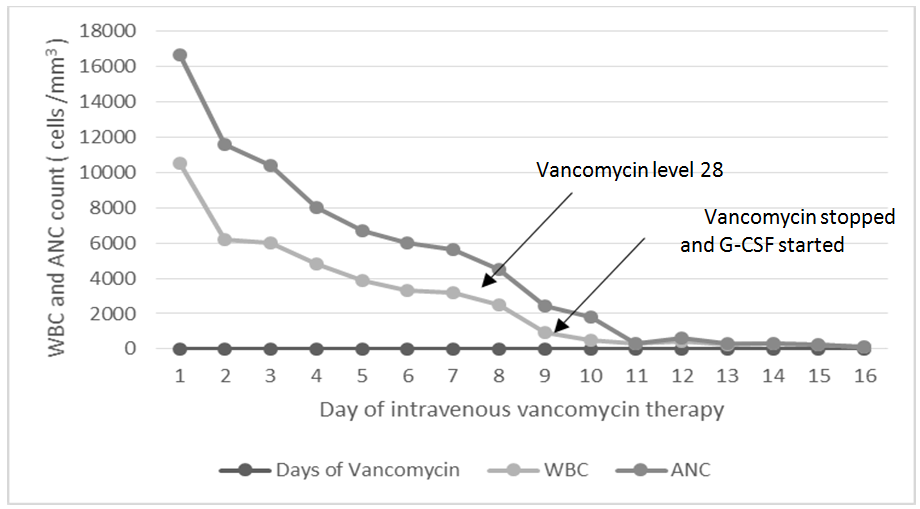
A 53-year-old male, a known case of diabetes mellitus and hypertension for 20 years, presented with ischemic heart disease for the last 12 years, and chronic kidney disease for the last five years. He was admitted to the hospital as a case of left shoulder septic arthritis as a complication of intra-articular steroid injection for tendonitis, started empirically on vancomycin 1 g IV every 24 hours and clindamycin 600 mg IV q 8 hr. Two days later, blood culture revealed methicillin sensitive staphylococcus aureus (MSSA) at which both antibiotics stopped and cloxacillin 2 g IV every 4 hr was initiated. Throughout his hospital stay he developed acute on top of chronic renal failure requiring hemodialysis. On day-25 he developed hypotension during dialysis session, associated with decreased level of consciousness (LOC), which mandated transfer to intensive care unit. Furthermore, he developed acute respiratory distress syndrome (ARDS) requiring mechanical ventilation in addition to severe circulatory failure all of that due to septic shock. The patient's intravenous (IV) antibiotics were escalated to meropenem 1 g IV q 12 hr and vancomycin 1 g IV q 24 hr (target trough level 10–15) with full septic screen sent. The daily vancomycin trough level continued to be supra-therapeutic (range 17–28 µg/mL), given patient's poor renal function, mandating several times of dose holding. Despite the maximum therapeutic care provided, patient's condition started to deteriorate manifested by severe hemodynamic instability demanding maximum doses of vasopressors. On day-31, his blood gases analysis was consistent with severe hypoxemia in addition to lactic acidosis. Laboratory results showed neutropenia with ANC 200 cells/mm3 (baseline was 6,200 cells/mm3), in which vancomycin stopped after total duration of nine days (cumulative dose received 5 g), and filgrastim (G-CSF) 300 µg SC started. Patient remained on meropenem and cloxacillin resumed over. Blood culture showed Pseudomonas aeruginosa for which colistin was added (loading dose of 9 million units IV followed by maintenance dose 2 million units IV every 8 hr). The neutrophil count continued to fall to < 100 cells /mm3 reaching undetectable amount even after he received seven doses of G-CSF (Figure 1). On day-40, the patient had worsening multiorgan failure and was declared for comfort care ending with cardiorespiratory arrest. | ||||||
| ||||||
|
Discussion
| ||||||
|
Several published case reports demonstrated neutropenia as an adverse event associated with vancomycin therapy, nevertheless, to date there are no published prospective studies assessing this important clinical complication. Neutropenia may occur at any dose, but generally with the prolonged vancomycin use for more than seven days. To our knowledge, this is the first case report addressed vancomycin induced neutropenia in Saudi Arabia. Many of the cases reported included patients receiving concomitant drugs also known to cause neutropenia, resulting in uncertainty with the influence of vancomycin. Based on the Naranjo probability scale, the association of vancomycin with neutropenia was considered as probable in our case. In addition to delayed onset, vancomycin induced neutropenia has always been reported as reversible, with complete resolution taking place in 2–5 days which is not the case. Factors, other than drug related, including sepsis and hemodialysis could be the cause of our patient's prolonged neutropenia. Latest American Society of Health-System Pharmacists and the Infectious Diseases Society of America (ASHP/IDSA) guidelines did not indicate the need of frequent monitoring of leukocyte count while receiving vancomycin [9]. Although there are no guidelines or recommendations exist for the use of G-CSF in vancomycin-induced neutropenia, several case reports have shown successful treatment of vancomycin-induced neutropenia with G-CSF while continuing use of vancomycin [4]. It is crucial that patients undergoing prolonged vancomycin therapy remain under close monitoring with at least once weekly laboratory testing for blood counts. At present, it is uncertain whether patients with history of vancomycin-associated neutropenia would develop the same response if re-challenged with vancomycin. Koo et al. has reported a successful case where a patient who recovered from vancomycin induced neutropenia restarted on a five days course and at a lower dose without recurrence of neutropenia. In most circumstances, clinicians prefer to use an alternative agent rather than resuming the offending agent. Further studies are needed to conclude the possibility of neutropenia with repeat exposure to vancomycin [10]. | ||||||
|
Conclusion
| ||||||
|
Vancomycin induced neutropenia may occur at any dose, but generally with the prolonged vancomycin use for more than seven days. Our findings suggest that clinicians should be cautious that vancomycin-associated neutropenia can occur at any time in the course of treatment, and can be linked to the toxic serum level. All patients who receive vancomycin for more than seven days should have white blood cell and differential counts monitored weekly. Discontinuation of the drug appears to be prudent as soon as this hematological abnormality detected. | ||||||
|
References
| ||||||
| ||||||

|
[HTML Abstract]
[PDF Full Text]
|
|
Author Contributions
Esraa S. Altawil – Substantial contributions to conception and design, Acquisition of data, Analysis and interpretation of data, Drafting the article, Revising it critically for important intellectual content, Final approval of the version to be published Fadi S. Aljamaan – Analysis and interpretation of data, Revising it critically for important intellectual content, Final approval of the version to be published |
|
Guarantor of submission
The corresponding author is the guarantor of submission. |
|
Source of support
None |
|
Conflict of interest
Authors declare no conflict of interest. |
|
Copyright
© 2017 Esraa S. Altawil et al. This article is distributed under the terms of Creative Commons Attribution License which permits unrestricted use, distribution and reproduction in any medium provided the original author(s) and original publisher are properly credited. Please see the copyright policy on the journal website for more information. |
|
|