
  |

|
 |
|
Case Report
| ||||||
| Penetrating neck trauma in children causing aerodigestive tract injury: A case presentation | ||||||
| Aram Baram1, Fahmi Kakamad1, Fitoon Yaldo2, Twana Kareem2 | ||||||
|
1Faculty of Medical Sciences, School of Medicine, Department Cardiothoracic and Vascular Surgery, University of Sulaimani, François Mitterrand, Street, Sulaimani, Kurdistan Region, Iraq.
2Sulaiman teaching Hospital, Sulaimani, Kurdistan Region, Iraq. | ||||||
| ||||||
|
[HTML Abstract]
[PDF Full Text]
[Print This Article]
[Similar article in Pumed] [Similar article in Google Scholar] 
|


| How to cite this article |
| Baram A, Kakamad F, Yaldo F, Kareem T. Penetrating neck trauma in children causing aerodigestive tract injury: A case presentation. Int J Case Rep Images 2017;8(3):175–178. |
|
Abstract
|
|
Introduction:
Pediatric traumatic esophageal perforation has high morbidity and mortality rates. It is most commonly iatrogenic in nature with penetrating trauma account for only 0.5% of cases. We report a case of pediatric penetrating trauma to the neck (zone two) causing both through and through cervical esophageal injury and laceration of the posterior wall of the trachea.
Case Report: A six-year-old boy suffering from penetrating neck trauma due to blast explosion presented to us with severe respiratory distress and drooling of saliva. Diagnostic workup revealed both tracheal and esophageal injury. Immediate primary repair was done for both the organs. Postoperatively, he developed ARDS which treated conservatively with good outcome. Conclusion: High index of suspicion is always required not to miss any injuries especially esophageal injuries, bearing in mind whenever you have one injury searching for others is rationale. Tracheostomy tube whenever applied in children needs more meticulous care than adult population. | |
|
Keywords:
Esophagus, Perforation, Sharp nail, Tracheostomy
| |
|
Introduction
| ||||||
|
Pediatric penetrating neck traumatic has high morbidity and mortality rates [1]. Pediatric esophageal perforation is most often due to iatrogenic instrumentation, foreign body impactions and rarely trauma. External penetrating trauma is infrequent [2] [3]. While no definite data available for pediatric cervical esophageal perforation in current literature. The signs and symptoms of early esophageal injury can be vague and nonspecific. The clinical presentation depends on the cause, location of the injury, size of the perforation, degree of contamination, length of time elapsed after injury, and presence of associated injury. Pain is the most common symptom (71%), followed by fever (51%), dyspnea (24%), and crepitus (22%) [4]. Signs and symptoms of upper air way obstruction are not recognized features of esophageal injury and whenever present they may indicate accompanying airway injury [5]. Plain chest and neck radiographs may show pneumomediastinum, subcutaneous emphysema, pleural effusions, and hydropneumothorax but they are not sensitive enough to exclude the diagnosis of esophageal perforation. Contrast study remains the "gold standard" for excluding the diagnosis of an esophageal perforation [2]. Computed tomography scan and esophagoscopy are other diagnostic modalities that can be used when contrast radiography failed to demonstrate perforation despite of high clinical suspicion [4] [6]. Surgery has been the traditional and preferred treatment which aims to restore continuity, elimination of septic focus, provides adequate drainage, augments host defenses and maintains adequate nutrition [4]. Cervical esophageal perforation caused by blast injury is a rare presentation. We report a case of through and through cervical esophageal perforation accompanied by minor upper airway injury (aerodigestive tract injury) caused by shell injury in a six-year-old boy. | ||||||
|
Case Report
| ||||||
|
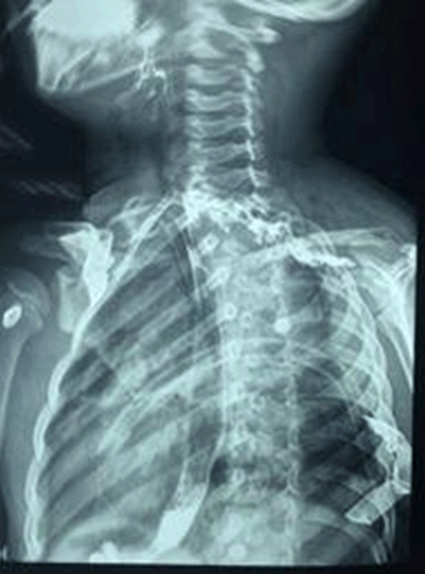
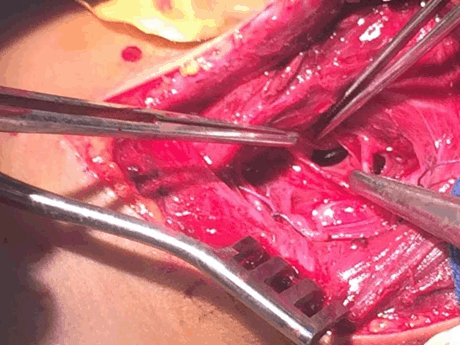
A six-year-old boy, victim of blast injury, was referred to our tertiary center seven hours after the accident. Tracheostomy has been done there as an urgent procedure for relieving upper airway obstruction. He sustained sharp nail injury to the left side of the neck, in zone II and outlet was to the right side of the back over the scapula. He was conscious but in distress, dyspneic, there was swelling, tenderness with subcutaneous emphysema all over the neck, more on left side. Chest examination showed decreased air entry on the right side. Abdominal and vascular examinations were unremarkable. His oxygen saturation (SPO2) was 95% with 10 liters oxygen, pulse rate 130 beats/minute, temperature 38.5°C, blood pressure 90/60 mmHg, respiratory rate 60 cycles/minutes. Focused assessment with sonography for trauma (FAST) showed mild right side pleural collection. Chest and neck radiographies showed right upper opacity and subcutaneous emphysema. Computed tomography (CT) scan revealed fractured right first rib with apical hematoma, and right side hemothorax with pneumomediastinum. Patient was transferred to intensive care unit (ICU), sedation with 1 mg midazolam and 20 mg fentanyl done, right side tube thoracostomy was inserted which drained 200 cc of blood. After stabilization of the condition, gastrografin swallow was done which showed contrast leak at the mid-cervical esophagus (Figure 1). Under general anesthesia with nasogastric tube, exploration was done via left longitudinal incision, ipsilateral internal jugular vein was found to be transected with through and through injury to the esophagus (Figure 2). The vein was ligated and the perforations in the esophagus was repaired using 3.0 vicryl in single layer, the right side perforation repaired from within the lumen and the left side perforation by 4 interrupted stiches. Postoperatively, nasogastric tube feeding was started with antibiotic coverage. In the second postoperative day, the tracheostomy tube blocked, resulted in aspiration and desaturation. The child did not respond to conservative management. Rigid bronchoscopy was performed. Pus was found filling both major bronchi, bronchial lavage was done. Saturation was improved. Few hours later the patient condition deteriorated again, saturation decreased, chest examination revealed bilateral coarse crackles and chest-X-ray showed pictures in favor of pulmonary edema. Supportive treatment was started; patient was put on continuous positive airway pressure (CPAP). He was weaned from CPAP four days later. Water soluble contrast study showed no leak at seventh postoperative day. Oral intake started. Tracheostomy tube was removed at 10th postoperative day and he was discharged from hospital a day later. | ||||||
| ||||||
| ||||||
|
Discussion
| ||||||
|
Among all perforations of the alimentary tract, perforations of the esophagus are considered the most dire and life-threatening especially in children [2]. These perforations are: (i) more often iatrogenic, (ii) more likely to occur within the cervical esophagus, and (iii) not generally associated with an underlying malignancy. Chest pain, fever, tachypnea, and/or tachycardia with subcutaneous emphysema are common features which were found in our case too [2]. Esophageal perforation is a surgical emergency associated with high morbidity and mortality. Consensus regarding the appropriate management of this life-threatening condition is lacking [7]. The reported mortality from treated esophageal perforation is 10–25%, when therapy is initiated within 24 hours of perforation and it is 40–60% when the treatment is delayed. The reason for this multifold increase in mortality is due to the unique anatomical configuration and location of the esophagus, which allows bacteria and digestive enzymes easy access to the mediastinum, leading to the development of severe mediastinitis, empyema, sepsis, and multiple organ dysfunction syndromes [7]. After immediate resuscitations and multisystem support, the child was taken to the operating room for cervical esophageal exploration. The most common type of esophageal perforation is iatrogenic (approximately 60% in most series), usually as part of endoscopic therapy for stricture or achalasia. Barogenic or Boerhaave syndrome make up about 15–30% of cases, with trauma, foreign body ingestion, and operative injury accounting for most of the remaining benign perforations [8]. Penetrating injury as a causal factor is one of the rare causes [8]. To our knowledge, there is no reported case in literature about blast injuries causing through and through cervical esophageal perforation with minor upper airway trauma. In our case, first complaint was confused with tracheal injury for which he underwent tracheostomy in the first hospital, and it was one of the morbidity factors as it is well known that tracheotomy tube occlusion is a common problem, occurring at a rate of up to 72% of premature and newborn children and, less frequently, at a rate of up to 14%, in children one year and older which also emphasizes the need for meticulous monitoring for pediatric patients to avoid such disastrous events [9] . Our case developed suffocation and aspiration from tracheostomy tube obstruction despite had been in intensive care unit with continuous nursing care. The shell tract in this patient was also unusual being its inlet from zone II on the left side, and its outlet from the right side of the back, causing fracture of the right first rib with neither neurological deficits nor vascular injuries. Intraoperatively, the edges were healthy, no debridement was needed, and repair was done after good irrigation by normal saline by single layer using absorbable suture material. | ||||||
|
Conclusion
| ||||||
|
High index of suspicion is always required not to miss any injuries especially esophageal injuries. Tracheostomy tube whenever applied in children needs more meticulous care than adult population. | ||||||
|
Acknowledgements
| ||||||
|
We would like to acknowledge all our personnel who assisted in serving our patients. | ||||||
|
References
| ||||||
| ||||||

|
[HTML Abstract]
[PDF Full Text]
|
|
Author Contributions
Aram Baram – Substantial contributions to conception and design, Acquisition of data, Analysis and interpretation of data, Drafting the article, Revising it critically for important intellectual content, Final approval of the version to be published Fahmi Kakamad – Analysis and interpretation of data, Revising it critically for important intellectual content, Final approval of the version to be published Fitoon Yaldo – Analysis and interpretation of data, Revising it critically for important intellectual content, Final approval of the version to be published Twana Kareem – Analysis and interpretation of data, Revising it critically for important intellectual content, Final approval of the version to be published |
|
Guarantor of submission
The corresponding author is the guarantor of submission. |
|
Source of support
None |
|
Conflict of interest
Authors declare no conflict of interest. |
|
Copyright
© 2017 Aram Baram et al. This article is distributed under the terms of Creative Commons Attribution License which permits unrestricted use, distribution and reproduction in any medium provided the original author(s) and original publisher are properly credited. Please see the copyright policy on the journal website for more information. |
|
|