
  |

|
 |
|
Case Report
| ||||||
| Very delayed coronary stent fracture presenting as unstable angina: A case report | ||||||
| Saurabh Mehrotra1, Praful Sharma P.2, Yashpaul Sharma Y.P.3 | ||||||
|
1MD, DM, Assistant Professor, Department of Cardiology, Post Graduate Institute of Medical Education and Research (PGIMER), Chandigarh, Punjab, India.
2MD, DM, Senior Resident, Department of Cardiology, Post Graduate Institute of Medical Education and Research (PGIMER), Chandigarh, Punjab, India. 3MD, DM, Head, Cardiology, Department of Cardiology, Post Graduate Institute of Medical Education and Research (PGIMER), Chandigarh, Punjab, India. | ||||||
| ||||||
|
[HTML Abstract]
[PDF Full Text]
[Print This Article]
[Similar article in Pumed] [Similar article in Google Scholar] 
|


| How to cite this article |
| Mehrotra S, Sharma PP, Sharma YYP. Very delayed coronary stent fracture presenting as unstable angina: A case report. Int J Case Rep Images 2017;8(2):147–150. |
|
Abstract
|
|
Introduction:
Coronary stent fracture represents an under diagnosed clinical event of drug-eluting stents which is often associated with adverse clinical outcomes of in-stent restenosis. Numerous risk factors are associated with stent fracture that include stent overexpansion, creation of hinge points due to stent overlapping, use of longer stents for complex lesions as well as mechanical fatigue causing stent distortion in the right coronary artery and vein grafts.
Case Report: A 64-year old male, a cigarette smoker, presented with rest angina. Coronary angiogram showed discrete 99% stenosis in proximal left anterior descending artery and a mid-eccentric 90% lesion in the right coronary artery (RCA). The patient was taken up for angioplasty of both the vessels. A type V fracture was detected after four years of zotarolimus-eluting stent placement in the right coronary artery. Conclusion: Despite the recent advances in drug-eluting stents design, there remains a potential of stent fracture especially when a long drug-eluting stents is implanted in a tortuous vessel and is exposed to torsion forces at the hinge points. | |
|
Keywords:
Drug-eluting stent, Stent fracture, Zotarolimus-eluting stent
| |
|
Introduction
| ||||||
|
The introduction of drug-eluting stents has marked a new era in the field of interventional cardiology with significant reduction in the incidence of restenosis as well as repeat revascularization [1] [2]. Although drug-eluting stents has become the standard of care for percutaneous coronary intervention, the occurrence of late stent thrombosis has raised concern over their long-term safety. Stent fracture is being increasingly recognized as a potential cause of in-stent restenosis and stent thrombosis with the clinical manifestation of recurrent angina, myocardial infarction and even sudden death [3] [4] [5] [6]. We report a rare case of delayed stent fracture after percutaneous coronary intervention with zotarolimus-eluting stent (ZES). | ||||||
|
Case Report
| ||||||
|
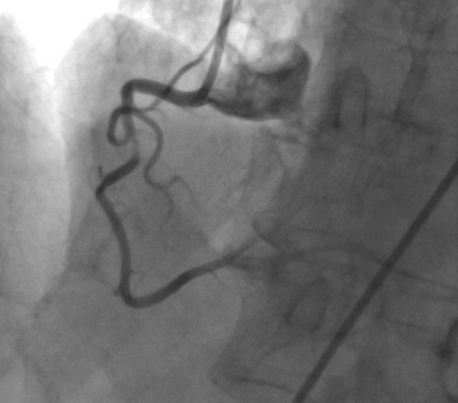
A 64-year old male, a cigarette smoker, presented to us with rest angina. The patient was not on any medication at the time of presentation. Clinical evaluation revealed ST segment elevation in anterior precordial leads on electrocardiogram along with raised troponins (29.834 ng/ml, normal level <1.5 ng/ml). His white blood cell count was 11.26×10⁹/l (normal range 4–10×109/l), granulocyte proportion was 79.7% (normal range 46–75%), red blood cell count was 4.07×10¹²/l (normal range 4.0–5.5×10¹²/l), blood platelet count was 167×109/l (normal range 100–300×109/l), potassium was 3.54 mmol/l (normal range 3.5–5.3 mmol/l), sodium was 137 mmol/l (normal range 135–145 mmol/l) and urea was 6.6 mmol/l (normal range 2.9–8.6 mmol/l. The patient was thrombolysed with streptokinase (1.5 MU over 45 min). Coronary angiogram showed discrete 99% stenosis in proximal left anterior descending artery along with diffuse disease distally. The right coronary artery showed a mid-eccentric 90% lesion (Figure 1). The patient was taken up for angioplasty of both the vessels. Endeavour Resolute stent 3.0×38 mm (Medtronic Inc. Santa Rosa, CA, USA) was deployed in mid to distal left anterior descending, followed by another overlapping Endeavour Re solute stent 3.5×38 mm in mid to proximal left anterior descending. Both the stents were post-dilated sequentially with 3.0×10 mm and 4.0×9 mm Dura Star noncompliant balloons (Cordis Corp, Johnson & Johnson, Miami Lakes, FL 33014) respectively. A third Endeavour Resolute stent 3.0×38 mm was deployed in the right coronary artery at 10 atmospheric pressure then post dilated with 4.0×12 mm noncompliant balloon at 10, 12 and 14 atm distal to proximally, with good angiographic results (Figure 2A-B). The patient was subsequently discharged in stable condition and followed-up as outpatient uneventfully. His medications included ecosprin 150 mg daily, metoprolol 50 mg daily, clopidogrel 75 mg daily, and atorvastatin calcium 40 mg daily. After four years, patient once again presented with unstable angina. Laboratory tests revealed an HbA1c of 6.1%, lipid profile within goal range with total cholesterol 3.4 mmol/l, triglyceride 1.10 mmol/l, HDL 1.64 mmol/l and LDL 1.29 mmol/l. Serum creatinine was elevated at 120 mmol/l (normal range 58–110 mmol/l) and 24-h urinary protein 1.13 g. Further investigations revealed a normal troponin I of 0.3 ng/ml on the day of admission. Repeat coronary angiogram showed stents in left anterior descending. The right coronary artery stent showed a Type V fracture (multiple strut fractures with acquired transaction with gap in the stent body) in the middle with a clear gap between the two fractured segments (Figure 3A-C). The patient was advised bypass graft to right coronary artery and is currently asymptomatic at 6 month follow-up. | ||||||
| ||||||
| ||||||
|
| ||||||
|
Discussion
| ||||||
|
Stent fracture is an important yet underestimated clinical entity associated with adverse clinical sequelae. Various clinical studies have reported the incidence of stent fracture in the range of 0.84–7.7% [7] whereas an autopsy study by Nakazawa et al. reported a 29% incidence of stent fracture in drug-eluting stents at autopsy [8]. Stent fracture is classified as isolated strut fractures (type 1, single-strut fracture; type 2, incomplete trans-verse fracture) and complete fracture (type 3, complete transverse fracture without displacement; type 4, transverse fracture with displacement). Risk factors associated with stent fracture that has been reported in clinical studies include longer stent length, extremely angular and calcified lesion, post-dilatation with high pressure, right coronary artery or saphenous vein graft lesion location, lesion with high motion, overlapping stent and use of sirolimus eluting stent [9]. The rigid, and closed cell design of the sirolimus eluting stent results in greater straightening of the vessel thereby subjecting the stent to greater forces during the cardiac cycle [1] [10]. Zotarolimus-eluting stent with its open cell flexible design is less affected by torsion forces and there are only isolated case reports of stent fracture with ZES. In our case, a single ZES was implanted in non-calcified right coronary artery and the post dilatation pressure was well within the prescribed burst pressure. Symptomatic stent fracture four years after implantation in our case is possibly due to the chronic stretch at the bend point in the tortuous vessel resulting from the forceful exaggerated motion of the RCA. Stent fracture can present as recurrent angina, myocardial in farction or even sudden death with the adversity of clinical presentation having a direct relation to the severity of stent fracture [8]. Our case of Type V stent fracture has presented as unstable angina while the more significant clinical presentation of stent thrombosis was probably prevented due to the extended dual antiplatelet therapy of the patient. As on date there is no clear cut consensus statement for the treatment of stent fracture and the decision is generally guided by the type of stent fracture , presence of ischemia as well as likelihood of recurrence. Since the patient in our case presented with rest angina along with a Type V stent fracture despite being on dual antiplatelet therapy, revascularization was indicated. Considering the high likelihood of recurrence in our case, the decision to graft the right coronary artery was taken. | ||||||
|
Conclusion
| ||||||
|
This case highlights the importance of considering stent fracture, a not so rare entity as previously believed, as an etiological factor for causing late drug-eluting stents related complications with adverse clinical sequelae. Despite the recent advances in drug-eluting stents design, there remains a potential of this dreaded complication more so when a long drug-eluting stents is implanted in a tortuous vessel (right coronary artery in our case) and is exposed to torsion forces at the hinge points. | ||||||
|
References
| ||||||
| ||||||


|
[HTML Abstract]
[PDF Full Text]
|
|
Author Contributions
Saurabh Mehrotra – Substantial contribution to Conception and design, Analysis and interpretation of data, Drafting the article, Final approval of the version to be published Praful Sharma P. – Substantial contribution to Conception and design, Analysis and interpretation of data, Final approval of the version to be published Yashpaul Sharma Y.P. – Substantial contribution to Conception and design, Analysis and interpretation of data, Final approval of the version to be published |
|
Guarantor of submission
The corresponding author is the guarantor of submission. |
|
Source of support
None |
|
Conflict of interest
Authors declare no conflict of interest. |
|
Copyright
© 2017 Saurabh Mehrotra et al. This article is distributed under the terms of Creative Commons Attribution License which permits unrestricted use, distribution and reproduction in any medium provided the original author(s) and original publisher are properly credited. Please see the copyright policy on the journal website for more information. |
|
|