
  |

|
 |
|
Case Report
| ||||||
| Use of a fracture table for irreducible bipolar hemiarthroplasty dislocation: A case report | ||||||
| Chelsea S. Mathews1, Robert L. Garrison2, Regis L. Renard3 | ||||||
|
1MD, PGY-3 Resident, Department of Orthopedic Surgery, University of Arkansas for Medical Sciences, Little Rock, Arkansas, USA.
2MD, Assistant Professor, Department of Orthopedic Surgery, University of Arkansas for Medical Sciences, Little Rock, Arkansas, USA. 3MS, MD, Assistant Professor, Department of Orthopedic Surgery, University of Arkansas for Medical Sciences, Little Rock, Arkansas, USA. | ||||||
| ||||||
|
[HTML Abstract]
[PDF Full Text]
[Print This Article]
[Similar article in Pumed] [Similar article in Google Scholar] 
|


| How to cite this article |
| Mathews CS, Garrison RL, Renard RL. Use of a fracture table for irreducible bipolar hemiarthroplasty dislocation: A case report. Int J Case Rep Images 2017;8(2):138–142. |
|
Abstract
|
|
Introduction:
This article describes a case in which a fracture table was used to successfully reduce a hip dislocation which was seemingly irreducible using other common methods.
Case Report: A 53-year-old female presented to the authors' facility with pain in the right hip and an infected posterolateral hip incision. Radiographs showed a posterior dislocation of the right hip status post bipolar hemiarthroplasty. The patient was taken to the operating room and successfully closed reduced using the Allis method. The infection was eradicated with IV antibiotics and I & D. After six weeks of post reduction, the patient presented to the emergency room with another right hip dislocation. A closed reduction was attempted using the same technique as before, but it was unsuccessful. Based on the patient's chronic diagnosis (stage IV lung cancer) we chose to treat this again in a closed manner. The patient was transferred to a fracture table, and using longitudinal traction, a successful reduction was achieved. At final follow-up the patient had maintained reduction without signs or symptoms of infection. Conclusion: Use of the fracture table for hip reduction may be an option in certain selected patients. | |
|
Keywords:
Bipolar, Dislocation, Hemiarthroplasty, Irreducible
| |
|
Introduction
| ||||||
|
Over a quarter-million femoral neck fractures occur annually and these numbers are expected to rise to 500,000 by 2040 [1] . The optimal treatment of displaced femoral neck fractures is still debated and includes unipolar and bipolar hemiarthroplasty, as well as total hip arthroplasty. Although there are reported advantages to each method, the general tendency amongst arthroplasty surgeons is to perform hemiarthroplasty. In a survey of AAHKS members, 85% reported this to be their primary method of treatment for patients age 65 or older with a displaced femoral neck fracture [1]. The incidence of dislocation after hip hemiarthroplasty after a femoral neck fracture can range from 1.5–3.8% [2]. Risk factors that appear to increase the risk of dislocation include a smaller center-edge angle and lack of tendon to bone reconstruction of the short external rotators [3]. Patients who are receiving hemiarthroplasty for hip fracture are also at a greater risk for dislocation than from other diagnoses [2]. Dislocation after a hemiarthroplasty can be a devastating issue that is often difficult to treat. Closed reduction is the primary method of treatment after the first dislocation. Use of a fracture table in this instance can provide a gentle method of reduction with more control than with manual manipulation. | ||||||
|
Case Report
| ||||||
|
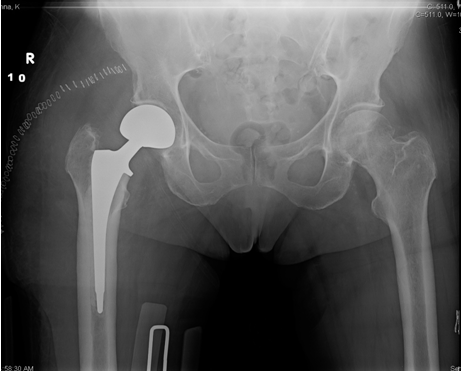
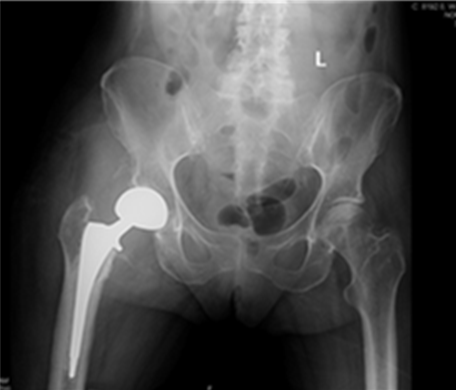
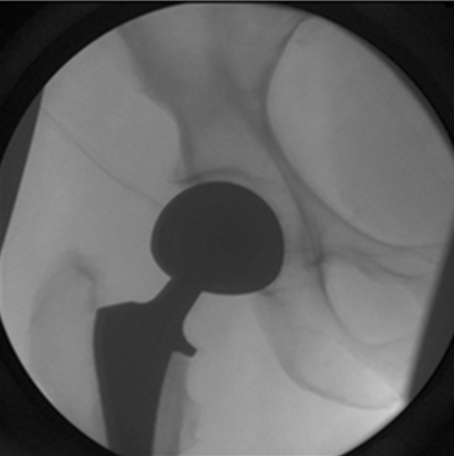
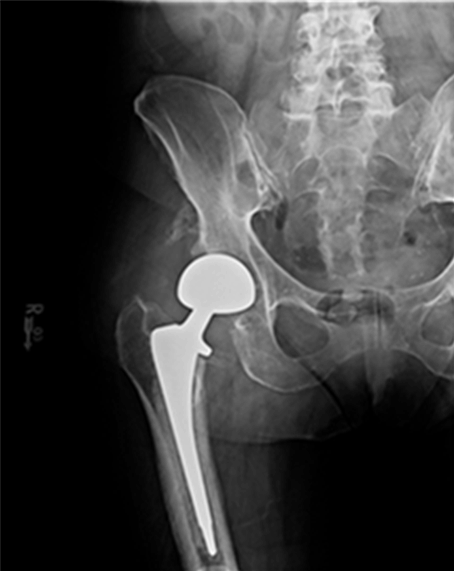
A 53-year-old female presented to the emergency room with pain in the right hip. She was unable to ambulate and had drainage from a right posterolateral hip incision. Ten days prior to presentation she underwent hemi-arthroplasty of the right hip by a physician at another hospital. She was unhappy with her postoperative care at the outside hospital and thus presented to our emergency department for evaluation and treatment. She was unable to recall any recent trauma or incident that caused her worsening pain. The patient was not a community ambulator prior to her surgery but would ambulate at home with assistive devices. She had a history of stage IV lung cancer, with chemotherapy and radiation treatment, as well as brain metastasis. She was receiving palliative care. Upon examination, the patient was sitting up in bed and appeared to be comfortable. It was noted that the right leg was shortened and internally rotated. The patient was afebrile and vital signs were stable. Staples were in place over the posterolateral hip incision. The area was erythematous and had some mild drainage. There was no obvious wound dehiscence or purulent material. Her right leg was well perfused with a normal sensorimotor examination. Laboratory examinations revealed a C-reactive protein 13.8, erythrocyte sedimentation rate (ESR) 15 and white blood cell count 8.09 cm3. Imaging of the right hip showed a posterior dislocation of the right hip status post bipolar hemiarthroplasty (Figure 1). After obtaining consent, under propofol sedation, the patient's hip was reduced in the emergency room using the Allis maneuver. Reduction was confirmed by radiograph (Figure 2). The patient was admitted with an abduction pillow and knee immobilizer. She was started on antibiotic therapy for the surgical site infection. She was placed on posterior hip precautions with touch-down weight-bearing status to the right lower extremity. For several days, the wound was monitored and it was felt that the infection would resolve with IV antibiotic therapy. However, no improvement was noted. So on hospital day-5, the patient returned to the operating room for irrigation and debridement of the right hip. Cultures from the wound were positive for multiple organisms and the patient was started on a course of vancomycin and levaquin. On postoperative day-1, hospital day-6, the patient's right lower extremity was noted to be shorter than the left. X-rays of the right hip revealed a dislocated right hemiarthroplasty (Figure 3). The patient was taken back to the operating room that day for reduction. The hip was reduced using a sheet over the pelvis for counter traction. The right leg was gently adducted and flexed with longitudinal traction. Reduction was confirmed on two views and the patient was transferred back to the floor with an abduction pillow. On hospital day-9, the patient was discharged to rehab with an abduction brace and was instructed on touch-down weight-bearing to the right leg. Three weeks from discharge, the patient presented to clinic for follow-up. The hip remained reduced (Figure 4). Sutures were removed and there were no additional concerns. Two weeks after the first clinic visit, the patient presented to the emergency room with another right hip dislocation (Figure 5). The surgical site remained clean with no signs or symptoms of infection. She, admittedly, had been non-compliant with her abduction brace. She was admitted overnight for reduction the next morning. We discussed with the patient the possibility of a girdle stone procedure versus closed reduction based on her chronic diagnosis of stage IV lung cancer. Patient elected to proceed with a closed reduction with an understanding that compliance with bracing would be needed. The next morning, the patient was brought to the operating room and placed on a radiolucent flat top table. A sheet was placed over the pelvis for countertraction and the same reduction maneuver was performed as before. After an unsuccessful attempt at reduction, the patient was transferred to a fracture table with a well-padded perineal post. Bilateral lower extremities were placed in longitudinal traction. With longitudinal traction, the right leg was externally rotated, then internally rotated and abducted. The hip was reduced and remained stable through range of motion (Figure 6). The patient was then transferred back to the floor with an abduction pillow. The next day, the patient was discharged back to the rehab facility. She was instructed on touchdown weight-bearing to the right leg. She was strongly encouraged to be compliant with her abduction brace at all times out of bed and with an abduction pillow in bed. At the time of this writing, the patient is three months status post right hip reduction on fracture table. She has returned to clinic on three occasions. She has remained compliant with the brace and pillow. Her hip remains reduced and her surgical site is well healed (Figure 7). She has graduated to full weight-bearing status. | ||||||
| ||||||
| ||||||
| ||||||
| ||||||
| ||||||
| ||||||
| ||||||
|
Discussion
| ||||||
|
Dislocation of bipolar hemiarthroplasty is not a common complication, but it is a problem that needs acute management and can be difficult to correct. Many hip hemiarthroplasties that dislocate require open reduction and revision. The reduction of a hip hemiarthroplasty is a tenuous process that requires gentle reduction and great care to protect both the implant and the native bone. In a study performed by Sierra et al. [4], dislocations at 1, 5, 10, and 20 years were 1.1%, 1.5%, 2.1% and 5% respectively. More than half of the dislocations occurred in the first six months postoperatively. Only 30% of patients were treated successfully with closed reduction and no need for additional surgery. Another study published by Salem et al. [5], shows their dislocation rate of hip hemiarthroplasties to be 0.76%. The majority of dislocations in their study occurred in the first six weeks after surgery and closed reduction was the definitive treatment in only 23% of the cases. There are many techniques described for reducing a hip dislocation, but the literature has not thoroughly explored the use of a fracture table as a reduction technique. Commonly described reduction maneuvers include Allis', Bigelow's, Rochester and the Gravity method of Stimson. Position of the patient varies per maneuver, but the hip is generally gently flexed, internally rotated and then externally rotated into reduction. An article published by Flint et al. [6], describes a similar technique to the fracture table technique. They describe using an operating table with a peg board attached. They feel that this technique is more timely than placing the patient on a fracture table and may be of use in non-reducible hips requiring open reduction. The article describes a reduction technique combining longitudinal traction, internal rotation and pressure over the greater trochanter. While the peg board technique may allow for easier transition to open reduction, it does not offer the same gentle controlled traction that a fracture table provides. | ||||||
|
Conclusion
| ||||||
|
In conclusion, an irreducible hemiarthroplasty dislocation may be treated with a fracture table using controlled traction. This technique may allow the hip to be closed reduced without the need for an open reduction. | ||||||
|
Acknowledgements
| ||||||
|
We are thankful to Dana L. Garrison for her help and support in preparing this report. | ||||||
|
References
| ||||||
| ||||||




|
[HTML Abstract]
[PDF Full Text]
|
|
Author Contributions
Chelsea S. Mathews – Substantial contributions to conception and design, Acquisition of data, Analysis and interpretation of data, Drafting the article, Revising it critically for important intellectual content, Final approval of the version to be published Robert L. Garrison II – Substantial contributions to conception and design, Acquisition of data, Analysis and interpretation of data, Drafting the article, Revising it critically for important intellectual content, Final approval of the version to be published Regis L. Renard – Substantial contributions to conception and design, Acquisition of data, Analysis and interpretation of data, Drafting the article, Revising it critically for important intellectual content, Final approval of the version to be published |
|
Guarantor of submission
The corresponding author is the guarantor of submission. |
|
Source of support
None |
|
Conflict of interest
Authors declare no conflict of interest. |
|
Copyright
© 2017 Chelsea S. Mathews et al. This article is distributed under the terms of Creative Commons Attribution License which permits unrestricted use, distribution and reproduction in any medium provided the original author(s) and original publisher are properly credited. Please see the copyright policy on the journal website for more information. |
|
|