| |
|
|
|
Case Report
| ||||||
| Intralobar pulmonary sequestration: A rare presentation in adults | ||||||
| Ahmed Ehab1, Marwa Ghanem1, Ahmed Ibrahim Twafik2, Magda Abdel-salam1, Nasef Abdel-Salam A. Rezk1, Asem A. Hewidy1 | ||||||
|
1Department of Chest Medicine, Faculty of Medicine, Mansoura University, Egypt.
2Department of Diagnostic and Interventional Radiology Faculty of Medicine, Mansoura University, Egypt. | ||||||
| ||||||
|
[HTML Abstract]
[PDF Full Text]
[Print This Article]
[Similar article in Pumed] [Similar article in Google Scholar] 
|
| How to cite this article |
| Ehab A, Ghanem M, Twafik AI, Abdel-Salam M, Abdel-Salam N, A. Rezk NA, Hewidy AA. Intralobar pulmonary sequestration: A rare presentation in adults. Int J Case Rep Images 2017;8(2):133–137. |
|
Abstract
|
|
Introduction:
Pulmonary sequestration represents a rare congenital anomaly of the lower respiratory tract. Interlobar sequestration is the most common form and usually presents in the left hemithorax during the second decade of life or earlier. Its blood supply usually arises from systemic circulation. Surgical intervention is the treatment of choice in patients with pulmonary sequestration.
Case Report: We describe a late presentation of an intralobar sequestration in a 59-year-old male. It presented with recurrent attack of hemoptysis. Radiological investigations revealed pulmonary sequestration. Two unusual features were found in this case: being in the right side and having double blood supply from both systemic and pulmonary circulation. Conclusion: In this case report, we described a case of unusual presentation of ILS in old patients, right sided with double blood supply from both pulmonary artery and abdominal aorta. | |
|
Keywords:
Intralobar pulmonary sequestration, Lung anomalies, Pulmonary angiography
| |
|
Introduction
| ||||||
|
Pulmonary sequestration is a rare congenital malformation of the lower respiratory tract. It defined as a nonfunctioning primitive solid or cystic aberrant lung mass which has no connection with tracheobronchial tree and has systemic arterial supply [1]. Intralobar sequestration (ILS) is overall the most common form. In 50–60% of cases, the diagnosis of ILS is made during the second decade or younger. Later presentation is rare [2]. Surgical excision is the treatment of choice of pulmonary sequestration. The preoperative assessment includes besides confirmation of the diagnosis the proper identification of the vascular supply of the sequestartion [3]. We describe intralobar pulmonary seqestration in a male patient 59-year-old, who presented with recurrent attacks of hemoptysis. The discovered ILS was abnormally supplied with a double blood supply. | ||||||
|
Case Report
| ||||||
|
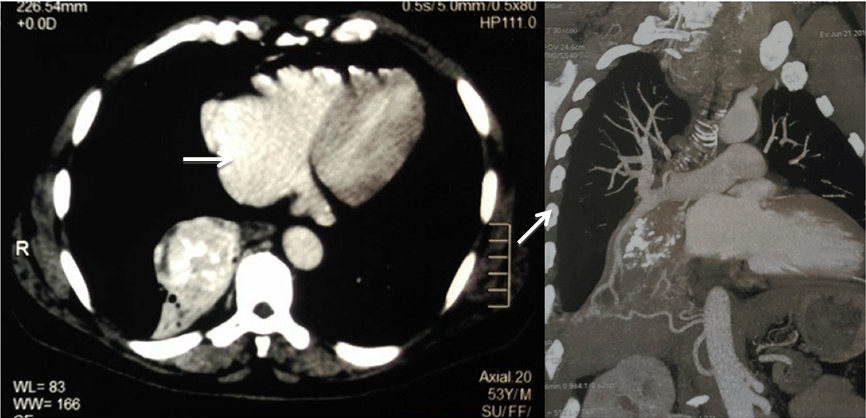
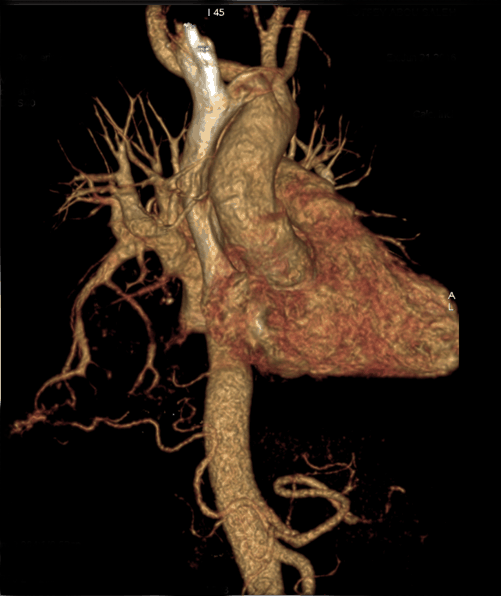
A 59-year-old male current smoker presented with recurrent attacks of hemoptysis. The first attack started 12 years ago, after that he experienced recurrent attacks of blood-tinged sputum (average 3 attacks per year). The patient was first investigated in the primary health care facility where chest X-ray (Figure 1) was done and was interpreted as a case of bronchitis despite the obvious right para cardiac opacity. The patient was treated with supportive measures. Then the patient was admitted to a general hospital due to another attack of hemoptysis with syncope. Computed tomography scan of thorax with contrast revealed right lower lobe opacity with calcification (Figure 2). Due to the suspicious of malignancy, ultrasonographic-guided aspiration was done twice and the pathological examination revealed fibrous tissue with dilated vascular spaces. Finally, the patient was referred to our chest medicine department for further evaluation and bronchoscopy. After revision of his history and chest radiology, the pulmonary sequestration was suspected besides other benign lung lesions and CT angiography was ordered before any further interventions. It revealed evidence of right intralobular pulmonary sequestration. It has dual arterial supply from both right pulmonary artery and multiple branches from aorta arise, the venous drainage into right pulmonary vein (Figure 2) and (Figure 3). Finally, the patient was transferred to the surgical department for surgical intervention, but the patient refused to perform any interventions. | ||||||
| ||||||
| ||||||
| ||||||
|
Discussion
| ||||||
|
Pulmonary sequestration was first described by Pryce in 1946. Its name was derived from the Latin verb 'sequestrate' which means to set apart. It can be defined as a developmental lung disease with non-functioning pulmonary tissue; which has no communication with the bronchial tree and receive a systemic blood flow [4]. Pulmonary sequestration is classified into three subtypes:
The incidence of the pulmonary sequestration is rare and represented about 0.15–6.4% of all congenital pulmonary malformations [6]. Generally, ILS is the most common form of pulmonary sequestration. It represents about 75–90% with no sex differentiation [5]. The embryologic basis of the pulmonary sequestration remained unclear. Many possibilities had been suggested. The first referred to very early abnormality in the development during lung bud formation. Another theory suggested mechanical separation of a portion of the developing lung due to compression or traction by aberrant vascular structure or inadequate pulmonary blood flow. However, the mechanical theory cannot fully explain all types of the pulmonary sequestration especially BPFM [7]. The third theory suggested that ILS may be an acquired rather than developmental lesion [8]. Recently, researchers found that the abnormal vascular development in the pulmonary arterial blood supply can lead to retention and proliferation of the nascent systemic capillary network [1]. Intralobar sequestration (ILS) usually presents in patients less than 20 years of age in 50% of the patients and rarely found in patients older than 50 years. Lower lobe above the diaphragm is typically the mostly affected area and left side is common in 55–60% of the patients [2] [4]. Herein, we describe presentation of ILS in a male patient 59-year-old which is not only atypical due to the old age but also due to the atypical site in the right lower lobe. The time of ILS presentation is variable. It usually present in late childhood or adolescence. It presented with recurrent lower respiratory tract infection. Hemoptysis and chest pain were also reported. It may be also asymptomatic and discovered in routine chest radiology in 15.5% of the patients with ILS [6] . In rare cases, heart failure occurs due to high flow through the anomalous artery [1]. The radiological assessment aimed not only to confirm the sequestration diagnosis, but also to evaluate its vascular supply for further management. Besides the chest radiography, ultrasonography, computed tomography scan and magnetic resonance imaging scan, the relatively recent introduced angiography represent the diagnostic tool of choice to define the vascular supply prior to any surgical intervention [3]. Single feeding blood supply was detected in 71% of the patients. It arises from the thoracic aorta in 36% [6]. The intralobar sequestration can be classified according to Pryce et al. into:
The main management of the pulmonary sequestration in symptomatic patient is surgical resection for curative purposes. Proper identification and ligation of the feeding vessels is crucial. While in asymptomatic patients with ILS, the surgery is also recommended to prevent recurrent infections and the unfavorable cardiac influence caused by the existing aortopulmonary shunt. Recently, published data has introduced the emerging successful role of video-assisted thoracoscopic surgery (VATS) for pulmonary sequestration resection despite the difficulties in surgical dissection due to recurrent inflammation and fibrosis owing to the recurrent infections [9]. Arterial embolization of the feeding vessels has been also reported [10]. | ||||||
|
Conclusion
| ||||||
|
The interesting points in our case include the late presentation of the patient (59-year-old), unusual right-sided Intralobar sequestration (ILS) and the double blood supply from both pulmonary artery and abdominal aorta. Finally, we should emphasize the importance of proper interpretation of the chest radiology by the primary medical care providers as a standard tool of chest examination for early and adequate diagnosis of catastrophic hidden chest diseases. | ||||||
|
References
| ||||||
| ||||||
|
[HTML Abstract]
[PDF Full Text]
|
|
Author Contributions
Ahmed Ehab – Substantial contributions to conception and design, Acquisition of data, Analysis and interpretation of data, Drafting the article, Revising it critically for important intellectual content, Final approval of the version to be published Marwa Ghanem – Analysis and interpretation of data, Revising it critically for important intellectual content, Final approval of the version to be published Ahmed Ibrahim Twafik – Analysis and interpretation of data, Revising it critically for important intellectual content, Final approval of the version to be published Magda Abdel-salam – Analysis and interpretation of data, Revising it critically for important intellectual content, Final approval of the version to be published Nasef Abdel-Salam A. Rezk – Analysis and interpretation of data, Revising it critically for important intellectual content, Final approval of the version to be published Asem A. Hewidy – Analysis and interpretation of data, Revising it critically for important intellectual content, Final approval of the version to be published |
|
Guarantor of submission
The corresponding author is the guarantor of submission. |
|
Source of support
None |
|
Conflict of interest
Authors declare no conflict of interest. |
|
Copyright
© 2017 Ahmed Ehab et al. This article is distributed under the terms of Creative Commons Attribution License which permits unrestricted use, distribution and reproduction in any medium provided the original author(s) and original publisher are properly credited. Please see the copyright policy on the journal website for more information. |
|
|
|
About The Authors
| |||
| |||
| |||
| |||
| |||
| |||
| |||