| |
|
|
|
Case Report
| ||||||
| A case of inversely fused tooth of impacted maxillary third molar and supernumerary tooth | ||||||
| Eiji Mitate1,2, Shintaro Kawano2, Yurie Mikami2, Tamotsu Kiyoshima3, Tetsuro Ikebe1, Seiji Nakamura2 | ||||||
|
1Section of oral surgery, Department of Oral and Maxillofacial Surgery, Fukuoka Dental College, 2-15-1, Tamura, Sawara-ku, Fukuoka 814-0175, Japan.
2Section of Oral and Maxillofacial Oncology, Division of Maxillofacial Diagnostic and Surgical, Sciences, Faculty of Dental Science, Kyushu University, 3-1-1, Maidashi, Higashi-ku, Fukuoka 812-8582, Japan. 3Laboratory of Oral Pathology, Division of Maxillofacial Diagnostic and Surgical Sciences, Faculty of Dental Science, Kyushu University, 3-1-1, Maidashi, Higashi-ku, Fukuoka 812-8582, Japan. | ||||||
| ||||||
|
[HTML Abstract]
[PDF Full Text]
[Print This Article]
[Similar article in Pumed] [Similar article in Google Scholar] 
|
| How to cite this article |
| Mitate E, Kawano S, Mikami Y, Kiyoshima T, Ikebe T, Nakamura S. A case of inversely fused tooth of impacted maxillary third molar and supernumerary tooth. Int J Case Rep Images 2017;8(2):129–132. |
|
Abstract
|
|
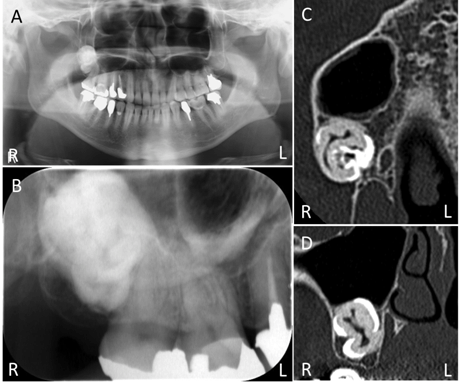
We report an extremely rare case of an impacted maxillary third molar inversely fused with a supernumerary tooth in a 51-year-old male. The panoramic and dental radiographs show a radiopaque and tooth-like mass of 20×15 mm located in the third maxillary region of the right maxilla. Computed tomography revealed that the tooth-like structure was a union of the impacted maxillary third molar with a inversed supernumerary tooth, creating a fused tooth with a common dental pulp. To our knowledge, only one case of inversely fusion of a maxillary third molar with a supernumerary tooth has been reported.
| |
|
Keywords:
Anomaly. Impacted third molar, Inversed fused tooth, Maxilla, Supernumerary tooth
| |
|
Introduction
|
|
Fused teeth result from the union of two or more tooth germs in the developing stage. This is common in the lower anterior, but rare in maxilla, and found in both sexes [1]. They are more commonly found in the deciduous dentition than in the permanent dentition. The reported incidence rate ranges from 0.5–2.5% [1]. But the etiology is still unknown. We report an extremely rare case of an impacted maxillary third molar inversely fused with a supernumerary tooth. |
|
Case Report
|
|
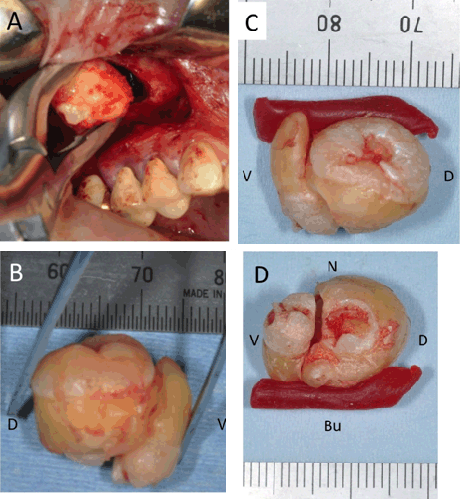
A 51-year-old male patient visited oral and maxillofacial surgery of Kyushu University Hospital complaining of slight pain in the right maxillary molar region. Clinical examination revealed slight percussion pain on maxillary tuberosity, but with no sign of infection such as swelling and redness of the gingival mucosa, fistula formation, and pus discharge in the right maxilla. The right maxillary third molar was not erupted. First, we take a panoramic X-ray for overview, and dental X-ray for detail. The panoramic and dental radiographs showed a radiopaque mass (20x15 mm) located in the third maxillary molar region of the right maxilla (Figure 1A-B). To detect its shape and location, we took computed tomography (CT). Computed tomography scan revealed a tooth-like mass composed of an enamel-like and a dentin-like region, and dental pulp-like cavities near arteria palatina major (Figure 1C-D). Furthermore, the mass consisted of two tooth-like structures that shared a dental pulp cavity. The lesion was partially projecting into the right maxillary sinus (Figure 1D). The clinical diagnosis of the lesion was odontoma or fused tooth and slight pericoronitis may cause slight pain. As he had slight pain, removal of the mass through the canine fossa of maxilla was planed. From the point of view of operation time and procedure, this operation was performed under general anesthesia. The mass was divided into two pieces at removal, because the size of the mass was larger than that of the canine fossa aperture. The extirpated mass is shown in Figure 2. |
|
|
|
|
|
Discussion
|
|
Levitas [2] suggested that dental malformation might be classified as gemination, twinning, concrescence, and fusion. A fused tooth is defined as one in which there is union of dentin from two separate tooth germs during development. On the other hand, occurrence of two teeth with cementum union indicates concrescence. In this case, the mass consisted of two tooth-like structures that shared one dental pulp cavity, as revealed by CT scan. This mass was found to result from an inversely fusion of the third molar with a supernumerary tooth because the mass was located at the site of the third maxillary molar region and since the number of erupted teeth was normal. With respect to fusion of the third molar and the supernumerary tooth, a number of reports in English scientific literature have described this occurrence primarily in the mandible [3] [4] [5] [6] [7], but there is only one report of a fused tooth in the maxilla [8]. On the other hand, we found many reports in Japanese scientific literature. For example, Uchida [8] reviewed 46 cases of supernumerary teeth fused with maxillary or mandibular third molars reported between 1934 and 2008 in the Japanese literature. Of the 46 cases (24 males and 22 females), 12 were in the right maxilla and 10 were in the left maxilla. However, it was unclear whether these included a case of inversely fused tooth. Nakanishi [9] reported that the prevalence of supernumerary tooth is almost 1% in all regions of the dentition, and only 0.063% in the upper molar region. This suggests that the frequency of fusion of the maxillary third molar and supernumerary tooth may be even lower. These facts, considered together, indicate the extreme rarity of this case. Sugibayashi [10] proposed that the causes of supernumerary teeth might be heredity, physical forces, and/or trauma in the tooth germ. Some cases of fusion between maxillary third molar and supernumerary tooth have been reported in English literature. The association of hereditary, racial, or environmental factors with the pathogenesis of this anomaly may not have been explored in detail. About the treatment, most of the cases were extracted with local anesthesia. These kinds of cases were found after eruption. In this case, fused teeth were fully impacted, and located near arteria palatina major and pterygoid plexus. As we have to remove more carefully, operation under local anesthesia is intolerable. |
|
Conclusion
|
|
We reported a rare case of inversely fusion of impacted maxillary third molar and supernumerary tooth. In previous reports, the reason may be hereditary, racial, or environmental factors and so on. To remove the fused teeth, we have to take better procedure of removal and anesthesia. |
|
References
|
|
|
[HTML Abstract]
[PDF Full Text]
|
|
Author Contributions
Eiji Mitate – Substantial contributions to conception and design, Acquisition of data, Analysis and interpretation of data, Drafting the article, Revising it critically for important intellectual content, Final approval of the version to be published Shintaro Kawano – Substantial contributions to conception and design, Acquisition of data, Analysis and interpretation of data, Drafting the article, Revising it critically for important intellectual content, Final approval of the version to be published Yurie Mikami – Substantial contributions to conception and design, Acquisition of data, Analysis and interpretation of data, Drafting the article, Revising it critically for important intellectual content, Final approval of the version to be published Tamotsu Kiyoshima – Substantial contributions to conception and design, Acquisition of data, Analysis and interpretation of data, Drafting the article, Revising it critically for important intellectual content, Final approval of the version to be published Tetsuro Ikebe – Substantial contributions to conception and design, Acquisition of data, Analysis and interpretation of data, Drafting the article, Revising it critically for important intellectual content, Final approval of the version to be published Seiji Nakamura – Substantial contributions to conception and design, Acquisition of data, Analysis and interpretation of data, Drafting the article, Revising it critically for important intellectual content, Final approval of the version to be published |
|
Guarantor of submission
The corresponding author is the guarantor of submission. |
|
Source of support
None |
|
Conflict of interest
Authors declare no conflict of interest. |
|
Copyright
© 2017 Eiji Mitate et al. This article is distributed under the terms of Creative Commons Attribution License which permits unrestricted use, distribution and reproduction in any medium provided the original author(s) and original publisher are properly credited. Please see the copyright policy on the journal website for more information. |
|
|