
  |

|
 |
|
Case Report
| ||||||
| A case of uncombable hair syndrome and global developmental delays | ||||||
| Hana Kathryn Cobb1, Alvin Yuhico Tiu2 | ||||||
|
1BS, Fourth Year Medical Student, University of Washington School of Medicine, Seattle, Washington, United States.
2MD, Attending Physician, Family Medicine, VA Puget Sound Health Care System, Seattle, Washington, United States. | ||||||
| ||||||
|
[HTML Abstract]
[PDF Full Text]
[Print This Article]
[Similar article in Pumed] [Similar article in Google Scholar] 
|


| How to cite this article |
| Cobb HK, Tiu AY. A case of uncombable hair syndrome and global developmental delays. Int J Case Rep Images 2017;8(2):108–111. |
|
Abstract
|
|
Introduction:
Uncombable hair syndrome, also known as spun-glass hair and pili trianguli et canaliculi, is a rare genetic disorder where a structural anomaly of the hair shaft causes silvery-blonde, disorganized and unruly hair. The hair is usually normal in infancy, becomes uncombable during the first year of life, and improves during puberty or later in life. All scalp hair is affected. However, other body hair is unaffected. Uncombable hair syndrome is usually isolated and not typically associated with developmental delays or disorders of other organs. Autosomal dominant and sporadic inheritance patterns have been reported. A genetic mutation or causal gene has not been identified.
Case Report: We report a case of 17-month-old girl with uncombable hair and global developmental delays. She was born with straight brown hair, However by four months of age her hair became silvery, stiff, and unruly. Extensive evaluation by specialists failed to identify a reason for her developmental delays. Both parents were healthy and had normal hair. The maternal grandmother had blonde, coarse and slightly unruly hair that was worse when she was younger and improved during puberty. Microscopic hair evaluation of the child's hair showed triangular cross sections (pili trianguli) and longitudinal canal-like grooves (pili canaliculi) confirming the diagnosis of uncombable hair syndrome. Conclusion: Uncombable hair syndrome is a rare genetic disorder that must be suspected clinically. Scanning electron microscopy can confirm the diagnosis, differentiate uncombable hair syndrome from other hair shaft anomalies and accurately determine the inheritance pattern within a family. | |
|
Keywords:
Congenital hair anomalies, Genodermatoses, Pili trianguli et canaliculi, Spun-glass hair, Uncombable hair syndrome
| |
|
Introduction
| ||||||
|
Uncombable hair syndrome, also known as spun-glass hair and pili trianguli et canaliculi, is a rare genetic disorder where a structural anomaly of the hair shaft causes the hair to be silvery-blonde, disorganized and stand out from the scalp [1] [2] [3]. The hair is usually normal in infancy, becomes uncombable during the first year of life, and improves in late childhood or during puberty [1] [2] [3] [4]. The stiffness and unruly nature of the hair is due to premature keratinization of the inner root sheath [1]. The diagnosis must be suspected clinically and can be confirmed with microscopy. Scanning electron microscopy shows both characteristic features of uncombable hair syndrome: triangular cross sections (pili trianguli) and canal-like longitudinal grooves (pili canaliculi) [1] [2] [3] [4] [5]. Uncombable hair syndrome is usually an isolated disorder and not associated with developmental delays, diseases of other organs, or other genetic syndromes [1] [2] . Autosomal dominant and sporadic inheritance patterns have been reported. A genetic mutation or causal gene has yet to be identified [1][2][4][6]. | ||||||
|
Case Report
| ||||||
|
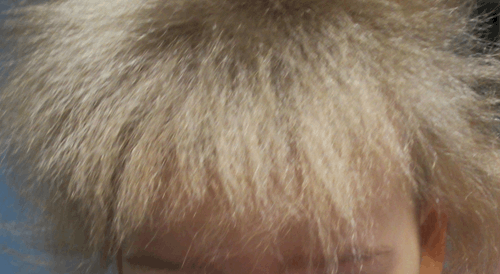
A 17-month-old baby girl was presented to the dermatology and genetics clinics with unusual hair. She was born at 36 weeks gestation by spontaneous vaginal delivery following an uneventful pregnancy. She received phototherapy for perinatal jaundice. She was born with straight dark brown hair; however, by four months of age her hair became progressively silvery-blonde, dry, stiff and unruly. Her parents were unable to comb her hair flat and different treatments and shampoos were not effective. She had low muscle tone and global developmental delays. She did not walk and had just started to crawl. She had difficulty swallowing and sometimes rocked back and forth to soothe herself when she was upset. Both parents were healthy, had no other children, and had normal hair. The maternal grandmother had blonde, coarse and slightly unruly hair that was worse when she was younger and improved during puberty. No other family members had unusual hair. On examination the patient's scalp hair was shiny, silvery-blonde, coarse and stuck out from her head (Figure 1). Her eyebrows, eyelashes, fingernails, toenails and the remainder of her body hair were normal. The quality and appearance of her skin was normal. On neurological assessment she was hypotonic with decreased deep tendon reflexes. Her fine motors skills, gross motor skills and speech were delayed six months. A swallow study showed aspiration of thin liquids. Routine vision screening, hearing screening, EEG and brain MRI scan were normal. Genetic and metabolic testing including array comparative genomic hybridization, newborn metabolic screening, Prader–Willi syndrome testing, urine organic acids, plasma amino acids, and transferrin isoelectric focusing for congenital disorders of glycosylation were normal. Serum ammonia, lactate, copper, ceruloplasmin and creatine kinase were also normal. The extensive medical testing and evaluation failed to identify a unifying cause or genetic syndrome to explain her hypotonia and developmental delays. Uncombable hair syndrome was suspected based on the appearance of her scalp hair and the family history. Scanning electron microscopy of her hair showed triangular cross sections (pili trianguli) and longitudinal canal-like grooves (pili canaliculi) consistent with uncombable hair syndrome. The patient's family was advised to gently brush her hair and avoid harsh chemicals in the hair. They were advised that the stiffness and unruly nature of her hair should improve during puberty or later in life. | ||||||
| ||||||
| ||||||
|
Discussion
| ||||||
|
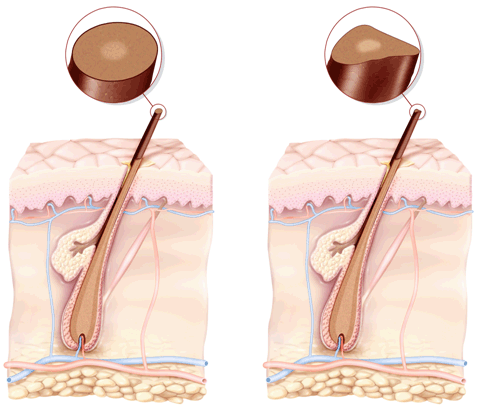
Uncombable hair syndrome, also known as spun-glass hair and pili trianguli et canaliculi, is a rare genetic hair disorder. It was likely first described in the book 'Les Velus' (the Hirsute) where an affected individual was described as having mop hair [7]. The hair is generally normal in infancy, becomes unruly and uncombable between three and twelve months of life, and improves during puberty or later in life [1] [2][3][4] [5]. All scalp hair is affected; however, the eyelashes, eyebrows and remaining body hair are generally unaffected. The hair quantity and tensile strength is normal [1] [2] [3]. A structural anomaly of the hair shaft causes the hair to be silvery-blonde, disorganized, coarse and stand out from the scalp. The stiffness and unruly nature of the hair is due to the triangular, or kidney-shaped, hair shaft when viewed in cross section (Figure 2). Premature keratinization of the inner root sheath of the hair alters the shape of the hair shaft [3]. The silvery or shiny appearance of the hair is due to the way the unique hair shaft reflects light [3] [7]. Treatment for uncombable hair syndrome is largely ineffective and generally limited to gentle handling, soft brushes, avoidance of harsh chemical treatments and creative styling [3] [5]. There is a report of a patient who had increased hair growth and improved combability of their hair following four months of oral biotin supplementation [8]. Hair conditioners with zinc pyrithione may lead to some improvement due to a moisturizing effect [3]. The condition usually spontaneously improves in late childhood or during puberty [2][3] [5]. The diagnosis of uncombable hair syndrome must be suspected clinically and is confirmed with microscopy [1] [7]. The differential diagnosis is primarily the other structural hair anomalies including monilethrix, pili annulati, pili torti (twisting hair), pseudomonilethrix, trichorrhexis invaginata (bamboo hair), trichorrhexis nodosa (broom stick hair), and wooly hair [2] [5][6]. Most hair shaft defects can be readily seen with light microscopy. Light microscopy of an uncombable hair syndrome hair shaft may show a band or darkening on one edge caused by the shadow as light passes over the longitudinally grooved hair. Gently moving the microscope's micrometer may allow the observer to see the canal along the length of the hair [2] [3]. However, often the hair appears normal under light microscopy. The diagnosis of uncombable hair syndrome can be reliably confirmed with scanning electron microscopy where the two classic hair shaft alterations are clearly seen: triangular cross sections (pili trianguli) and longitudinal canal-like grooves (pili canaliculi) [1][2][3] [5]. If scanning electron microscopy is not available, light microscopic examination of hairs embedded in paraffin show the triangular hair cross sections [3] [5]. Uncombable hair syndrome is usually an isolated condition and not typically associated with other genetic syndromes, disorders of other organs, developmental delays or neuropsychological problems. Genetic counseling for uncombable hair syndrome is not indicated unless features of other genetic syndromes are present [1] [2][9]. Affected individuals often have a negative family history, implying sporadic inheritance, though the characteristic hair shaft anomaly may be seen in clinically unaffected family members when hair is evaluated with scanning electron microscopy. In one report, two siblings were clinically affected and both parents had normal hair. Scanning electron microscopic evaluation of the affected siblings and their father showed the classic hair morphology (pili trianguli et canaliculi) indicating autosomal dominant inheritance in the family [2] [4]. Uncombable hair syndrome is not clinically detectable unless at least 50% of the hairs are affected [1] [3]. Autosomal dominant inheritance has been reported with both complete and incomplete penetrance [3] [9]. Families thought to have incomplete penetrance may actually show complete penetrance when clinically unaffected family members are evaluated with scanning electron microscopy. A causal gene, locus or mutation has yet to be identified [3] [5] [6]. | ||||||
|
Conclusion
| ||||||
|
Uncombable hair syndrome is a rare genetic structural hair shaft anomaly with autosomal dominant and sporadic inheritance patterns reported. Treatment is usually not effective and the condition often spontaneously resolves during puberty. Scanning electron microscopy is useful to differentiate uncombable hair syndrome from the other hair shaft anomalies and to accurately determine the inheritance pattern within a family. Potential future investigations to consider include attempts to identify a causative gene and determine possible associations of uncombable hair syndrome with other medical conditions or genetic syndromes. | ||||||
|
References
| ||||||
| ||||||

|
[HTML Abstract]
[PDF Full Text]
|
|
Author Contributions
Hana Kathryn Cobb – Substantial contributions to conception and design, Acquisition of data, Analysis and interpretation of data, Drafting the article, Revising it critically for important intellectual content, Final approval of the version to be published Alvin Yuhico Tiu – Substantial contributions to conception and design, Drafting the article, Revising it critically for important intellectual content, Final approval of the version to be published |
|
Guarantor of submission
The corresponding author is the guarantor of submission. |
|
Source of support
None |
|
Conflict of interest
Authors declare no conflict of interest. |
|
Copyright
© 2017 Hana Kathryn Cobb et al. This article is distributed under the terms of Creative Commons Attribution License which permits unrestricted use, distribution and reproduction in any medium provided the original author(s) and original publisher are properly credited. Please see the copyright policy on the journal website for more information. |
|
|