
  |

|
 |
|
Case Report
| ||||||
| Diaphragmatic pacing as a treatment option for congenital central hypoventilation syndrome | ||||||
| Rodrigo A. S. Sardenberg1, Riad N. Younes1 | ||||||
|
1MD, Thoracic Surgery Department, Hospital Alemão Oswaldo Cruz Brazil.
| ||||||
| ||||||
|
[HTML Abstract]
[PDF Full Text]
[Print This Article]
[Similar article in Pumed] [Similar article in Google Scholar] 
|


| How to cite this article |
| Sardenberg RAS, Younes RN. Diaphragmatic pacing as a treatment option for congenital central hypoventilation syndrome. Int J Case Rep Images 2017;8(2):101–104. |
|
Abstract
|
|
The aim of this study is to present a 15-month-old child, case of congenital central hypoventilation syndrome successfully treated by diaphragmatic pacing. The diagnosis of this syndrome depends on the documentation of hypoventilation during sleep in the absence of primary neuromuscular, lung, cardiac, metabolic disease, or an identifiable brainstem lesion. While the cause of central congenital hypoventilation syndrome is not completely elucidated, the patients have mutations of the PHOX2B gene on chromosome 4. The diaphragmatic pacemaker currently represents an excellent treatment option, and the use of this device can provide reduction in upper airway infections and quality of life improvement.
| |
|
Keywords:
Diaphragm, Diaphragmatic paralysis, Pacemaker, Phrenic nerve
| |
|
Introduction
| ||||||
|
Classical congenital central hypoventilation syndrome (CCHS), also known as Ondine's Curse, is characterized by hypoventilation with normal respiration rates and shallow breathing during sleep with adequate ventilation during wakefulness. Severely affected individuals hypoventilate also when awake [1]. The CCHS represents an increasingly recognized group of conditions characterized by respiratory and autonomic nervous system dysregulation [2]. This rare disease was first reported in 1970 as a case report titled "Failure of Autonomic Control of Ventilation" [3] , and came most visibly to the medical and public community with the American Thoracic Society (ATS) statement on CCHS in 1999 [2]. The diagnosis of CCHS is suspected due to absence of adequate ventilation during sleep, and others diseases were ruled out. While the cause of CCHS is not completely elucidated, those with CCHS have mutations of the PHOX2B gene, on chromosome 4. There are two types of disease presentation: the classic way, where the patient needs ventilatory support only during sleep (80% of cases), and the severe (20% of cases) when the patient requires ventilatory support 24 hours/day. We report a CCHS patient with severe presentation type, successfully treated by diaphragmatic pacing. | ||||||
|
Case Report
| ||||||
|
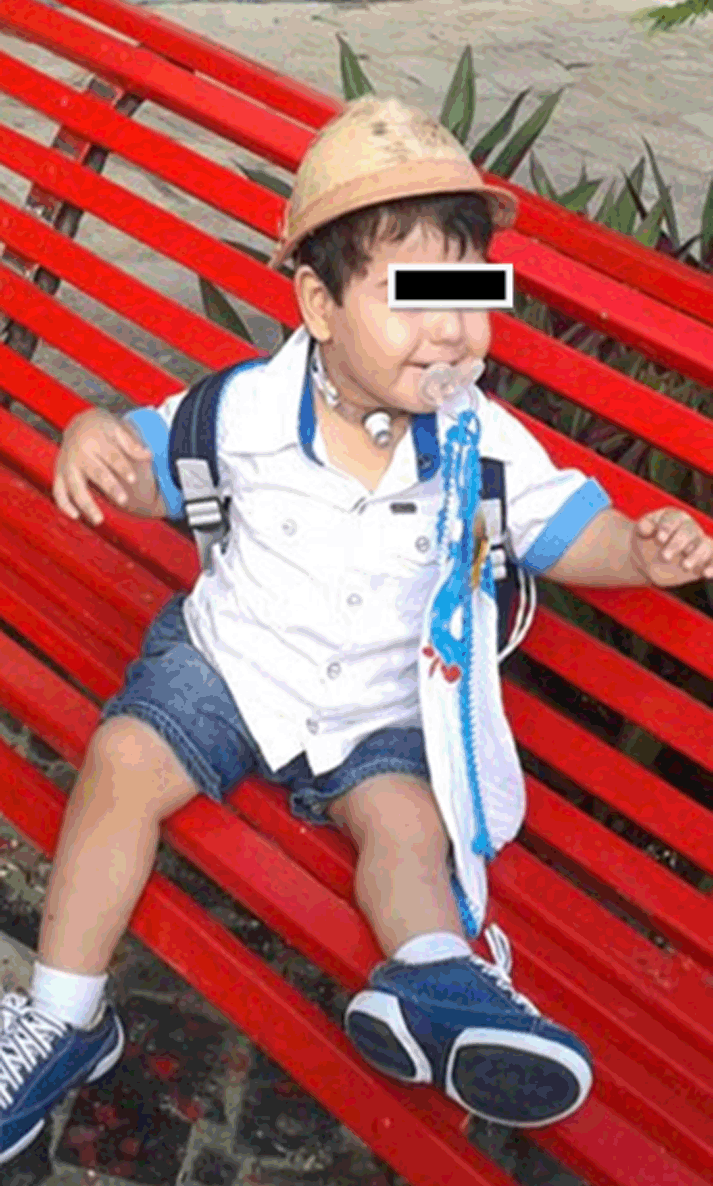
A 15-month-old child, CCHS patient was referred as a candidate for diaphragmatic pacing with phrenic nerve stimulation, because he had chronic apnea and been dependent on mechanical ventilation since birth. At referral, his clinical condition was good. Blood tests and chest tomography were normal. The PHOX2B mutation was confirmed as 20/26. The patient underwent general anesthesia without muscle blockers with single intubation. A staged bilateral mini-thoracotomy to access the pleural cavity was performed. The electrodes were placed underneath the phrenic nerves through careful dissection, and sutured to the pericardium by 4-0 prolene suture. The receivers were placed in the subcutaneous tissue on the costal margin, and once they were connected to the electrodes, and they tested they showed good diaphragmatic function. The incisions were closed in layers and no chest tube was necessary. After an uneventfully recovery period, the diaphragm pacing was initiated four weeks after surgery. Radiofrequency signals, generated by a battery-powered transmitter, were sent from an external antenna (Figure 1A), fixed to the implanted receivers (Figure 1B), which convert the radio signals into electrical impulses, causing diaphragmatic contraction. To avoid fatigue, diaphragmatic pacing was initiated at a frequency of 15 Hz for 30 minutes during each waking hour in the first week, with increases of 30–45 minutes/week as tolerated by the patient. After 150 days hospitalization, the patient was discharged in good clinical condition, being submitted to 24 hours/day of continuous diaphragmatic pacing every day. | ||||||
| ||||||
| ||||||
|
Discussion
| ||||||
|
Congenital central hypoventilation syndrome is a rare disease– one for every 200,000 births, usually genetic in origin, resulting from a mutation in the gene PHOX2B on chromosome 4. This mutation causes a disorder in the central nervous system which leads to apnea, especially during REM sleep [2]. According to the gravity of the case, even when the individual is awake, able to maintain a satisfactory breathing on their health. As a result of hypoventilation, these individuals became hypoxemic and hypercarbic but lack the normal ventilation and arousal responses to the endogenous challenges during sleep, and the perception of asphyxia during wakefulness with and without exertion. When the disease is congenital, symptoms are present from birth, and the main symptoms are difficulty in maintaining the breathing frequency, difficulty in swallowing, cardiac arrhythmia, changes in temperature, eye disorders and gastroesophageal reflux. In 20% of patients, congenital megacolon (Hirschsprung's disease) is present, when so called these findings Haddad syndrome. The diagnosis of such disease is made initially with the clinical state of the patient, followed by the completion of genetic testing, which identifies the type of gene mutation and PHOX2B, therefore, more appropriate monitoring of possible malfunctions associated with the specific type of mutation, and a genetic counseling for parents who wish to have other children. Normally, other neuromuscular diseases, cardiac and neurological disorders should be investigated. There are two types of CCHS presentation: the classic way, where the patient needs ventilatory support only during sleep (80% of cases), and the severe (20% of cases) when the patient requires ventilatory support 24 hours/day. The diaphragmatic pacemaker currently represents an excellent treatment option. Available for use in the US for 40 years, and released in Brazil by ANVISA in 2009. It has been used by our group in 21 patients of various etiologies, all successfully. The youngest patient implanted in Brazil –the patient in this study– was 15 months old at the time of implantation and is progressing successfully. Currently around the world, some patients are pacing for 30 years, and many for 20 years. The longest pacer patient in Brazil is pacing full time for three years [4]. diaphragmatic pacing can provide advantages to patients such as: reduction in lung infections; tracheostomy decannulation in some cases; ventilator weaning and better quality of life [4]. An upper airway evaluation is another assessment that can be helpful, specially in those where tracheostomy decannulation is being considered. Increasing the size of the upper airway with tonsillectomy and/or adenoidectomy may help minimize upper airway obstruction [5]. If the patient can sustain adequate ventilation with a small tracheostomy, the cannula may be removed [6]. Recently, a new drug treatment (desogestrel) for CCHS patients– in order to improve CO2 chemosensitivity– was reported. One of the two patients described that without setting up the non-invasive ventilation, in this context, the benefit of desogestrel is currently conjectural [7]. Successful diaphragm pacing requires proximity to a medical team willing to maintain this system. Therefore, diaphragm pacing is an attractive alternative mode of mechanically assisted ventilation for many patients with CCHS. Patients can lead a much more normal life by being ventilator-free, enabling them to participate in daily activities, thus improving quality of life. | ||||||
|
Conclusion
| ||||||
|
Diaphragm pacing is an attractive alternative mode of mechanically assisted ventilation for many patients with congenital central hypoventilation syndrome. Patients can lead a much more normal life by being ventilator free, enabling them to participate in daily activities, thus improving quality of life. | ||||||
|
References
| ||||||
| ||||||


|
[HTML Abstract]
[PDF Full Text]
|
|
Author Contributions
Rodrigo A. S. Sardenberg – Substantial contributions to conception and design, Acquisition of data, Analysis and interpretation of data, Drafting the article, Revising it critically for important intellectual content, Final approval of the version to be published Riad N. Younes – Analysis and interpretation of data, Revising it critically for important intellectual content, Final approval of the version to be published |
|
Guarantor of submission
The corresponding author is the guarantor of submission. |
|
Source of support
None |
|
Conflict of interest
Authors declare no conflict of interest. |
|
Copyright
© 2017 Rodrigo A. S. Sardenberg et al. This article is distributed under the terms of Creative Commons Attribution License which permits unrestricted use, distribution and reproduction in any medium provided the original author(s) and original publisher are properly credited. Please see the copyright policy on the journal website for more information. |
|
|