| |
|
|
|
Case Report
| ||||||
| Burkitt's lymphoma presenting as jejunojejunal intussusception in a child: A case report | ||||||
| Karimy Hamad Mehanna1, José Ederaldo Queiroz Telles2, Danielle Priscila Mauro3 | ||||||
|
1MD, Department of Pediatric Surgery, Municipal Hospital and Maternity of São José dos Pinhais, State of Paraná, Brazil.
2MD, PhD, Department of Pathology, Municipal Hospital and Maternity of São José dos Pinhais, Federal University of Paraná, State of Paraná, Brazil. 3MD, First-year resident in pediatrics, Municipal Hospital and Maternity of São José dos Pinhais, State of Paraná, Brazil. | ||||||
| ||||||
|
[HTML Abstract]
[PDF Full Text]
[Print This Article]
[Similar article in Pumed] [Similar article in Google Scholar] 
|
| How to cite this article |
| Mehanna KH, Telles JEQ, Mauro DP. Burkitt's lymphoma presenting as jejunojejunal intussus-ception in a child: A case report. Int J Case Rep Images 2017;8(2):96–100. |
|
Abstract
|
|
Burkitt's lymphoma represents 1–2% of all lymphoma and displays aggressive behavior, with B cells showing rapid growth. Its presentation as intestinal intussusception is unusual. We describe case of a seven-year-old boy with intussusception due to Burkitt's lymphoma. An emergency laparotomy revealed jejunojejunal intussusception as the cause of obstruction. The patient underwent enterectomy with restoration of the bowel continuity. Pathologist diagnosed Burkitt's lymphoma. He is receiving chemotherapy and is well one month postoperatively.
| |
|
Keywords:
Burkitt's lymphoma, Child, Intussusception, Non-Hodgkin lymphoma
| |
|
Introduction
| ||||||
|
Intussusception of the bowel can be described as the telescoping of a proximal segment of the intestine within the lumen of the adjacent segment. First reported in 1674, it is one of the most common causes of an acute abdomen in infancy. Burkitt's lymphoma is a subtype of non-Hodgkin lymphoma (NHL), showing malignant features and rapid growth. It was first described by Denis Burkitt in 1958. Commonly, presents as acute leukemia or malignant lesions in extra nodal sites. Intussusception due to Burkitt's lymphoma is rare presenting, with nonspecific symptoms. We present a case of jejunojejunal intussusception secondary to Burkitt's lymphoma in a child, and we would like to share the presentation, outcome, and our experience in the management of this child, with a review of literature. | ||||||
|
Case Report
| ||||||
|
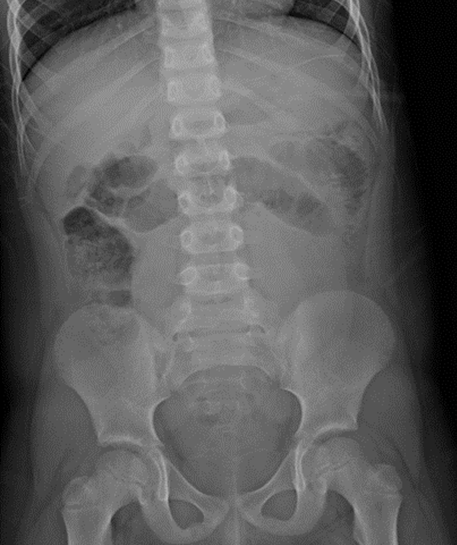
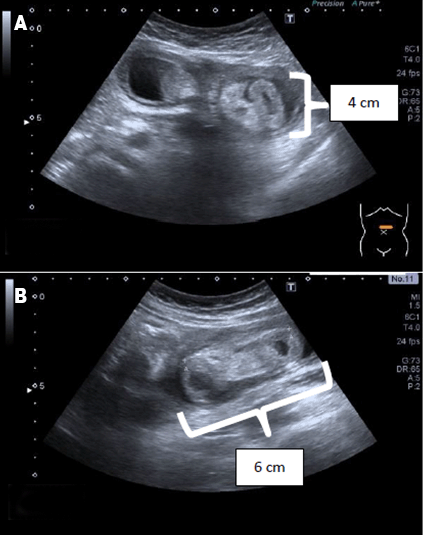
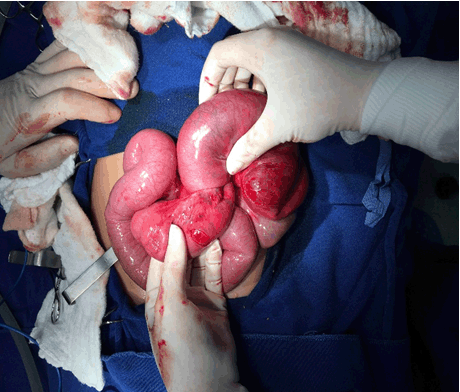
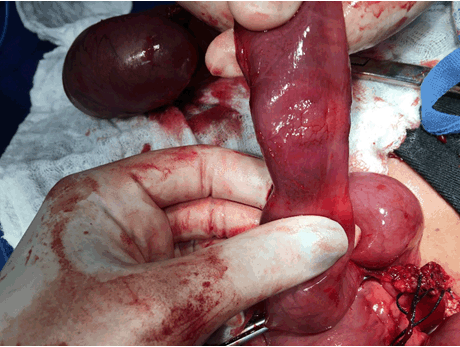
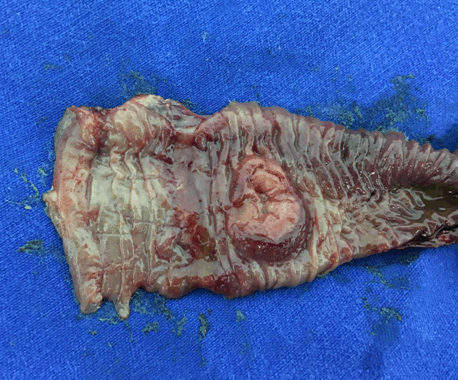
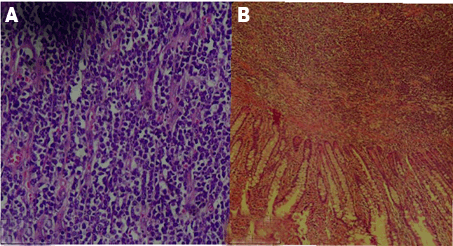
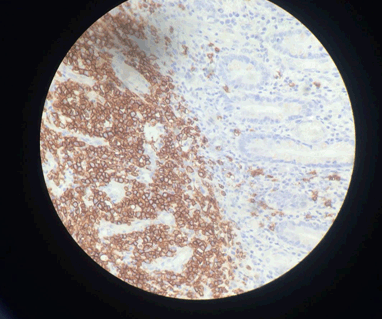
A 7-year-old boy reported to the emergency with abdominal pain and vomiting for the last two days. A detailed history revealed an intermittent colicky abdominal pain for at least one year. No changes in bowel habits and no weight loss was reported. On clinical examination, abdomen was mildly distended with palpable mass in the left flank and signs of peritoneal reaction in this affected site. Bowel sounds were reduced. All other aspects of the examination were normal. Laboratory investigations showed total leukocyte counts (TLC) of 12.55/mm3 with neutrophilia and raised inflammatory markers (CRP 3.56 mg/dl). Chest X-ray was normal; abdominal plain X-ray showed dilated loops of bowel containing gas, but the findings were nonspecific for intestinal obstruction or ileus (Figure 1). Ultrasonography (USG) showed target sign located at mesogastrium and left flank. The diameter of the lesion was 4 cm and the length was 6 cm (Figure 2). Additionally, a small amount of ascites was noted. A decision for an emergency laparotomy was taken. Intraoperative findings confirmed jejunojejunal intussusception (Figure 3). The involved parts of the bowel were resected and end-to-end anastomosis was performed. During inspection of the bowel, we noted a mass within the jejunum, working as lead point of the intussusception (Figure 4). Cut sections of the specimen showed jejunal tumor (Figure 5). The histopathological diagnosis was Burkitt's lymphoma with clear surgical margins (Figure 6). On immunohistochemistry, CD-20 was positive (Figure 7). Postoperatively the patient made an uneventful recovery and was referred to the oncology team for appropriate further management. He was subject to chest CT scan and bone-marrow biopsy. Both tests were normal. The disease was classificated in stage II (extra nodal site, disease restricted to abdomen). He is receiving vincristine, adriamycin, cyclophosphamide and prednisolone based chemotherapy on Department of Oncology (chemotherapy protocol of the French Society of Pediatric Oncology) and is well one month postoperatively. | ||||||
| ||||||
| ||||||
| ||||||
| ||||||
| ||||||
| ||||||
| ||||||
|
Discussion
| ||||||
|
Non-Hodgkin Lymphoma (NHL) is the third most frequent cancer of childhood and represents 1–4% of all gastrointestinal malignancies [1]. The peak age for gastrointestinal NHL in children is 5–15 years with a male sex preponderance 1.8-2.5 times that of female [2]. Small and large intestines are frequent affected and ileum is most commonly involved, in which the greatest concentration of gut-associated lymphoid tissue is present. Non-Hodgkin Lymphoma (NHL) is usually subdivided into three histological subtypes: (a) 65% B-cell NHL including both Burkitt's lymphoma and diffuse large B cell lymphoma – most commonly predict the abdomen as a primary site of presentation; (b) 20% lymphoblastic, and (c) 15% anaplastic large cell lymphoma. Burkitt's NHL is the most common, representing 40–50% of all NHL cases in childhood [3]. In upto 18% patients with primary abdominal Burkitt's lymphoma, intussusception is the first clinical sign. The incidence of NHL acting as lead point in intussusception is reported to be as high as 17%, and even higher (more than 50%) in children over 4–6 years of age [4]. Abdominal pain is present in 80% of cases, along with nausea, vomiting, changes in bowel habits and weight loss. Intestinal involvement by NHL was associated with an increased frequency of abdominal symptoms resulting in earlier laparotomies and earlier diagnosis [4]. Previous author's experiences with the combination of NHL with intussusception have not been satisfactory. In Ein et al. study, only 3 of 11 children were term survivors [5]. This study of over than 1200 infants and children in Toronto over a 40-year period revealed 11 lymphomas manifested as a leading point for the intussusception. Most patients were older than 4.5 years, were chronically ill, sometimes for several months, and had weight loss and abdominal mass, all of which pointed to a malignant process [5]. Puri et al. also reported that the only one death out of the entire series of 292 children with intussusception was a child with lymphoma [6]. The ideal treatment of gastrointestinal lymphoma must be individualized based on the type of disease and its location and a multidisciplinary approach with surgery and chemotherapy increases the chances of event free survival. Surgery plays a pivotal role in the management. In fact, LaQuaglia et al. in his study has concluded that bowel resection performed during emergency laparotomies for symptomatic, localized bowel involvement in patients with NHL was associated with better prognosis [7]. Some reports demonstrate higher survival rate (58–89%) in patients having extensive surgical resection versus patients having only partial or incomplete resection (40–45%) at 2–5 years [3]. Complete resection of the tumor was shown to have the added advantage of avoiding bowel perforation, gastrointestinal hemorrhage or the tumor lysis syndrome after the initiation of chemotherapy [4]. Chemotherapy represents a cornerstone in the treatment of these patients and offers an excellent chance for long term disease free survival. Burkitt's lymphoma is very sensitive to chemotherapy. Therapy courses include the following drugs: cyclophosphamide, methotrexate, cytarabine, ifosfamide, etoposide, vincristine, vindesine, adriamycin, doxorubicin, dexamethasone. Rituximab is currently being studied in clinical trials, because it has shown good results in adult NHL. Although regimens are effective, they are toxic and up to 3% patients can die from treatment complications, with the acute tumor lysis syndrome being one of them. Burkitt's lymphoma patients who present with intussusception have a low stage disease (stage II), have a complete resection of their tumor, require shorter-duration, and less intense chemotherapy than patients diagnosed in other ways. Extent of disease at presentation and the resectability has been found to be the most important prognostic factor [4]. | ||||||
|
Conclusion
| ||||||
|
Intussusception should be considered in the differential diagnosis of all children who present with an acute abdomen, regardless of age. In the older age group of children, we need to keep a high index of suspicion for malignant lymphoma of the bowel. The clinical presentation is non-specific with abdominal pain, nausea and vomiting in most of the cases. Surgery is the gold standard in both diagnosis and treatment, ensuring the excision of the entire tumor with free margins. A multidisciplinary team with an oncologist assures efficient therapeutic management. | ||||||
|
References
| ||||||
| ||||||
|
[HTML Abstract]
[PDF Full Text]
|
|
Author Contributions
Karimy Hamad Mehanna – Substantial contributions to conception and design, Acquisition of data, Analysis and interpretation of data, Drafting the article, Revising it critically for important intellectual content, Final approval of the version to be published José Ederaldo Queiroz Telles – Analysis and interpretation of data, Revising it critically for important intellectual content, Final approval of the version to be published Danielle Priscila Mauro – Analysis and interpretation of data, Revising it critically for important intellectual content, Final approval of the version to be published |
|
Guarantor of submission
The corresponding author is the guarantor of submission. |
|
Source of support
None |
|
Conflict of interest
Authors declare no conflict of interest. |
|
Copyright
© 2017 Karimy Hamad Mehanna et al. This article is distributed under the terms of Creative Commons Attribution License which permits unrestricted use, distribution and reproduction in any medium provided the original author(s) and original publisher are properly credited. Please see the copyright policy on the journal website for more information. |
|
|