|

|
 |
|
Case Report
| ||||||
| The idiopathic avascular osteonecrosis of the third metacarpal head (M. Mauclaire/Dieterich's disease) | ||||||
| Ingo Schmidt | ||||||
|
SRH Poliklinik Gera GmbH, Straße des Friedens 122, 07548 Gera (Germany).
| ||||||
| ||||||
|
[HTML Abstract]
[PDF Full Text]
[Print This Article]
[Similar article in Pumed] [Similar article in Google Scholar] 
|


| How to cite this article |
| Schmidt I. The idiopathic avascular osteonecrosis of the third metacarpal head (M. Mauclaire/Dieterich's disease). Int J Case Rep Images 2017;8(2):92–95. |
|
Abstract
|
|
Introduction:
M. Mauclaire/Dieterich's disease is an uncommon condition mostly affecting the third metacarpal head, and can lead to secondary osteoarthritis of the metacarpophalangeal joint. For this condition, the total joint replacement is inevitable.
Case Report: We report a 64-year-old male with a history of increasing pain in his third metacarpophalangeal joint right over a period of 10 years. Radiographically, there was a severe osteonecrosis of the third metacarpal head that was accompanied with pronounced osteoarthritis of the metacarpophalangeal joint. The patient was treated successfully with an unconstrained resurfacing total joint replacement. Conclusion: The preservation of motion in the metacarpophalangeal joints II–V has a top priority. A stable and functioning metacarpophalangeal joint is the key for satisfactory function of the overall finger. If a avascular osteonecrosis of a metacarpal head is not accompanied with secondary osteoarthritis, other joints preserving procedures are the methods of choice. In case of secondary osteoarthritis, the total joint replacement is inevitable. Resection arthroplasty or arthrodesis should be avoided as primary surgical procedure, and are to be considered as salvage options after a failed total joint replacement. | |
|
Keywords:
Metacarpophalangeal joint, Idiopathic avascular osteonecrosis, Joint replacement
| |
|
Introduction
|
|
The avascular osteonecrosis of the metacarpal head is a rare juvenile/adolescent lesion of the hand, and was first described in 1927 by Mauclaire [1]. Dieterich published in 1932 first results of eight treated patients and suggested that there is a strong correlation for manifestation of the third metacarpal head in young females [2]. These observations have been found its confirmation in all subsequent publications. Usually, the symptoms occur in childhood and adolescence, followed by patients in the middle decades of life, elderly patients from the 5th decade of life are tend to be under-represented, it also may be present in the 1st, 2nd, 4th and 5th metacarpal, and bilateral occurrence was observed as well [3] [4][5][6] [7][8][9] [10][11]. |
|
Case Report
|
|
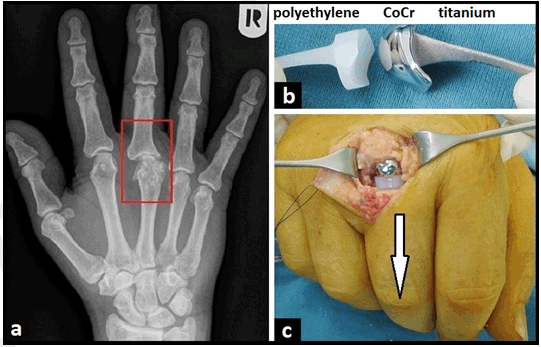
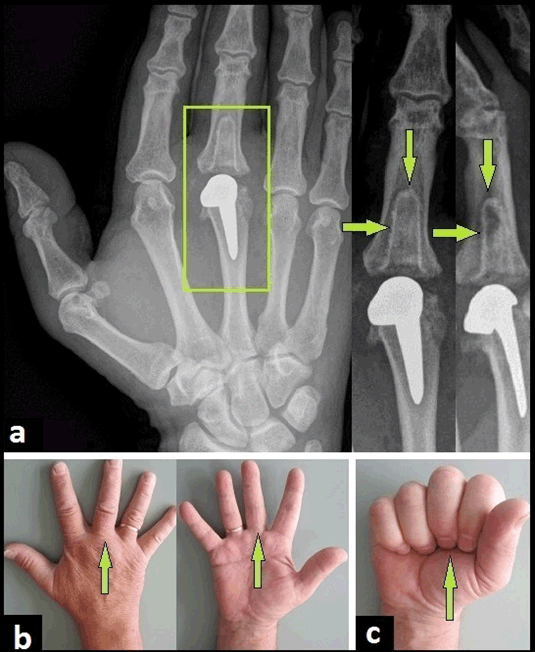
At presentation, 64-year-old male reported increasing pain in his metacarpophalangeal joint III right over a period of 10 years. There was no history of any additional trauma. Professionally, he has been worked as a miner with jackhammers, and also he was a passionate boxer over a period of 20 years. The fist conclusion was incomplete. The extension of the third finger showed a deficit of 20 degrees to neutral, the flexion was limited to 60 degree. Radiographically, a severe osteonecrosis of the third metacarpal head was present that was accompanied with secondary osteoarthritis of the metacarpophalangeal joint (Figure 1a). The resurfacing joint replacement using the unconstrained SR™ MCP implant (formerly Avanta SR, Small Bone Innovations, Morrisville, PA, USA) with it uncemented cobalt-chrome (CoCr) alloy metacarpal hemispherical head that articulates against the cemented ultra-high molecular weight polyethylene (UHMWPE) phalangeal component was performed through a dorsal incision (Figure 1b-c). Radiographically follow-up, at the fourth year showed that there was unchanged a correct positioning of the implant without any signs of loosening nor subsidence (Figure 2a). Fist conlusion and long finger extension were completely restored (Figure 2b-c). Grip strength (Jamar dynamometer) improved from 6–13 kp, and pain improved from 8 points to 0 points in visual analogue score (0–10 points). The patient reported that he would have the same procedure again if it necessary. |
|
|
|
|
|
Discussion
|
|
M. Mauclaire/Dieterich's disease is an uncommon condition mostly affecting the third metacarpal head. In literature, only case reports with no reliable conclusions regarding etiology and pathogenesis could be found. Any predispositions in systemic lupus erythematosus, juvenile dermatomyositis, gene mutations, long-term medication of glucocorticoids and intraosseous microinfarcts by repetitive microtrauma on the prominent third metacarpal head as the central pillar to load transmission are discussed [12] [13] [14]. Wright et al. [15] suggest a predisposition in vascular malformations of the epiphyseal vascular network that was found in 35% of specimens. The preservation of motion in the metacarpophalangeal joints II–V has a top priority. A stable and functioning metacarpophalangeal joint is the key for satisfactory function of the overall finger. The stable active extrinsic motion-arc modulates synergistically the intrinsic function in the proximal interphalangeal (PIP) joint for a powerful extension and fist conclusion. On the other hand, the actions of the intrinsic muscles are necessary for stabilizing the metacarpophalangeal joint in flexion posture during PIP joint motion. Functional flexion postures averaged about 60 degree at the metacarpophalangeal and PIP joint and 40 degree at the distal interphalangeal (DIP) joint [16][17]. A metacarpophalangeal joint arthrodesis should be avoided, and it is only considered when other surgical procedures have been failed [18]. Metacarpophalangeal joint resection arthroplasty can be one surgical option for low demand and/or rheumatoid patients [19]. In addition to the initial conservative treatment in patients with M. Mauclaire/ Dieterich's disease [20], joint-preserving surgical procedures and joint replacement can be applied. The core decompression is the method of choice when smaller intra-osseous findings are present [6]. For larger intra-osseous focal findings, curettage and filling of the necrotic cavity with autologous cancellous bone grafts is recommended [3] [21]. The subcapital flexion osteotomy (open wedge) of the metacarpal can be applied if the dorsal joint surface does not show cartilage lesions [22] [23]. For central or dorsal cartilage lesions the mosaicplasty is recommended [10]. Erne et al. [4] published satisfactory results with two cases following transplantation of a metatarsal head. If the metacarpophalangeal joint is completely involved in osteoarthritis, the total joint replacement is inevitable. The unconstrained partial cemented metacarpophalangeal joint resurfacing SR™ MCP implant is one of the new generation type that is current in use [24]. The metacarpophalangeal joint is a condylar ball-and-socket joint with a convex surface on the metacarpal head and an incongruent (larger radius of curvature) concave surface on the proximal phalanx. One of the major complications of all unconstrained metacarpophalangeal joint implants is luxation tendency in the ulnopalmar direction. The SRTM MCP implant is designed to decrease this risk by having a greater arc of curvature on the dorsal aspect of the proximal component. In a biomechanical study, a higher intrinsic stability of this implant compared to un-affected human cadaver joints could be evaluated [25]. One disadvantage of implant is that cement removal is difficult in the necessity of revision and also there is a concern about the effect of heat polymerization [26]. Further studies with long-term results are needed to validate this concept. |
|
Conclusion
|
|
M. Mauclaire/Dieterich's diesease as a rare condition mostly affecting the third metacarpal head. Motion preserving procedures at the metacarpophalangeal joints II-V are absolutely required to obtain function of the overall long finger. When distintictive osteoarthritis in metacarpophalangeal joints II-V is present, the use of an unconstrained resurfing metacarpophalangeal joint replacement is one surgical option that can be recommended. Arthrodesis or resection arthroplasty as a primary procedure should be avoided, and is to be considered as a salvage option when a joint replacement has failed. |
|
References
|
|

|
[HTML Abstract]
[PDF Full Text]
|
|
Author Contributions
Ingo Schmidt – Substantial contributions to conception and design, Acquisition of data, Analysis and interpretation of data, Drafting the article, Revising it critically for important intellectual content, Final approval of the version to be published |
|
Guarantor of submission
The corresponding author is the guarantor of submission. |
|
Source of support
None |
|
Conflict of interest
Authors declare no conflict of interest. |
|
Copyright
© 2017 Ingo Schmidt. This article is distributed under the terms of Creative Commons Attribution License which permits unrestricted use, distribution and reproduction in any medium provided the original author(s) and original publisher are properly credited. Please see the copyright policy on the journal website for more information. |
|
|
|
About The Author
| |||
| |||