| |
|
|
|
Clinical Image
| ||||||
| Perforated inferior vena cava filter removal by concurrent femoral and internal jugular vein approaches | ||||||
| Raymond Yap1, Ankur Sidhu1, Mark Brooks2, Mehrdad Nikfarjam1 | ||||||
|
1Department of Surgery, University of Melbourne Austin Health, Heidelberg, Melbourne, Victoria, Australia.
2University of Melbourne Department of Radiology, Austin Health, Heidelberg, Melbourne, Victoria, Australia. | ||||||
| ||||||
|
[HTML Abstract]
[PDF Full Text]
[Print This Article]
[Similar article in Pumed] [Similar article in Google Scholar] 
|
| How to cite this article |
| Yap R, Sidhu A, Brooks M, Nikfarjam M. Perforated inferior vena cava filter removal by concurrent femoral and internal jugular vein approaches. Int J Case Rep Images 2017;8(2):161–164. |
|
Case Report
| ||||||
|
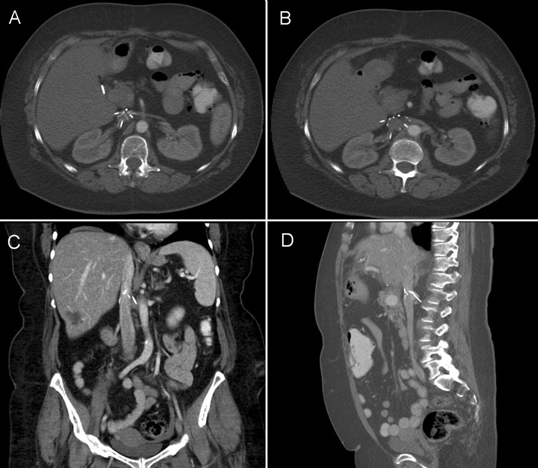
It is commonly accepted that insertion of inferior vena cava (IVC) filters is safe, effective and their use is constantly increasing [1]. Inferior vena cava filters are commonly used adjuncts in the prevention of pulmonary embolism from deep vein thrombosis, particularly in the setting of gastrointestinal malignancy. Although their use is widespread, there is some misunderstanding in regards to the commonality of potential serious consequences from their deployment. We highlight the pitfalls in their use, as well as a technique for percutaneous removal of filter that may have migrated beyond the lumen of the IVC, using a combined internal jugular and femoral vein approach. A 70-year-old female with colorectal liver metastases had an inferior vena caval (IVC) filter inserted prior to a major liver resection. She had developed a deep vein thrombosis (DVT) and pulmonary embolus (PE) four months previously following a right hemicolectomy, despite perioperative use of graduated compression stockings, intermittent pneumatic compression and use of low molecular weight heparin (LMWH). Following the diagnosis of DVT and pulmonary embolus, she was treated by with therapeutic LMWH, while receiving neoadjuvant chemotherapy, prior to her liver surgery. It was anticipated that she was at high risk of developing further thrombus in the setting of prolonged abdominal surgery, and it was decided that she should have an IVC filter inserted (Cook Celect® Vena Cava filter, Cook medical, Brisbane, QLD, Australia). She had an uncomplicated liver operation and a decision was made for her to have adjuvant chemotherapy prior to considering removal of her IVC filter. She received therapeutic does of LMWH during her postoperative follow-up. At six months following completion of adjuvant therapy the patient had restaging computed tomography imaging of the chest, abdomen and pelvis that showed no evidence of disease recurrence. The imaging did, however, demonstrate perforation of the tines of the filter through the walls of the inferior vein cava (Figure 1), with one in close proximity to the aorta and resulting in some aortic wall thickening. The filter had also become tilted and its removal hook was projecting through the anterior wall of the cava. These findings were not present on the initial postoperative computed tomography scan. She was asymptomatic, but there were concerns of possible future complications, in particular the development of aorto-caval fistula. An attempt to remove the filter was made percutaneously through the right internal jugular vein approach. Venogram confirmed that the tines and hook of the filter lying outside the vein. Initial attempts to snare the filter with a retrieval kit were unsuccessful through both internal jugular and femoral approaches. A second percutaneous attempt was made with a combined right internal jugular and femoral vein approach under general anesthesia (Figure 2). Two wires were looped under the filter legs from a 16Fr internal jugular sheath. A 3rd wire was passed from the jugular sheath to an 8Fr femoral vein sheath. With the filter trapped between the tips of the two sheaths it was mobilized with repeated cranial and caudal movements. The tines and the hook were thus maneuvered back into the IVC lumen. Once this was accomplished, the filter was enclosed by a snare. The IVC filter was then inverted and removed through the right femoral vein. A completion venogram showed no injury to the IVC or contrast extravasation. The patient's stay had no complications and was discharged home the following day. | ||||||
|
| ||||||
|
| ||||||
| ||||||
|
Discussion
| ||||||
|
Inferior vena cava (IVC) filters have been well established as useful alternatives or adjuncts to anticoagulation for deep vein thrombosis to prevent pulmonary embolism [1]. They are generally considered safe. There are, however, numerous case reports in literature of serious complications including IVC filter perforation into the aorta or duodenum, stent migration and occlusion [2]. These complications can have serious consequences, including death and significant morbidity. Durack et al. [3] published a case series of 50 IVC filters which had CT scans for reasons other than concerns of stent complications. Eighty-six percent of filters showed perforation through the IVC on review CT scan, and the earliest of this was at six days. All filters imaged after 71 days showed a degree of perforation which appeared to be progressive. Although this is a small case series using one type of filter, it does demonstrate that caution should be used in IVC filter use. The clinical significance of CT-detected IVC filter perforation is not known, however, due to the possible catastrophic complications, these findings should always be taken seriously. Our patient had no symptoms related to her filter, but we had concerns for future complications if we were to leave it in situ. While we have shown it is possible to remove an IVC filter with tines and hook projecting beyond the cava the procedure was prolonged and difficult and carried some potential risk. We strongly suggest that IVC filters should be removed as soon as the clinical need for them has passed. If their use is to continue, past three months interval CT imaging should be considered even if the patient is asymptomatic and if perforation is detected, strong consideration should be given to removal of the IVC filter. The technique described using concurrent internal jugular and femoral vein approach appears to be useful method to consider for the difficult to remove IVC filter, even in the setting tine perforation. Further research is needed to delineate the natural history of IVC filters and perforation. While the current generation of removable IVC filters appear safe and effective for short-term protection from pulmonary embolus more work is required to develop removable filters which also perform safely as long-term devices. | ||||||
|
Conclusion
| ||||||
|
Vena caval filer perforation of the vena cava by filter tines can occur. Filter removal can be difficult in some cases and a combined internal jugular and femoral vein approach may be required for removal. Keywords: Deep venous thrombosis, Filter, Pulmonary emboli, Inferior Vena Cava | ||||||
|
References
| ||||||
| ||||||
|
[HTML Abstract]
[PDF Full Text]
|
|
Author Contributions
Raymond Yap – Acquisition of data, Drafting the article, Final approval of the version to be published Ankur Sidhu – Acquisition of data, Revising it critically for important intellectual content, Final approval of the version to be published Mark Brooks – Substantial contributions to conception and design, Revising it critically for important intellectual content, Final approval of the version to be published Mehrdad Nikfarjam – Substantial contributions to conception and design, Revising it critically for important intellectual content, Final approval of the version to be published |
|
Guarantor of submission
The corresponding author is the guarantor of submission. |
|
Source of support
None |
|
Conflict of interest
Authors declare no conflict of interest. |
|
Copyright
© 2017 Raymond Yap et al. This article is distributed under the terms of Creative Commons Attribution License which permits unrestricted use, distribution and reproduction in any medium provided the original author(s) and original publisher are properly credited. Please see the copyright policy on the journal website for more information. |
|
|