|

|
 |
|
Clinical Image
| ||||||
| Ochronotic arthropathy | ||||||
| Kayahan Karaytug1, Eren Yildiz2 | ||||||
|
1State Hospital, Department of Orhopedic Surgery Sarikamiş-Kars, Turkey.
2State Hospital, Department of Orhopedic Surgery Nusaybin-Mardin, Turkey. | ||||||
| ||||||
|
[HTML Abstract]
[PDF Full Text]
[Print This Article]
[Similar article in Pumed] [Similar article in Google Scholar] 
|


| How to cite this article |
| Karaytug K, Yildiz E. Ochronotic arthropathy. Int J Case Rep Images 2017;8(2):158–160. |
|
Case Report
|
|
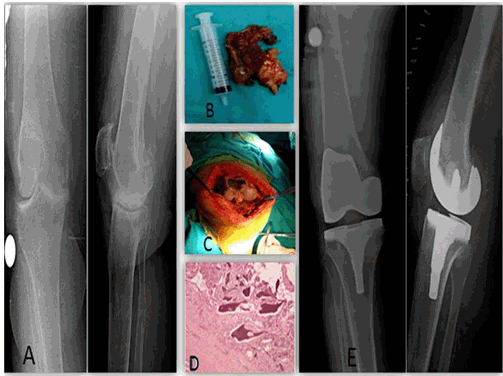
A 56-year-old female was referred to our clinic with severe pain on her right knee. She was admitted to physiotherapy and took analgesics previously. On physical examination, there was moderate pain on flexion and extension of the right knee with crepitations. Osteoarthritis was detected in X-ray of both knees (Figure 1A). After conservative treatment there was no significant progress. We offered surgical treatment and after the patient confirm the surgery, cemented total knee replacement surgery was performed. During the operation black discoloration of the synovial tissue, capsules and surfaces of the tibiofemoral joint was observed (Figure 1B-C). Microbiological analysis detected no organism. Some analyses were made for metabolic diseases because of discoloration of the soft tissue and the bones. Blood and urine samples were taken for screening. Metabolic disease was suspected due to organic acids in urine screening. Urine levels of homogentisic acid was 20 times higher than upper level of normal range. A diagnosis of alkaptonuria was made. Histopathological examination was consistent with ochronotic arthropathy (Figure 1D). A childhood metabolic disease called alkaptonuria was diagnosed in a 56-year-old patient, due to findings during surgery. Postoperative two years later physical examination showed 0–120° range of motion and patient reported no pain with normal findings on X-ray (Figure 1E). |
|
|
|
Discussion
|
|
Alkaptonuria is rare autosomal recessive metabolic disease [1]. Homogentisic acid deficiency occurs due to mutations in the gene 1-2 dioxygenase [2]. It is seen in one out of one million population [3][4]. Alkaptonuria is a disease caused due to deficiency of the homogentisic acid oxidase enzyme. Homogentisic acid polymers condense in the urine and accumulate in the urine (called alkaptonuria), soft tissue and connective tissues as brownish black pigmentation (called ochronosis). Changes in cartilage, internal organs and osteoporosis are lead to pathognomonic change [5]. Alkaptonuria is often the first sign of Madiran darkening of the urine [6]. Ochronotic arthropathy is a manifestation of the alkaptonuria developed after a long period of time. Ochronotic homogentisic acid occurs in the articular cartilage with increasing age as a result of osteoarthritis. In this case, there were observed black soft tissue and bone tissue during knee joint replacement surgeries. Tissue sampling was done. Histopathological examination diagnosed with ochronosis and alkaptonuria diagnosed in the urine sample taken from the patient was placed as a result. This metabolic disease is diagnosed in early age of life. In these cases, based on the findings of secondary diagnosis at an advanced age was put alkaptonuria |
|
Conclusion
|
|
Ochronosis is a rare metabolic disease involving the periphery joints. Although there is no definitive treatment, joint replacement is one of the most effective treatments recommended. It provides painless quality of life and patients have close to a full joint motion. Keywords: Alkaptonuria, Black discoloration, Ochronotic arthropathy, Total knee replacement |
|
References
|
|

|
[HTML Abstract]
[PDF Full Text]
|
|
Author Contributions
Kayahan Karaytug – Substantial contributions to conception and design, Drafting the article, Revising it critically for important intellectual content, Final approval of the version to be published Eren Yildiz – Substantial contributions to conception and design, Drafting the article, Final approval of the version to be published |
|
Guarantor of submission
The corresponding author is the guarantor of submission. |
|
Source of support
None |
|
Conflict of interest
Authors declare no conflict of interest. |
|
Copyright
© 2017 Kayahan Karaytug et al. This article is distributed under the terms of Creative Commons Attribution License which permits unrestricted use, distribution and reproduction in any medium provided the original author(s) and original publisher are properly credited. Please see the copyright policy on the journal website for more information. |
|
|
|
About The Authors
| |||
| |||
| |||