|

|
 |
|
Case Report
| ||||||
| Collaborative endodontic and surgical management of a type II dens invaginatus: One year follow-up | ||||||
| Kammishetty Shekar1, Dola Binoy2, Bollavaram Vijaya Ramakrishna Reddy3, Cherukupalli Ravi Chandra4, Surrender Reddy5, Bollu Indhira Priyadharshini6 | ||||||
|
1MDS, Shekar kammishetty, Head of the Department, Conservative Dentistry and Endodontics, Sri Sai Dental College of Surgery, Vikarabad, Telangana, India.
2MDS, Binoy Dola, Assistant Professor, Conservative Dentistry and Endodontics, Sri Sai Dental College of Surgery, Vikarabad, Telangana, India. 3MDS, Bollavaram vijaya Ramakrishna reddy, Assistant Professor, Conservative Dentistry and Endodontics, Sri Sai Dental College of Surgery, Vikarabad, Telangana, India. 4MDS, C. Ravi Chandra, Reader, Conservative Dentistry and Endodontics, Sri Sai Dental College of Surgery, Vikarabad, Telangana, India. 5MDS, Munnangi Surrender Reddy, Reader, Pediatric Dentistry, Sri Venkata Sai Dental College, Mahaboobnagar, Telangana, India. 6MDS, B. Indhira Priyadharshini, Assistant Professor, Conservative Dentistry and Endodontics, St. Joseph Dental College, Eluru, Andhra Pradesh. | ||||||
| ||||||
|
[HTML Abstract]
[PDF Full Text]
[Print This Article]
[Similar article in Pumed] [Similar article in Google Scholar] 
|


| How to cite this article |
| Shekar K, Binoy D, Reddy BVR, Chandra CR, Reddy S, Priyadharshini BI. Collaborative endodontic and surgical management of a type II dens invaginatus: One year follow-up. Int J Case Rep Images 2016;7(11):738–744. |
|
Abstract
|
|
This case report illustrates type II dens invaginatus (DI) and analyzes the possible aspects of this defect. Dens invaginatus is a developmental anomaly of teeth that commonly affects permanent maxillary lateral incisors. This case report focuses on the non-surgical and surgical management of right maxillary lateral incisor associated with type II DI. Pulpal involvement of malformed tooth, bizarre in root canal anatomy, periapical pathosis and severe periodontal destruction were noticed. Endodontic therapy with combined obturation techniques, surgical therapy with apical-curettage, retrofilling with glass ionomer cement and bone grafting were performed. A year follow-up evaluation showed satisfactory periapical healing.
| |
|
Keywords:
Demineralized freeze-dried bone allograft (DFDBA), Dens invaginatus (DI), Dental anomalies, Endodontic therapy and endodontic surgery, Guided tissue regeneration (GTR)
| |
|
Introduction
| ||||||
|
Dens invaginatus (DI) is a developmental anomaly of the tooth resulting from invagination of the enamel organ into the dental papilla during development phase of tooth and before calcification phase. Coronal invagination usually originates from an anomalous infolding of the enamel organ into the dental papilla. The most severe form of this anomaly is referred to as 'dilated odontoma' [1]. Dens invaginatus was first described by Ploquetin in 1794 who found it in whale's tooth and in 1856, Socrates described the DI anomaly in human beings. Synonyms for dens invaginatus are dens in dente, dilated gestant odontoma, invaginated odontome, dilated composite odontome, dentoid in dente, and tooth inclusion [2]. Oehlers described DI coronalis and DI radicularis. Oehlers proposed coronal invaginations in 1957. He described the anomaly in three forms: Type I: An enamel-lined minor invagination confined within the crown not extending beyond the cemento-enamel junction (Figure 1a). Type II: An enamel lined invagination invading the root but remains confined as a blind sac. It may or may not communicate with the dental pulp (Figure 1b). Type III A: invagination extending into the root and communicating laterally with the periodontal ligament space through a pseudoforamen. There is usually no communication with the pulp, which lies compressed within the root (Figure 1c). Type III B A-invagination which extend through the root and perforates apically through a pseudoforamen (Figure 1d) [3]. In 1972, Schulze and Brand proposed a more detailed classification, including coronal invaginations and dysmorphic root configuration. Kronfeld speculated that DI is caused by failure in growth of the internal enamel epithelium and increased proliferation of surrounding epithelium producing a static area of engulfing. Ectomesenchymal signaling between dental papilla and internal enamel epithelium can affect tooth morphogenesis. They have specific roles such as tooth morphogenesis and infolding of enamel organ [3]. The incidence of DI is about 0.04–10% and maxillary lateral incisors are most frequently affected approximately 9% and bilateral involvement of 43% [4] [5]. According to the theories put forward by Hulsmann the etiology behind DI is distortion of the internal enamel epithelium development, infections and traumas. Dens invaginatus can be asymptomatic or symptomatic with evident signs including malformation and mottling of the crown, tumefaction of the soft tissue, cyst, tooth eruption defect, and communication with the maxillary sinus with indications of sinusitis. A radiographic examination reveals a radiopaque invagination, equal in density to the enamel that extends for varying distances from the cingulum to inside the roots. Treatment of DI depends upon the degree of complexity of root canal system. Treatment modalities include non-surgical endodontic treatment, surgical endodontic treatment, intentional replantation or extraction [2]. | ||||||
| ||||||
|
| ||||||
|
Case Report
| ||||||
|
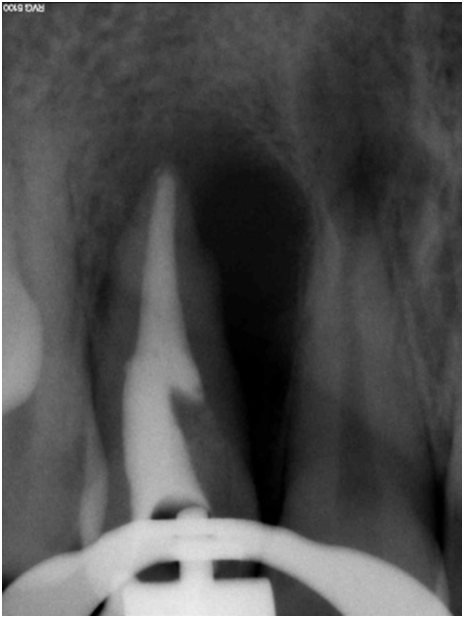
A 25-year-old male patient was referred to the clinic for regular dental check-up. The patient's general health and the systemic review were unremarkable. On oral examination, the maxillary right incisor, 12 revealed a light brownish discoloration, without caries, mobility and tenderness on percussion. Periodontal evaluation revealed deep periodontal pocket at the mesial surface of the tooth. Upon vitality tests tooth 12 was non-responsive to cold, heat and electric pulp tests whereas adjacent teeth 13, 11, 21 revealed normal response. The panoramic and periapical radiographs revealed radiopaque mass in the 12 (Figure 2). Cone beam computed tomographic (CBCT) evaluation revealed a large pulp space volume extending from coronal third to middle third of the root and a small enclosed pulp canal space in middle third of root which cannot be accessed (Figure 3). Based on clinical and radiographic examination the final diagnosis made was dens invaginatus with pulpal necrosis and periapical abscess i.r.t 12. Hence endodontic treatment was advised followed by surgical therapy at subsequent appointments with 12. Endodontic Treatment Surgical management | ||||||
| ||||||
| ||||||
| ||||||
| ||||||
| ||||||
|
Discussion
| ||||||
|
Getting across with DI was a rare event for past few years. However, with increased number of dental screenings it is no longer a rare event today. Dens invaginatus is a hard tissue anomaly which is routinely unaffected and asymptomatic unless infected. It requires early diagnosis and treatment, as it may result in radicular and periapical pathosis. Dental invaginations on long standing may lead to of pulpal and periapical pathosis, which is from pulpal death [6] [7]. The treatment of invaginated teeth is a complex procedure. They present a complex root canal configuration that is often not possible to instrument completely. As a result, these teeth should be selected for combined orthograde and surgical treatment [8]. Usually, a patient will not discover an anomaly such as dens invaginatus until clinical signs appear, i.e., an acute dentoalveolar abscess or sinus tract. The first observation brought to light was light brown discoloration of the tooth 12. The panoramic and intraoral periapical radiographs showed large periapical radiolucency around 12. Cone beam computed tomography scan was very helpful in confirming the observations and giving more detailed anatomical variations and thus rendering more accurate and immediate treatment plan. With intraoral periapical radiography, external factors such as anatomical noise, geometry, poor irradiation, may reduce the detection level of periapical lesions. Cone beam computed tomography, apart from removing these external factors, improves the view of area of interest [9]. On the coronal axis scans tooth showed obstruction of the main canal with invaginated mass with a narrow access to the radicular canal. On the mid root axis scan, small separated canal was visualized. The treatment plan decided was root canal sanitization, 3-D obturation of root canal system and periapical surgery [10]. Combined obturation techniques were used which include cold lateral condensation and back fill with thermoplasticized gutta percha using Calamus system. In endodontic surgery, conventional periapical curettage with apical root resection was performed. To improve the rate of healing diode laser (810 nm) was used for sanitization of bony crypt and resected apical root dentin [11]. Diode laser is bactericidal, stimulates cell proliferation and shows inhibitory effect on inflammatory propagating enzymes. Repeated 2–3 laser irradiations results in 'knock on' effect on bacteria. Demineralized freeze dried bone allograft was used to pack the large bony lesions. It is osteoconductive as DFDBA causes bone to from heterotopically [12]. Bony defect was sealed with GTR membrane. In many case reports authors have concluded that the quality and quantity of regenerated bone formed was superior in case of GTR membrane [13] [14]. One year postoperative CBCT was taken to confirm the radiographic success of the endodontic and surgical therapy. This case report discusses not only the treatment but also rationale behind the treatment modalities. | ||||||
|
Conclusion
| ||||||
|
One year follow-up of this dens invaginatus case showed clinical and radiographic success after orthograde and retrograde endodontic treatment. | ||||||
|
References
| ||||||
| ||||||




|
[HTML Abstract]
[PDF Full Text]
|
|
Author Contributions
Shekar Kammishetty – Substantial contribution of conception and design, Acquisition of data, Drafting the article, Final approval of the version to be published Binoy Dola – Substantial contribution of conception and design, Acquisition of data, Drafting the article, Revising it critically for important intellectual content, Final approval of the version to be published Bollavaram Vijaya Ramakrishna Reddy – Substantial contribution of conception and design, Acquisition of data, Drafting the article, Final approval of the version to be published C. Ravi Chandra – Substantial contribution of conception and design, Acquisition of data, Drafting the article, Revising it critically for important intellectual content, Final approval of the version to be published Munnangi Surrender Reddy – Substantial contribution of conception and design, Acquisition of data, Drafting the article, Final approval of the version to be published B. Indhira Priyadharshini – Substantial contribution of conception and design, Acquisition of data, Drafting the article, Revising it critically for important intellectual content; Final approval of the version to be published |
|
Guarantor of submission
The corresponding author is the guarantor of submission. |
|
Source of support
None |
|
Conflict of interest
Authors declare no conflict of interest. |
|
Copyright
© 2016 Shekar Kammishetty et al. This article is distributed under the terms of Creative Commons Attribution License which permits unrestricted use, distribution and reproduction in any medium provided the original author(s) and original publisher are properly credited. Please see the copyright policy on the journal website for more information. |
|
|
|
About The Authors
| |||
| |||
| |||
| |||
| |||
| |||
| |||