Clinical Image
 
Scrub typhus cases in a family
Yasuyuki Taooka1, Gen Takezawa2
1MD, FACP, Department of General Medicine, Akiota Hospital, Hiroshima, Japan.
2MD, Department of General Medicine, Akiota Hospital, Hiroshima, Japan.

Article ID: Z01201609CL10105YT
doi:10.5348/ijcri-201612-CL-10105

Address correspondence to:
Yasuyuki Taooka
MD, FACP, Department of General Medicine, Akiota Hospital
Shimodomo-Gohchi 236, Akiota-Cho
Yamagata-Gun, Hiroshima, 731-3622
Japan

Access full text article on other devices

  Access PDF of article on other devices

[HTML Abstract]   [PDF Full Text] [Print This Article]
[Similar article in Pumed] [Similar article in Google Scholar]


How to cite this article
Taooka Y, Takezawa G. Scrub typhus cases in a family. Int J Case Rep Images 2016;7(9):618–621.


Case Report

Case 1
A 70-year-old male who was a Japanese forestry-worker complained of high-grade fever, headache, throat pain, and malaise for last five days. Two days before consulting our outpatient clinic, he consulted his attending physician and was treated with acetaminophen as common cold, but his fever elevation continued. On the next day, he noticed skin eruption on his back (Figure 1) and chest, then his skin eruption spread to the extremities. He did not feel pain or itching with his eruption. On physical examination, cervical lymphadenopathy was palpable, but hepatomegaly, jaundice or tonsillitis was not recognized. On his chest, a 10-mm of diameter of localized necrotic lesion was found. His blood examination showed abnormal liver function and elevated serum C-reactive protein as following (Table 1); Total bilirubin 0.6 mg/dL, LDH 307 IU/L (normal range: 106–211 IU/L), ALT 46 IU/L, AST 41 IU/L, and C-reactive protein 2.6 mg/dL, white blood cell count 8,630/µL. On his peripheral blood, 5% of atypical lymphocytes were observed. DNA analysis as PCR by using sample both of his blood and localized necrotic skin lesion showed positive for Orientia tsutsugamushi, Kuroki. As the diagnosis of scrub typhus (Tsutsugamushi disease), 10 days of oral administration of minocycline (200 mg/day) was prescribed, and his fever elevation subsided three days later.

Case 2
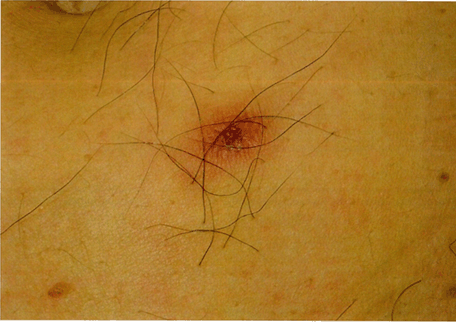
Five days after onset of Case 1, 64-year-old female, wife of patient in Case 1, came to our hospital complaining of similar symptoms, which were fever elevation and general malaise for two days. On her physical examination, cervical lymphadenopathy and pharyngitis were recognized. On her lower abdominal lesion, a 8 mm of diameter of localized necrotic lesion was also found (Figure 2), but maculopapular rash was not found on her trunk and extremities just like her husband. Her blood examination showed as following (Table 1); LDH 387 IU/L ALT 45 IU/L, AST 62 IU/L, and CRP 1.6 mg/dL, white blood cell count 4,490/µL. On her peripheral blood, 3% of atypical lymphocytes were also observed. They were similar with the results of (Case 1). She worked as a house-wife, and did not work in the endemic field like her husband. DNA analysis as PCR by using sample of her localized-necrotic skin lesion showed positive for Orientia tsutsugamushi, Kuroki. The diagnosis of her having scrub typhus (Tsutsugamushi disease) was performed, and oral administration of minocycline (200 mg/day) was started. Her symptoms relived three days later.


Cursor on image to zoom/Click text to open image
Figure 1: Maculopapular rash on his back.


Cursor on image to zoom/Click text to open image
Figure 2: Localized necrotic skin lesion (eschar).


Cursor on image to zoom/Click text to open image
Table 1: Laboratory data


Discussion

Scrub typhus is a kind of mite-transmitted infectious diseases, and occurs in mainly endemic rural areas [1][2][3]. Orientia tsutsugamushi is widely distributed through the Asia-Western Pacific region [1]. Fever, skin eruption, lymphadenopathy, and eschar (localized necrotic lesion) at the site of the chigger bite are known as the specific findings for the diagnosis [2][3][4] [5]. The incubation period is around two weeks, and sometimes occurs as imported disease in tourists [2] [3]. Therefore, physicians working other than Asia-Western Pacific region also should be aware of its clinical features. Rare but some, since the prognosis of the patients might be mortal [5][6], Tsutsugamushi diseased need early diagnosis and starting antibiotics including minocycline [4]. The standard regimen is tetracycline (minocycline or doxycycline), and alternatives is chloramphenicol, rifampicin, azithromycin, or clarithromycin [1] [4][6]. Usually measuring serum antibody titer against Orientia tsutsugamushi is utilized for the diagnosis [2], but sometimes that might need the days. By using patient's blood or eschar, PCR analysis detecting Orientia tsutsugamushi DNA is useful for having diagnosis [7][8]. According to the previous reports, sensitivity of detecting Orientia tsutsugamushi by PCR analysis using whole blood was more than 82%, and specificity was almost 100% [8]. More than half of scrub typhus patients, atypical erythematous rash is seen several days later after onset of fever elevation [2][3] [9]. Same with (Case 2), atypical erythematous rash was not recognized. One possible reason was that early diagnosis was performed by PCR before showing her eruption in (Case 2). The transmission pathway of scrub typhus in (Case 1) might be by contacting with Orientia tsutsugamushi in the forest during the work, but that of (Case 2) was uncertain. Since she has not been to the same forest, another transmission pathway was suspected. Although infection from person to person would not happen but familial infection was already reported [3] [5]. Former infected patients wearing contaminated-clothes come home and brought pathogen to their family via clothes contaminated with Orientia tsutsugamushi. She had no family other than her husband. As long as we heard from her, such like transmission pathway was possible in (Case 2).


Conclusion

Familial infected case of scrub typhus was reported. PCR analysis was valuable for its diagnosis.


Keywords: Eschar, Scrub typhus, Tsutsugamushi disease


References
  1. Jensenius M, Fournier PE, Raoult D. Rickettsioses and the international traveler. Clin Infect Dis 2004 Nov 15;39(10):1493–9.   [CrossRef]   [Pubmed]    Back to citation no. 1
  2. Koh GC, Maude RJ, Paris DH, Newton PN, Blacksell SD. Diagnosis of scrub typhus. Am J Trop Med Hyg 2010 Mar;82(3):368–70.   [CrossRef]   [Pubmed]    Back to citation no. 2
  3. Jeong YJ, Kim S, Wook YD, Lee JW, Kim KI, Lee SH. Scrub typhus: clinical, pathologic, and imaging findings. Radiographics 2007 Jan-Feb;27(1):161–72.   [CrossRef]   [Pubmed]    Back to citation no. 3
  4. Yasunaga H, Horiguchi H, Kuwabara K, Hashimoto H, Matsuda S. Delay in tetracycline treatment increases the risk of complications in Tsutsugamushi disease: data from the Japanese Diagnosis Procedure Combination database. Intern Med 2011;50(1):37–42.   [CrossRef]   [Pubmed]    Back to citation no. 4
  5. Rajapakse S, Rodrigo C, Fernando D. Scrub typhus: pathophysiology, clinical manifestations and prognosis. Asian Pac J Trop Med 2012 Apr;5(4):261–4.   [CrossRef]   [Pubmed]    Back to citation no. 5
  6. Peter JV, Sudarsan TI, Prakash JA, Varghese GM. Severe scrub typhus infection: Clinical features, diagnostic challenges and management. World J Crit Care Med 2015 Aug 4;4(3):244–50.   [CrossRef]   [Pubmed]    Back to citation no. 6
  7. Tange Y, Kobayashi Y. Transfiguration of rickettsial diseases: tsutsugamushi disease and spotted fever group rickettsiosis in Japan. Intern Med 1993 Dec;32(12):937–9.   [Pubmed]    Back to citation no. 7
  8. Kelly DJ, Fuerst PA, Ching WM, Richards AL. Scrub typhus: the geographic distribution of phenotypic and genotypic variants of Orientia tsutsugamushi. Clin Infect Dis 2009 Mar 15;48 Suppl 3:S203–30.   [CrossRef]   [Pubmed]    Back to citation no. 8
  9. Yoshimoto T, Yoshimoto T. Scrub typhus without eruption. Am J Trop Med Hyg 2012 Apr;86(4):559.   [CrossRef]   [Pubmed]    Back to citation no. 9
[HTML Abstract]   [PDF Full Text]

Author Contributions
Yasuyuki Taooka – Substantial contributions to conception and design, Acquisition of data, Analysis and interpretation of data, Drafting the article, Revising it critically for important intellectual content, Final approval of the version to be published
Gen Takezawa – Analysis and interpretation of data, Revising it critically for important intellectual content, Final approval of the version to be published
Guarantor of submission
The corresponding author is the guarantor of submission.
Source of support
None
Conflict of interest
Authors declare no conflict of interest.
Copyright
© 2016 Yasuyuki Taooka et al. This article is distributed under the terms of Creative Commons Attribution License which permits unrestricted use, distribution and reproduction in any medium provided the original author(s) and original publisher are properly credited. Please see the copyright policy on the journal website for more information.