| |
|
|
|
Clinical Image
| ||||||
| Dynamic breast deformity in a male | ||||||
| Martijn van Dorp1, Johan Somville2 | ||||||
|
1MD, Plastic Surgery Resident, Department of Plastic Surgery, Antwerp University Hospital, Antwerp, Belgium.
2MD PhD, Professor in Orthopaedic Surgery, Department of Orthopaedic Surgery, Antwerp University Hospital, Antwerp, Belgium. | ||||||
| ||||||
|
[HTML Abstract]
[PDF Full Text]
[Print This Article]
[Similar article in Pumed] [Similar article in Google Scholar] 
|
| How to cite this article |
| van Dorp M, Somville J. Dynamic breast deformity in a male. Int J Case Rep Images 2016;(6):416–418. |
|
Case Report
|
|
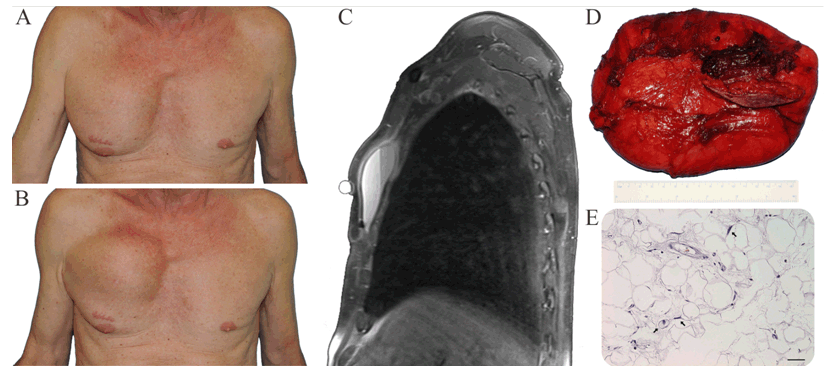
A 60-year-old male presented with a firm swelling of the right breast. Physical examination showed a dynamic breast deformity, also known as an animation deformity, during pectoralis muscle contraction (Figure 1A-B). Commonly, a dynamic breast deformity is seen following subpectoral breast augmentation. Magnetic resonance imaging scan revealed a well-described capsulated mass in the subpectoral plane of 20x20 cm (Figure 1C). Complete resection of the mass was performed after incisional biopsy (Figure 1D). Upon histopathological analysis (Figure 1E), the diagnosis was made of a well-differentiated adipocytic (lipoma-like) liposarcoma. This tumor entity consists of a proliferation of mature adipocytes of variable size together with few lipoblasts and atypical stromal cells (arrows). |
|
|
|
Discussion
|
|
To date, the available research regarding the dynamic breast deformity is based on subpectoral augmentation mammoplasty or implant-based breast reconstruction and no reports have come out regarding the presence of the dynamic breast deformity due to a neoplasm. Dynamic breast deformity, or animation deformity, is a common term in the field of aesthetic breast surgery and may be a result of subpectoral breast augmentation. When creating a subpectoral pocket plane, during augmentation mammoplasty, the overlying musculature retains its contractile ability. As a result the implant will be compressed when the muscle contracts. Typically this movement tends to draw the implant in an upward and outward directions and this directed compression creates a contour deformity in the breast. The deformity can easily be seen when the patient places her hands on the hips and pushes inwards [1]. Especially in the thin patient, the subpectoral plane has the benefit of having enhanced soft-tissue coverage of the prosthetic device. Whereby the potential for visible implant contours is minimalized and the incidence of capsular contraction is reduced. Alternatively, the subglandular plane is provided with the advantage of having more upper pole fullness and no animation deformity [2]. The magnitude of the deformity caused by the animation is highly variable and is usually only minimal to moderate in severity. At times, the degree of distortion of the implant can be dramatic and lead to patient dissatisfaction [3]. In transgender woman, subpectoral implantation carries increased risk of animation deformity due to the masculine pectoralis muscle [4]. Contraction-induced deformities are directly related to muscle strength and inversely related to the amount of breast tissue present [5]. Resolution of the animation deformity in augmentation mammoplasty may be achieved with a pocket change to the subglandular position and suturing the pectoralis major muscle down to the chest wall [1] [6]. Also, a biplane pectoralis muscle splitting technique has been described [7]. Alternatively, selective neurectomy of the medial pectoral nerve or botulinum toxin type A has been proposed to prevent the contraction of the pectoralis and may provide relief of muscular distortion [8]. |
|
Conclusion
|
|
Dynamic breast deformity is a common term in the field of aesthetic breast surgery in woman. However, as described in this extraordinary case, the dynamic breast deformity can be observed due to the presence of a subpectoral liposarcoma in a male patient. Keywords: Breast deformity, Breast augmentation, Muscle contraction, Swelling |
|
References
|
|
|
[HTML Abstract]
[PDF Full Text]
|
|
Author Contributions
Martijn van Dorp – Substantial contributions to conception and design, Acquisition of data, Analysis and interpretation of data, Drafting the article, Revising it critically for important intellectual content, Final approval of the version to be published Johan Somville – Substantial contributions to conception and design, Acquisition of data, Analysis and interpretation of data, Drafting the article, Revising it critically for important intellectual content, Final approval of the version to be published |
|
Guarantor of submission
The corresponding author is the guarantor of submission. |
|
Source of support
None |
|
Conflict of interest
Authors declare no conflict of interest. |
|
Copyright
© 2016 Martijn van Dorp et al. This article is distributed under the terms of Creative Commons Attribution License which permits unrestricted use, distribution and reproduction in any medium provided the original author(s) and original publisher are properly credited. Please see the copyright policy on the journal website for more information. |
|
|