| |
|
|
|
Case Report
| ||||||
| Testicular torsion in a patient with four testes and the ultrasound findings | ||||||
| Alborz Jahangiri1, Arash Moghadam1 | ||||||
|
1Department of Medical Imaging, the Prince Charles Hospital, Brisbane, Queensland, Australia.
| ||||||
| ||||||
|
[HTML Abstract]
[PDF Full Text]
[Print This Article]
[Similar article in Pumed] [Similar article in Google Scholar] 
|
| How to cite this article |
| Jahangiri A, Moghadam A. Testicular torsion in a patient with four testes and the ultrasound findings. Int J Case Rep Images 2016;7(3):178–180. |
|
Abstract
|
|
Introduction:
Polyorchidism is a rare medical condition, which is presence of more than two testes within the scrotum. Triorchidism is the more common form and the diagnosis is made with ultrasonography. One of the common anomalies associated with polyorchidism is testicular torsion.
Case Report: We report a case with four testes and testicular torsion in one testis. Conclusion: Testicular torsion in patients with polyorchidism is extremely rare and color Doppler ultrasound scan is the main diagnostic tool. | |
|
Keywords:
Congenital anomaly, Polyorchidism, Supernumerary testis, Testicular torsion, Ultrasonography
| |
|
Introduction
| ||||||
|
Polyorchidism is a rare congenital anomaly, which is the presence of more than two testes in the scrotum [1][2]. The first reported case was in 1880 by Ahlfeld and then in 1895 by Arbuthnot as a surgical discovery. The most common form is presence of three testes in the scrotal sac. The condition is usually diagnosed with sonography [3]. | ||||||
|
Case Report
| ||||||
|
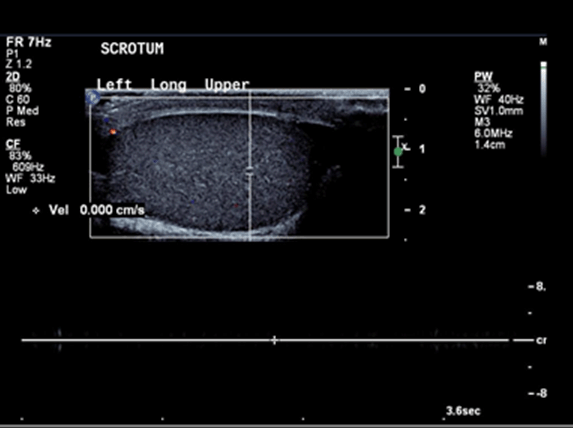
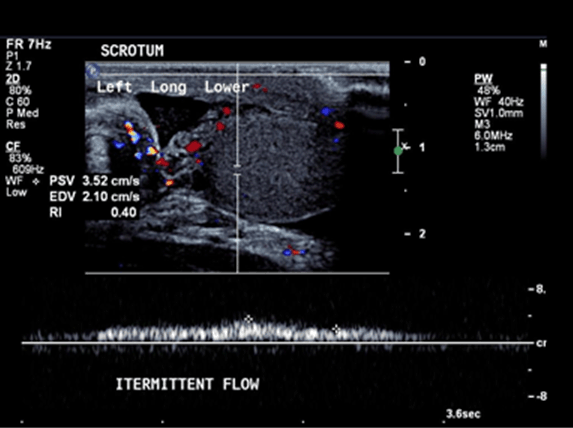
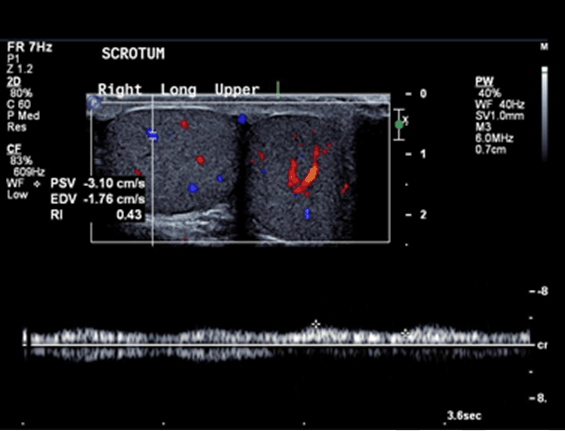
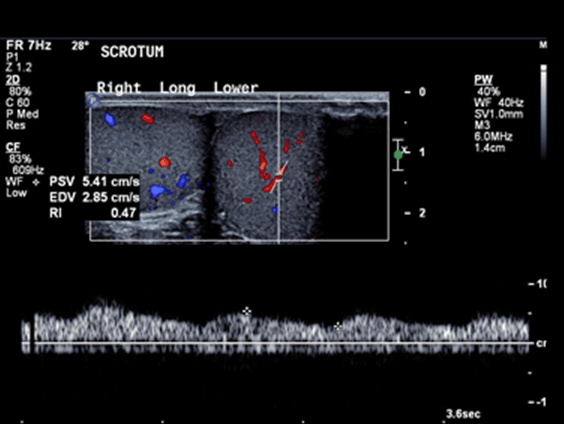
A 14-year-old boy presented to the emergency department with sudden onset of left sided testicular pain after playing soccer. He did not report any trauma to the scrotum and he was asymptomatic during the game. He did not have any urinary symptoms. On examination patient had generalized tenderness on the left hemiscrotum. A separate palpable lump also felt in the right hemiscrotum, which was not tender. Ultrasound of the scrotum showed polyorchidism with two distinct testes within each hemi-scrotum. The upper left testis measured 3.4x2.5 cm with no Doppler flow to the testis and adjacent hyperemia in the epididymis (Figure 1). The lower left testis measured 1.7x3.3 cm with decreased Doppler flow (Figure 2). The right hemi-scrotum contained two distinct testes measured 2.3x2.6 cm in the right upper testis (Figure 3) and 3.5x3.3 cm in the right lower testis (Figure 4). Scrotal exploration was performed immediately. Intraoperative findings revealed bilateral duplicate testis with sharing epididymis and vas deferens between the supernumerary testis and the other testis in each hemi-scrotum. Left sided upper testis was found to be torted with a 720 degrees twist. The testis was reduced and was found to be viable after reperfusion. Orchidopexy was performed for all fours testes. Patient had an uneventful recovery and was discharged the day after. | ||||||
| ||||||
| ||||||
| ||||||
| ||||||
|
Discussion
| ||||||
|
Polyorchidism is a rare congenital anomaly of the genital tract with presence of more than two testes usually within each hemi-scrotum [1][2]. Triorchidism is the most frequent presentation with presence of the supernumerary testis in the left hemi-scrotum [1]. Other locations include inguinal and retroperitoneal region [3]. Bilateral double testes have also been reported [4]. The most common location for the supernumerary testis is within the scrotum, superior or inferior to the other testis and it is diagnosed in early adulthood or adolescence between the ages of 15–25 years [5]. Ultrasonography is the initial tool to diagnose this anomaly with 80–95% sensitivity to differentiate intra and extra testicular masses. The main finding is the presence of a mass with identical echotexture to the ipsilateral testis with the similar flow characteristics to the ipsilateral testis on the color Doppler sonography [5]. In our case, the flow to the left supernumerary testis was absent and the flow to the left ipsilateral testis was also decreased which raised the suspicion of left sided supernumerary testicular torsion. Removal of the supernumerary testis and biopsy are not indicated for diagnosis. Polyorchidism is treated conservatively in the absence of complications such as testicular torsion, malignancy and cryptorchidism. Surgical treatment is only indicated when complication are present [6]. The torted testis in our case was viable after reduction and reperfusion. Orchidopexy was performed for all four testes and patient had an uneventful recovery and was discharged a day after the procedure. | ||||||
|
Conclusion
| ||||||
|
Polyorchidism with testicular torsion is extremely rare. If suspected, ultrasound with color Doppler needs to be performed to confirm the diagnosis. | ||||||
|
References
| ||||||
| ||||||
|
[HTML Abstract]
[PDF Full Text]
|
|
Author Contributions
Alborz Jahangiri – Substantial contributor to conception and design, Drafting the article, Revising it critically for important intellectual content, Final approval of the version to be published Arash Moghadam – Analysis and interpretation of data, Revising it critically for important intellectual content, Final approval of the version to be published |
|
Guarantor of submission
The corresponding author is the guarantor of submission. |
|
Source of support
None |
|
Conflict of interest
Authors declare no conflict of interest. |
|
Copyright
© 2016 Alborz Jahangiri et al. This article is distributed under the terms of Creative Commons Attribution License which permits unrestricted use, distribution and reproduction in any medium provided the original author(s) and original publisher are properly credited. Please see the copyright policy on the journal website for more information. |
|
|