
  |

|
 |
|
Case Report
| ||||||
| Exercise-induced coronary artery dissection in a 54-year-old male without atherosclerosis: A case report | ||||||
| Paul Ellis1, Victoria Grey1, Anthony D'Sa2, Derek Connolly3 | ||||||
|
1Foundation Doctor, Department of Cardiology, Sandwell and West Birmingham NHS Foundation Trust, West Bromwich, West Midlands, United Kingdom.
2Consultant Radiologist, Department of Radiology, Sandwell and West Birmingham NHS Foundation Trust, West Bromwich, West Midlands, United Kingdom. 3Consultant Cardiologist, Centre for Cardiovascular Sciences, University of Birmingham, Birmingham, West Midlands, United Kingdom. | ||||||
| ||||||
|
[HTML Abstract]
[PDF Full Text]
[Print This Article]
[Similar article in Pumed] [Similar article in Google Scholar] 
|


| How to cite this article |
| Ellis P, Grey V, D'Sa A, Connolly D. Exercise-induced coronary artery dissection in a 54-year-old male without atherosclerosis: A case report. Int J Case Rep Images 2016;7(1):11–14. |
|
Abstract
|
|
Introduction:
Spontaneous coronary artery dissection (SCAD) is an unusual cause of chest pain most often presenting in peripartum or postpartum women. The SCAD precipitated by exercise in patients without underlying atherosclerosis is very rare and has been described in literature only on a few occasions. It has never been described in a male above the age of 40.
Case Report: We present the case of a 54-year-old male presented with acute ST elevation myocardial infarction having suffered a left anterior descending artery dissection following an intense gym workout. He was successfully managed with coronary stenting. The patient suffered from on-going chest pain after initial recovery and was investigated with CT coronary angiography to assess stent patency and for evidence of underlying coronary artery disease. This showed a calcium score of 0 and no evidence of underlying atherosclerosis with a patent stent. Conclusion: In conclusion, SCAD should be considered in the differential diagnosis of patients presenting with acute coronary syndrome, even those without coronary risk factors. | |
|
Keywords:
Atherosclerosis, Coronary artery dissection, Exercise, Spontaneous coronary artery dissection (SCAD)
| |
|
Introduction
| ||||||
|
Spontaneous coronary artery dissection is an extremely rare condition that has a variety of presentations including angina, acute coronary syndrome, heart failure, arrhythmias and, in some cases, sudden death [1] [2]. We describe the case of a 54-year-old male with exercise induced coronary artery dissection presenting with acute coronary syndrome with discussion and review of literature. | ||||||
|
Case Report
| ||||||
|
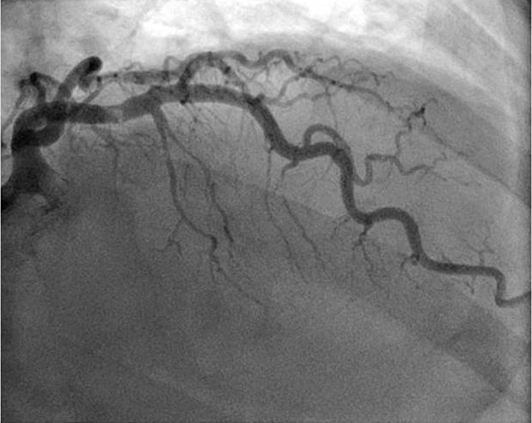
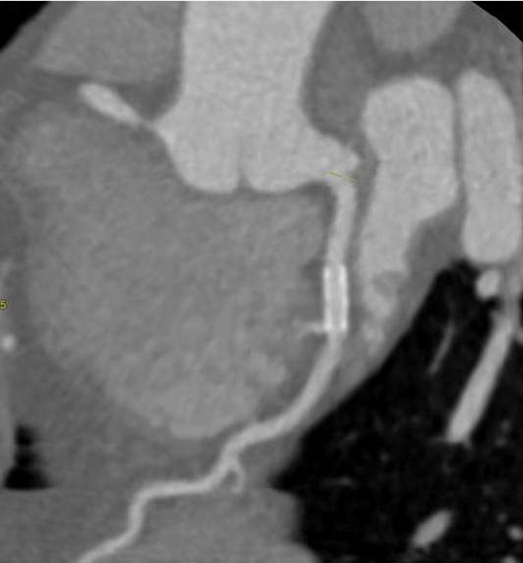
A 54-year-old male who had just finished his first ever gym session with a personal trainer was presented with a two-hour history of central chest pain radiating to his left arm. He had never experienced this chest pain before. The pain settled with the administration of sublingual nitrates and aspirin 300 mg. The patient denied any significant past medical history and had no personal or family history of ischemic heart disease. He was a non-smoker, exercised regularly and did not use recreational drugs. His baseline serum cholesterol was 5.2 mmol/L with HDL 1.3 mmol/L, and he had been started on simvastatin 40 mg daily recently by his family doctor. Physical examination was unremarkable including no signs of connective tissue disease. A 12-lead ECG showed subtle 1 mm ST elevation in V5 and V6. Chest radiograph showed clear lung fields and no cardiomegaly. Coronary angiography revealed a dissection flap in the proximal left anterior descending artery, TIMI grade II flow (Figure 1). This was subsequently successfully stented with deployment of a Xience Prime 3.5x12 mm post dilated to 4 mm with an NC Trek non-compliant balloon inflated to 16 atmospheres. Cardiac enzymes were elevated with serial troponins of 16 ng/L on presentation and 54 ng/L four hours later. The patient was discharged with aspirin 75 mg, perindopril 2 mg, atorvastatin 80 mg daily and ticagrelor 90 mg twice daily. Three months later, the patient continued to have atypical chest pain and was keen to know whether his myocardial infarction was related to coronary disease. Cardiac computed tomography scan was performed to assess stent patency and the degree of coronary artery atherosclerosis. This demonstrated an Agatston calcium score of 0 and the coronary angiography did not identify any coronary artery disease and demonstrated a patent stent in the left anterior descending artery (Figure 2). The patient was started on a cardiac rehabilitation program and continues to make good progress six months after the coronary artery dissection. | ||||||
| ||||||
| ||||||
|
Discussion
| ||||||
|
This case is unique as it demonstrates a spontaneous left anterior descending artery dissection caused by exercise alone without the presence of atherosclerosis in a middle aged man. It is also the first reported case of utilization of CT coronary angiography to investigate for atherosclerosis in a patient with SCAD. We reviewed 13 cases of exercise induced coronary artery dissection from 1995 to 2014. Nine of these patients were male and the mean age at the time of dissection was 36 years of age ranging from 17 to 53 years. The risk factors each patient had were analyzed; 30.7% were smokers, 30% had high cholesterol and 15.3% had a family history of ischemic heart disease [1] [3] [4] [5] [6] [7] [8] [9] [10] [11] [12]. Obesity was identified as a further risk factor in one of these patients [5]. In addition, one patient was an ex-smoker and had stopped smoking 6 years prior to the dissection [12]. The remaining 6 patients were found to have no risk factors for coronary artery disease or risk factors were not declared. The female to male ratio of these 6 patients was equal [1] [3][7][8][10][13]. From literature reviewed, seven cases (53.8%) were associated with aerobic activity and five cases (38.4%) were associated with anaerobic activity disease [1] [3] [4] [5] [6] [7] [8] [9] [10] [11] [12]. One further case that was found was associated with severe emotional distress and anxiety [3]. Additionally, five patients had delayed presentation after the initial event, the longest delay in presentation being a patient who presented following a cycling tour who had suffered angina pain for four months but had not sought medical attention [9]. The left anterior descending artery was the vessel most commonly affected with eight of the cases in literature review involving this artery alone [3] [4] [5] [6] [8] [9] [12]. Three further cases involved only the circumflex artery and finally two cases involved multiple coronary vessels [1] [3][7][10] [11]. Spontaneous coronary artery dissection (SCAD) is a rare and unusual cause of acute coronary syndrome with an approximate incidence of between 0.07% and 0.1% of patients having coronary angiography [14] [15]. Since the first described case of spontaneous coronary artery dissection by Pretty et al. [16] in 1931 three main groups of patients with SCAD have been identified [17]:
Women are most commonly affected [17], one study finding that 70% of all cases of SCAD from 1931 to 2008 were men, 26.1% of which were either pregnant or postpartum [18]. It has been postulated that high levels of oestrogen and progesterone with increased levels of collagenases during and after pregnancy may contribute to the development of SCAD in this group of patients [8] [10]. The second group is with underlying atherosclerosis. There is debate as to whether this group has truly had spontaneous coronary artery dissection because of the underlying weakness in the artery wall predisposing them to SCAD [6] [17]. Tweet et al. suggest that plaque dissection may well represent a differing presentation of typical acute coronary syndrome and that non-atherosclerotic SCAD is clinically separate [15]. The third group is those of idiopathic origin in patients without atherosclerosis. This includes those with connective tissue disease; such as Marfans syndrome, cocaine use [19], vasculitis, chest trauma, and as in this case, vigorous exercise [15]. Of the small proportion of cases where exercise is alone believed to be the precipitating event, many have risk factors or are found to have atherosclerosis with coronary angiography [3] [4] and the coronary dissection cannot be considered truly SCAD. We have found only one case that has described exercise induced coronary artery dissection in a patient without atherosclerosis demonstrated with CT coronary angiography in a 25-year-old male [7]. The pathogenesis of SCAD is still poorly understood due to its rarity. Alfonso et al. has identified two pathological subsets of patients [20]. The first are those with an intimal tear where the true and false lumens communicate directly. Initial intimal disruption may be due to a number of factors including structural changes in the vessel wall, increased shearing stress from hyperdynamic circulation or physical exertion [5]. Patients of second group are those who presented without an intimal tear. It has been suggested that this group may have a primary abnormality in the vasa vasorum [20]. In both subsets of patients, on-going hemorrhage or expanding hematoma within the false lumen compromises the true coronary lumen which manifests in myocardial ischemia and the presentation of acute coronary syndrome [3] [7][20]. The SCAD usually presents with dissection of a single vessel, the left anterior descending artery being most commonly affected [10]. Management of SCAD depends on a multitude of factors. These include location of dissection, number of coronary vessels involved, patient presentation and patient preference. Many studies agree that surgery with coronary artery bypass grafting is most suitable for involvement of the left main stem or for multiple vessel involvement. Studies where percutaneous coronary intervention has been used mostly involves the stenting of a single vessel [3] [5][8] [9] including the case described. Medical therapy has also been demonstrated to be an effective treatment option but is often used in stable patients without ongoing ischemia, in cases where extensive dissection is not suitable for intervention or in those that decline surgical or percutaneous intervention [1] [6][13][7][2]. | ||||||
|
Conclusion
| ||||||
|
In conclusion, spontaneous coronary artery dissection should be considered in the differential diagnosis of young patients or those without risk factors presenting with acute coronary syndrome. | ||||||
|
References
| ||||||
| ||||||

|
[HTML Abstract]
[PDF Full Text]
|
|
Author Contributions
Paul Ellis – Substantial contributions to conception and design, Acquisition of data, Analysis and interpretation of data, Drafting the article, Revising it critically for important intellectual content, Final approval of the version to be published Victoria Grey – Analysis and interpretation of data, Revising it critically for important intellectual content, Final approval of the version to be published Anthony D'Sa – Analysis and interpretation of data, Revising it critically for important intellectual content, Final approval of the version to be published Derek Connolly – Analysis and interpretation of data, Revising it critically for important intellectual content, Final approval of the version to be published |
|
Guarantor of submission
The corresponding author is the guarantor of submission. |
|
Source of support
None |
|
Conflict of interest
Authors declare no conflict of interest. |
|
Copyright
© 2016 Paul Ellis et al. This article is distributed under the terms of Creative Commons Attribution License which permits unrestricted use, distribution and reproduction in any medium provided the original author(s) and original publisher are properly credited. Please see the copyright policy on the journal website for more information. |
|
|