
  |

|
 |
|
Case Report
| ||||||
| Severe hyponatremia: A physician's nightmare | ||||||
| Michele Carron1, Mariarosa Meneghetti2, Giuseppe Gagliardi2, Carlo Ori3 | ||||||
|
1Anesthesiologist and Intensivist, Assistant Professor, Department of Medicine, Anesthesiology and Intensive Care, University of Padova, Padova, Italy.
2Anesthesiologist and Intensivist, Intensive Care Unit, St. Antony Hospital, Via Jacopo Facciolati, 71 - 35127 Padova, Italy. 3Anesthesiologist and Intensivist, Professor and Chief, Department of Medicine, Anesthesiology and Intensive Care, University of Padova, Padova, Italy. | ||||||
| ||||||
|
[HTML Abstract]
[PDF Full Text]
[Print This Article]
[Similar article in Pumed] [Similar article in Google Scholar] 
|


| How to cite this article |
| Carron M, Meneghetti M, Gagliardi G, Ori C. Severe hyponatremia: A physician's nightmare. Int J Case Rep Images 2015;6(11):694–697. |
|
Abstract
|
|
Introduction:
Osmotic demyelination syndrome is an uncommon neurological disease that may complicate the treatment of severe hyponatremia [1] [2] [3]
[4]. In case of osmotic demyelination syndrome, the computed tomography and the magnetic resonance imaging scans are used for diagnosis. The experience with positron emission tomography with 18Fluoro-fluorodeoxyglucose is limited.
Case Report: We report the case of a 32-year-old female who presented to the emergency department with signs and symptoms of severe hyponatremia (104 mmol/L). Treatment with hypertonic saline allowed to increase her serum sodium level to 132 mmol/L in the following three days with initial clinical benefit. On the 3rd day, the patient showed neurological deterioration complicated by seizures requiring intensive care. The computed tomography and magnetic resonance imaging scans of her brain obtained in the first fifteen days from hospital admission were normal. Instead, positron emission tomography with 18Fluoro-fluorodeoxyglucose revealed an overall reduction in 18Fluoro-fluorodeoxyglucose uptake in the cortical area attributable to diffuse brain damage, confirmed by a subsequent third magnetic resonance imaging scan taken twenty days after the hospitalization. Osmotic demyelination syndrome was diagnosed. The patient did not recover neurologically as confirmed by a second positron emission tomography with 18Fluoro-fluorodeoxyglucose performed ninety days after hospitalization. Conclusion: Great attention should be placed on treatment of severe hyponatremia. In case of osmotic demyelination syndrome, the use of positron emission tomography with 18Fluoro-fluorodeoxyglucose may be considered for diagnosis and for assessment of the degree and extent of cerebral damage over time. | |
|
Keywords:
18Fluoro-fluorodeoxyglucose, Hyponatremia, Osmotic demyelination syndrome, Positron emission tomography
| |
|
Introduction
|
|
Osmotic demyelination syndrome (ODS) is an uncommon neurological disease characterized by demyelination of areas of the central nervous system that may complicate the treatment of severe hyponatremia [1] [2] [3] [4]. Lesions can occur at central pons (central pontine myelinolysis) and/or outside the pons (extrapontine myelinolysis) [1] [2] [3] [4]. Damage is often permanent [1] [2] [3] [4]. In case of ODS, the use of adequate imaging is important for diagnosis and early treatment [4] [5] [6]. The computed tomography (CT) scan and the magnetic resonance imaging (MRI) scan are used for diagnosis [4] [5]. In particular, MRI scan is considered the radiological modality of choice for earlier detection of ODS lesions [4][5]. However, in highly suspect ODS, the radiological evidence of lesions may be not found at the beginning and a further MRI scan may be necessary [4] [5]. The role of positron emission tomography (PET) scan with 18Fluoro-fluorodeoxyglucose (18F-FDG) in case of ODS is not well established. |
|
Case Report
|
|
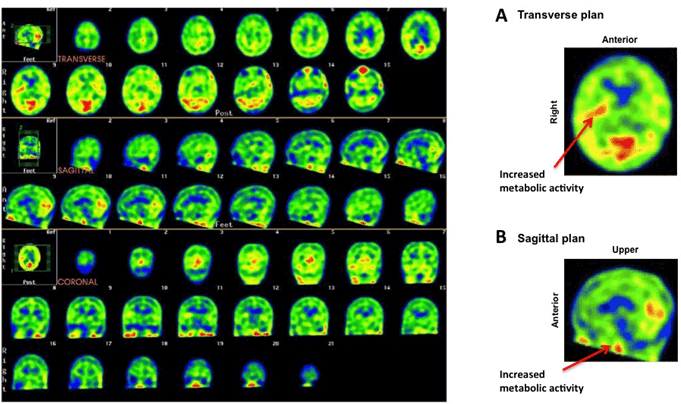
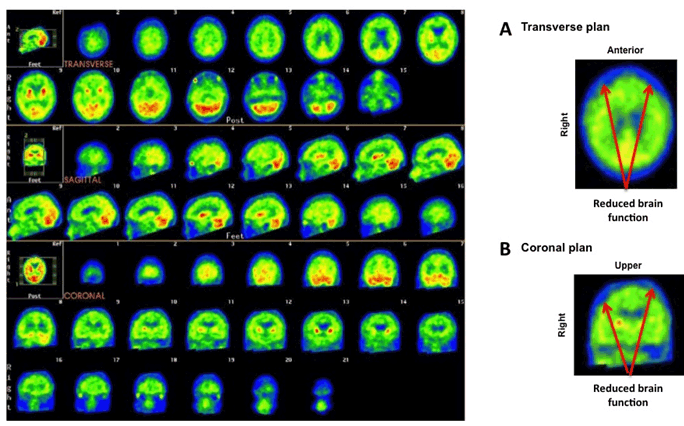
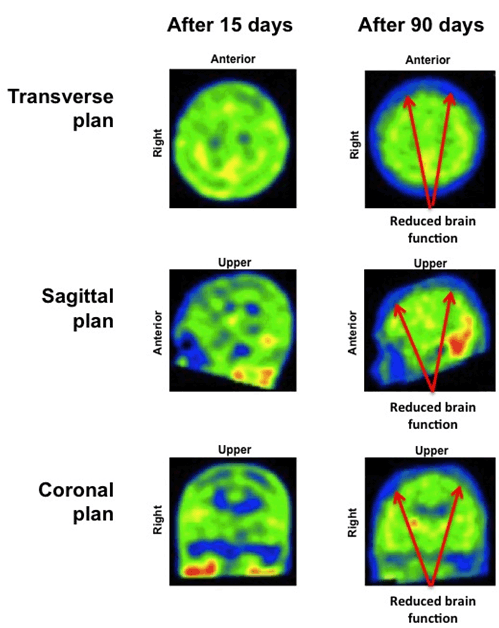
A 32-year old female presented to the hospital with severe confusion, weakness, and vomiting. She had a history of hypertension and kidney hypoplasia. Upon admission her serum sodium concentration was 104 mmol/L. Treatment with hypertonic saline allowed to increase her serum sodium level to 118 mmol/L on first day, 125 mmol/L on second day, and 132 mmol/L on third day after admission. On the 3rd day, the patient experienced neurological deterioration complicated by seizures, requiring medical treatment and tracheal intubation. The computed tomography (CT) scan and the magnetic resonance imaging (MRI) scan of her brain were initially normal. A second MRI scan was obtained fourteen days after hospitalization and did not reveal significant abnormalities. There were no anoxic or hypoxic episodes during the time in which the patient was being followed. However, her brain function did not recover. A 18F-FDG PET scan taken one day later the second MRI scan revealed an overall reduction in 18F-FDG uptake in the cortical area with two regions of increased metabolic activity (Figure 1). A third MRI scan performed twenty days after hospitalization showed diffuse brain damage. The ODS was, then, diagnosed. Similarly to other neurological disorders, general care were applied, including adequate nutrition, good skin care, passive joint exercises, airways suctioning, careful management of the bladder and bowel. Percutaneous tracheostomy and endoscopic gastrostomy were performed for manage secretions and feeding, respectively. An indwelling urinary catheter was also necessary. The ICU care was complicated by occurrence of ventilator-associated pneumonia. Once weaned from mechanical ventilation and stabilized her clinical condition, the patient was transferred to neurological ward for neuro-rehabilitation. The patient did not recover neurologically as confirmed by a second 18F-FDG PET scan performed ninety days after hospitalization (Figure 2) and (Figure 3) . The patient was able to spontaneously open and close her eyes, but she was unable to follow instructions or track movements, and speak or communicate in any forms. Three months after the diagnosis of ODS, she was still in a vegetative state and was, then, transferred to a neuro-rehabilitation centre for the care of case. |
|
|
|
|
|
|
|
Discussion
|
|
The ODS remains a feared complication of the treatment of severe hyponatremia [1] [2] [3] [4]. It is not clear the best rate of correction of hyponatremia [1][2][3]. Depending on the severity of the patient's symptoms, the serum sodium was suggested to be corrected at a rate of 0.5 mmol/L/h or 1 mmol/L/h [2] [3]. However, the revision of published reports on patients with very severe hyponatremia (serum sodium <106 mmol/L) revealed that neurologic sequelae were associated with correction of hyponatremia by more than 12 mmol/L per day [1]. So that, the more recent recommendations are to limit the increase in serum sodium concentration to a total of 10 mmol/L during the first 24 h and an additional 8 mmol/L during every 24 h thereafter until the serum sodium concentration reaches 130 mmol/L [4]. In case of ODS, uncertainty regarding the optimal approach still exists [5] [6] [7] [8]. Reinduction of hyponatremia by using desmopressin, intravenous 5% dextrose solution or a combination of both, is recommended in high risk patients [6][7]. Corticosteroids, plasmapheresis and intravenous immunoglobulin have been successfully proven in selected patients [7]. Besides pharmacological therapy, the treatment of ODS is supportive and includes physical therapy, similarly to other neurological disorders [7]. Outcome is variable. Patients who survive ODS are likely to require extensive and prolonged neuro-rehabilitation [5] [8]. The CT and the MRI scans are used for diagnosis. In particular, MRI scan is the radiological modality of choice for detection of ODS lesions [5] [8]. Typically, T2-weighted and fluid attenuated inversion recovery (FLAIR) MRI images show increased signal intensity where demyelination has occurred [5] [8]. Sometimes, however, radiological evidence of lesions in case of ODS may be not found. If ODS is highly suspected, but there is no evidence on imaging, it is recommended to repeat the MRI scan after 2–3 weeks (following the onset of symptoms or correction of hyponatremia) being able, at this time, to reveal lesions not apparent on early scans [5] [8]. The radiological findings may not improve over time, even in case of complete clinical recovery [7]. 18F-FDG is a glucose analog used in the medical imaging modality PET. The uptake of 18F-FDG by high-glucose-using cells, such as brain cells, is a marker for the tissue uptake of glucose, which in turn is closely correlated with tissue glucose metabolism [9] [10] [11]. In case of brain damage, 18F-FDG PET scan may provide earlier information than CT or MRI scan [10][11]. In case of ODS, 18F-FDG PET may demonstrate hypermetabolism in some brain regions, probably due to increased glucose activity of the phagocytic microglial cells and astrocytes [9], and a progressive hypometabolism owing to the destructive demyelination, as seen in our case. Furthermore, 18F-FDG PET has not only an important role in establishing the degree, and extent of cerebral damage, but also in providing information on the residual brain function in patients with ODS [10] [11]. |
|
Conclusion
|
|
Great attention should be placed on treatment of severe hyponatremia. It is necessary to follow strictly the more recent recommendations on treatment of severe hyponatremia. In case of osmotic demyelination syndrome, the use of adequate imaging is important for diagnosis and early treatment and for assessment of the degree and extent of cerebral damage over time. |
|
References
|
|

|
[HTML Abstract]
[PDF Full Text]
|
|
Author Contributions
Michele Carron – Substantial contributions to conception and design, Acquisition of data, Analysis and interpretation of data, Drafting the article, Revising it critically for important intellectual content, Final approval of the version to be published Mariarosa Meneghetti – Analysis and interpretation of data, Revising it critically for important intellectual content, Final approval of the version to be published Giuseppe Gagliardi – Analysis and interpretation of data, Revising it critically for important intellectual content, Final approval of the version to be published Carlo Ori – Analysis and interpretation of data, Revising it critically for important intellectual content, Final approval of the version to be published |
|
Guarantor of submission
The corresponding author is the guarantor of submission. |
|
Source of support
None |
|
Conflict of interest
Authors declare no conflict of interest. |
|
Copyright
© 2015 Michele Carron et al. This article is distributed under the terms of Creative Commons Attribution License which permits unrestricted use, distribution and reproduction in any medium provided the original author(s) and original publisher are properly credited. Please see the copyright policy on the journal website for more information. |
|
|