| |
|
|
|
Case Report
| ||||||
| Sarcoidosis associated with pseudopapillary pancreatic tumor | ||||||
| Elhadidy Tamer1, Morsy Nesreen Elsayed1, Abdelwahab Heba Wagih2, Refky Basel3, Zalata Khaled4 | ||||||
|
1Chest Medicine department, Mansoura University, Mansoura, Egypt.
2Chest Medicine department, Mansoura University, Mansoura, Egypt. 3Oncology surgery.Oncology center, Mansoura University, Mansoura, Egypt. 4Pathology department, Mansoura University, Mansoura, Egypt. | ||||||
| ||||||
|
[HTML Abstract]
[PDF Full Text]
[Print This Article]
[Similar article in Pumed] [Similar article in Google Scholar] 
|
| How to cite this article |
| Tamer E, Elsayed MN, Wagih AH, Basel R, Khaled Z. Sarcoidosis associated with pseudopapillary pancreatic tumor. Int J Case Rep Images 2015;6(11):690–693. |
|
Abstract
|
|
Introduction:
The sarcoidosis is an idiopathic multisystem inflammatory disease characterized by the presence of non-caseating granulomas in the affected organs. A clear association between sarcoidosis and malignancies has been reported. Cancer can occur in patients with an established diagnosis of sarcoidosis and sarcoidosis can subsequently develop in a cancer patient. Malignancy can also be associated with the occurrence of sarcoid reactions.
Case Report: We report the case of sarcoidosis/sarcoid-like reaction associated with pseudopapillary pancreatic tumor. Conclusion: This case report emphasizes the need to add sarcoidosis in the differential diagnosis of lung lesions associated with pancreatic tumors. | |
|
Keywords:
Pancreatic Neoplasms, Pseudopapillary neoplasm, Sarcoidosis
| |
|
Introduction
| ||||||
|
Solid pseudopapillary neoplasia of the pancreas is an extremely rare epithelial tumor of low malignant potential and accounts for less than 1–2% of exocrine pancreatic tumors [1]. This tumor was described by using various names including 'solid cystic tumor', 'papillary cystic tumor', 'papillary epithelial neoplasia', 'solid and papillary epithelial neoplasia', 'papillary epithelial tumor' and 'Frantz's tumor', 'solid and papillary tumor', 'solid-cystic papillary epithelial neoplasm', 'benign or malignant papillary tumor of the pancreas' until it was defined by the World Health Organization in 1996 as 'solid pseudopapillary tumor' of the pancreas [2]. Sarcoidosis is a multisystem inflammatory disease that mainly affects the intrathoracic lymph nodes, the lungs, the skin and the eyes. The clinical pictures include systemic and organ-specific symptoms. However, in the majority of cases it is diagnosed in asymptomatic patients, based on the finding of hilar adenopathy on chest radiography performed for other reasons [3]. Malignancy can be associated with the occurrence of sarcoid reactions. Problems may also arise in distinguishing between tumor-related sarcoidosis and true systemic sarcoidosis. In this study, we report, to our knowledge, the first case of sarcoidosis associated with pseudopapillary pancreatic tumor. | ||||||
|
Case Report
| ||||||
|
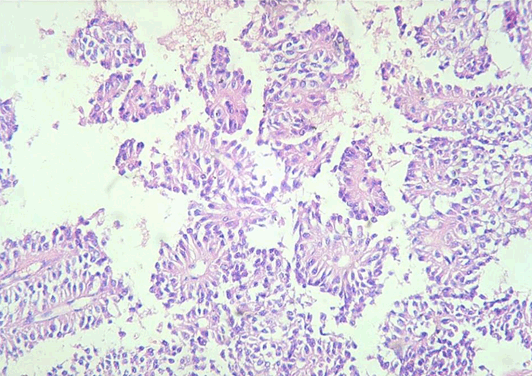
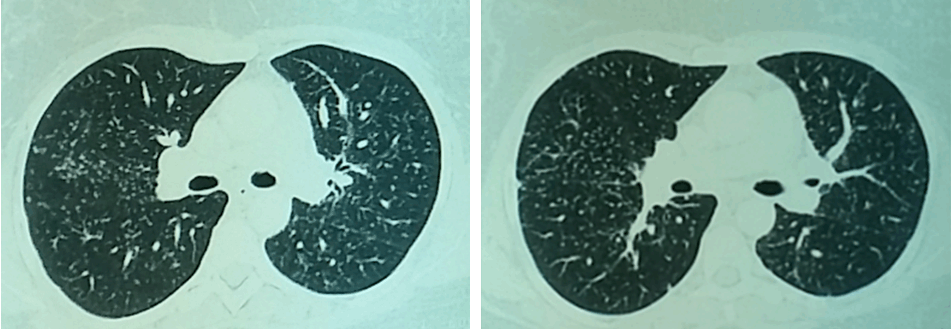
A 44-year-old female presented to oncology center Mansoura University with a one month history of vague abdominal pain and bilateral edema lower limbs. Abdominal ultrasound revealed well defined soft tissue mass at splenic and left renal area with area of cystic degenerations. Further etiological investigations were performed, including abdominal computed tomography (CT) scan which showed large enhanced soft tissue mass in left hypochondriac region with cystic degeneration and foci of calcifications inside. Anteriorly it was seen in contact with greater curvature of the stomach with no clear fat plane in between. Medially, it is seen contacting and displacing pancreatic tail. Chest CT scan showed multiple enlarged pretracheal, aortopulmonary, subcarinal and hilar lymph nodes. The largest seen was subcarinal lymph node measuring 3.5x2.8 cm. Both lung parenchymas showed bilateral perilymphatic nodules. A metastatic cancer was initially suspected then ultrasound-guided Tru-cut biopsy of the abdominal mass showed sheets of small uniform tumor cells surrounding delicate hyalinized fibrovascular stroma forming pseudopapillae. Some cells have eosinophilic others have vacuolated cytoplasm with grooved nuclei. Infrequent mitosis was detected. No significant immunohistochemical staining was observed for CD10PR picture consistent with pseudopapillary pancreatic tumor (Figure 1). The surgical removal of pancreatic mass was done and sent for pathological evaluation which confirms the result of previous tru-cut biopsy. She was discharged and transferred to chest department Mansoura University for assessment of CT chest. Fiber optic bronchoscopy was done from which bronchoalveolar lavage and transcarinal needle aspiration was taken but showed inflammatory cells without atypical or giant cells. Follow-up CT scan of chest 10 months later showed bilateral perilymphatic nodules with disappearance of previously described lymphadenopathy (Figure 2). Thoracoscopic lung biopsy then taken and histological examinations revealed non-caseating epithelioid granuloma. | ||||||
| ||||||
| ||||||
|
Discussion
| ||||||
|
A solid pseudopapillary neoplasm (SPN) of the pancreas was described firstly by Dr. Frantz in 1959.It is a rare pancreatic tumors which have a relatively low malignant potential and are mostly diagnosed in young women. The treatment is surgical resection; the prognosis is favorable after resection [4][5]. Sarcoidosis is a multisystem disease of unknown etiology that can affect any organ. It is characterized by non-caseating granulomatous lesions involving the lungs, skin, eyes, salivary glands and internal organs [6]. The question of whether there is a causal relationship between sarcoidosis and cancer has been debated for years. Sarcoidosis is associated with malignancy more than can be explained by chance. Cancer can occur in patients with an established diagnosis of sarcoidosis and sarcoidosis can subsequently develop in a cancer patient. Malignancy can also be associated with the occurrence of sarcoid reactions. Problems may also arise in distinguishing between tumor-related sarcoid reactions and true systemic sarcoidosis [7]. So, in this study revision of pathological specimen was then carried out in order to make a differential diagnosis between pancreatic tumor associated with sarcoidosis, or the presence of a pancreatic granuloma as a part of a systemic sarcoidosis. Pathological revision showed epithelioid granuloma of thoracoscopic biopsy and solid pseudopapillary pancreatic tumor of pancreatic mass biopsy. The strongest association between sarcoidosis and solid tumors is described with adenocarcinoma of the lung, although other cancers have also been reported. In most cases, the diagnosis of sarcoidosis preceded the detection of neoplasm, leading to the hypothesis that the immune system dysfunction and the tissue chronic inflammation characterizing sarcoidosis can facilitate cancer development. However, it has been also reported cases in which diagnosis of cancer precedes the development of sarcoidosis, as well as cases of concomitant diagnosis. Sarcoid-like reaction occurs more frequently in regional lymph nodes of neoplasm ("typical sarcoid-like reaction"), and is believed to represent a T cell-mediated immune response to soluble antigenic factors shed by the tumoral cells. However, cases of ("atypical sarcoid-like reaction") in distant lymph nodes have been observed [3]. Other studies such as Mastroroberto et al. reported the first case of association of sarcoidosis and pancreatic neuroendocrine tumor [3] and Zambrana et al. also reported a case with both sarcoidosis and pancreatic cancer [7]. In this study, we report, to our knowledge, the first case of sarcoidosis associated with pseudopapillary pancreatic tumor. | ||||||
|
Conclusion
| ||||||
|
This case report summarizes the association between sarcoidosis and pancreatic tumors to be one of the differential diagnoses in our mind while dealing with pancreatic cancer in addition to metastatic lesions. | ||||||
|
Acknowledgements
| ||||||
|
We wish to thank all the clinical staff at Clínicalas Americas in Medellin Colombia for their support in the care of the patient. | ||||||
|
References
| ||||||
| ||||||
|
[HTML Abstract]
[PDF Full Text]
|
|
Author Contributions
Elhadidy Tamer – Substantial contributions to conception and design, Acquisition of data, Analysis and interpretation of data, Drafting the article, Revising it critically for important intellectual content, Final approval of the version to be published Morsy Nesreen Elsayed – Analysis and interpretation of data, Revising it critically for important intellectual content, Final approval of the version to be published Abdelwahab Heba Wagih – Analysis and interpretation of data, Revising it critically for important intellectual content, Final approval of the version to be published Refky Basel – Analysis and interpretation of data, Revising it critically for important intellectual content, Final approval of the version to be published Zalata Khaled – Analysis and interpretation of data, Revising it critically for important intellectual content, Final approval of the version to be published |
|
Guarantor of submission
The corresponding author is the guarantor of submission. |
|
Source of support
None |
|
Conflict of interest
Authors declare no conflict of interest. |
|
Copyright
© 2015 Elhadidy Tamer et al. This article is distributed under the terms of Creative Commons Attribution License which permits unrestricted use, distribution and reproduction in any medium provided the original author(s) and original publisher are properly credited. Please see the copyright policy on the journal website for more information. |
|
|