| |
|
|
|
Case Report
| ||||||
| The appendix and the inguinal canal: Amyand's hernia a case report | ||||||
| Shariful Islam1, Devin Hosein1, Vinoo Bheem2, Vijay Naraynsingh3 | ||||||
|
1Senior House Officer, Surgery, San Fernando Teaching Hospital, Trinidad & Tobago.
2Head of the Department of Surgery (Ag), San Fernando Teaching Hospital, Trinidad & Tobago. 3Department of Clinical Surgical Sciences, University of the West Indies, St Augustine, Trinidad and Tobago. | ||||||
| ||||||
|
[HTML Abstract]
[PDF Full Text]
[Print This Article]
[Similar article in Pumed] [Similar article in Google Scholar] 
|
| How to cite this article |
| Islam S, Hosein D, Bheem V, Naraynsingh V. The appendix and the inguinal canal: Amyand's hernia a case report. Int J Case Rep Images 2015;6(10):636–639. |
|
Abstract
|
|
Introduction:
Inguinal hernia repairs are one of the most common operations performed by the general surgeon. Occasionally, an emergency repair must be performed in the setting of painful incarceration, strangulation or obstruction. It is, therefore, essential that sound knowledge of the anatomy of the inguinal canal and variants of the inguinal hernia are required. One such variant is an Amyand's hernia, a rare inguinal hernia defined by the presence of the appendix in the inguinal canal.
Case Report: We report a 52-year-old male who presented to our institution with a painful incarcerated right inguinal hernia who subsequently underwent emergency repair. A Type 1 Amyand's hernia was discovered on operation, an appendectomy and a Lichtenstein hernia repair were then performed. Due to the rarity of this hernia there are no standard guidelines for repair with respect to performing appendectomy or the use of mesh post appendectomy. Conclusion: The aim of this report is to assist the surgeon in making an informed decision on treatment of this rarity by review of current literature. | |
|
Keywords:
Inguinal hernia, Amyand's hernia, mesh repair
| |
|
Introduction
| ||||||
|
Hernia repairs are one of the most common operations done by the general surgeon with inguinal hernias being the most common type of abdominal wall hernias [1]. Inguinal hernias often present as acute emergencies and require emergent repair, therefore extensive knowledge of the anatomy and the variants of hernias is essential. An Amyand's hernia is one such variant of an inguinal hernia. This rare type of hernia is characterized by the presence of the appendix in the inguinal canal. Amyand's hernia can be further classified by the presence of co-existing pathology involving the appendix, that is, whether the appendix is inflamed or if there is unrelated pathology associated with the hernia [2]. The first case of an appendix within the inguinal sac was described by Claudius Amyand and published in the Philosophical Transactions of the Royal Society of London in 1976 [3]. He is also credited with performing the first successful appendectomy [3]. It is, therefore, important that awareness of this hernia and appropriate treatment of this rarity be kept in mind by every surgeon performing a hernia repair. | ||||||
|
Case Report
| ||||||
|
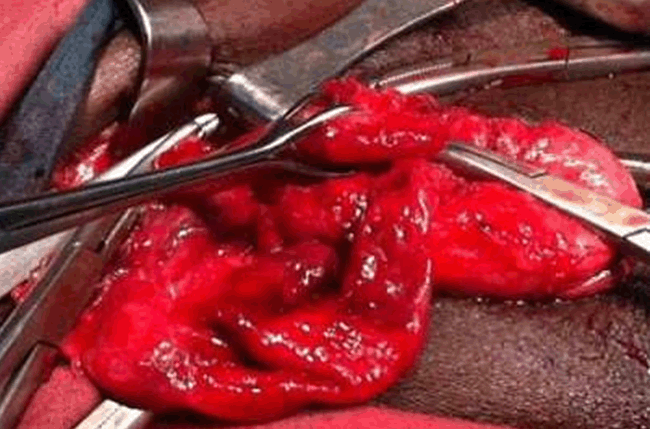
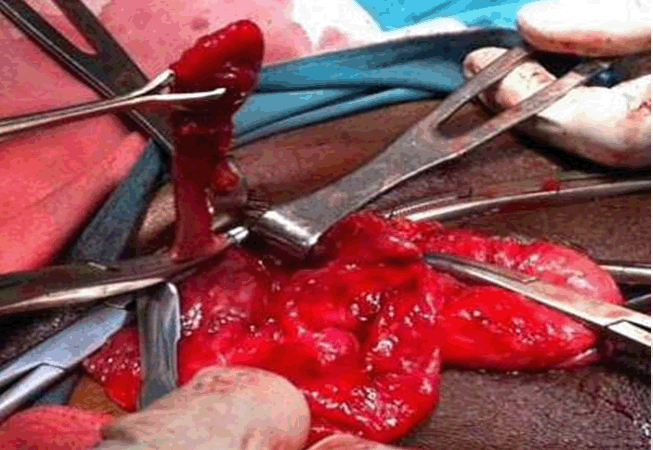
A 52-year-old male presented to the emergency department with sudden onset right sided groin pain and swelling. He is a construction worker by occupation and has been diagnosed with a right sided inguinal hernia one year prior. He has missed his date for surgery on several occasions. The pain was localized to the hernia which was irreducible. He had one episode of vomiting with no other symptoms of intestinal obstruction. He has a 30-pack year smoking history with no chronic cough or any urinary symptoms. On examination his abdomen was soft, with tenderness localized to right inguinal region and no signs of intestinal obstruction or peritonism. The hernia was tender, irreducible and no cough impulse was elicited. External genitals and rectal examinations were unremarkable. Hematological investigations, chest and abdominal X-rays were unremarkable. The patient was scheduled for emergency hernia repair. Findings on operation included sliding hernia with non-inflamed appendix in the inguinal canal (Figure 1) and (Figure 2) consistent with a Type 1 Amyand's hernia [4]. Appendectomy was performed and a macro-porous polypropylene mesh was placed via Lichtenstein method. The patient did well and was discharged day 1 post operation with prophylactic antibiotics. Histology revealed the appendix was not inflamed confirming the patient had a Type 1 Amyand's hernia [4]. The patient was followed-up in the surgical outpatient clinic and at sixth month follow-up he recovered fully. | ||||||
| ||||||
| ||||||
|
Discussion
| ||||||
|
Amyand's hernia is defined as the presence of the appendix in the inguinal canal. It accounts for less than 1% of all inguinal hernias [5]. Appendicitis occurring within the inguinal canal is even a rarer clinical entity [6] [7]. It almost always occurs on the right, however, there are a few cases of it occurring on the left [8] [9]. Amyand's hernia can be classified into different subtypes. The classification was put forward by Losanoff and Basson and incorporates the presence of co-existing pathology with the hernia. According to the classification, there are four different types [4]. Type 1 is the presence of a non-inflamed appendix in the inguinal canal. Type 2 acute appendicitis in the inguinal canal without abdominal wall sepsis. Type 3 acute appendicitis in the inguinal canal with abdominal wall sepsis. Type 4 acute appendicitis in the inguinal canal and related or unrelated abdominal pathology. Based on this classification, our patient had a Type 1 Amyand's hernia. How can we diagnose the presence of an Amyand's hernia preoperatively? Amyand's hernia is diagnosed almost exclusively intraoperatively, however, there are a few cases where the diagnosis was made preoperatively. In these cases, this was done via the use of radiological investigations [10]. Having obtained the diagnosis of Amyand's hernia, how should one proceed? What is considered best management? Should the appendix be removed in a Type 1 hernia? Can we safely use mesh after performing an appendectomy? Amyand's hernia, being a rarity, presents a dilemma in terms of management as there is insufficient evidence to come to a definite conclusion. In our case, the appendix was not inflamed and an appendectomy was performed. Some authors may choose not to remove the appendix [7] [11]. However, it is our belief that the appendix should be always removed in all Types of Amyand's hernia. If reduction of the appendix is performed, excessive manipulation may result in compromise of its blood supply therefore one may be reducing a compromised visceral structure. In addition, on reduction adhesions will develop between the appendix and the deep ring which will, in the event appendicitis develops, the presentation will be atypical. To further argue the point that appendectomy should be done in Type 1 Amyand's hernia, if one simply reduces the appendix and applies a mesh, the local inflammatory response produced by the mesh can induce an appendicitis [12]. Conversely, an unrelated appendicitis can result in a severe mesh infection [13]. The issue of using a prosthetic mesh after appendectomy in an Amyand's hernia is a tenuous one. The benefits of performing a mesh repair of a hernia are well documented. Mesh repairs are associated with lower rates of recurrence compared to non-mesh repairs [14]. A review of 13 trials compared open hernia repairs with and without mesh found a significantly lower risk of recurrent hernia with mesh repairs [[14]. In addition, the EU Hernia Trialists Collaboration reviewed 8221 patients and concluded a significantly higher recurrence rate for hernias repaired without mesh versus those performed with mesh using either open or laparoscopic techniques [15]. In our case, the patient is at increased risk for recurrence because of his occupation. Also, the appendix was noninflamed, therefore, mesh should be used. In type 2 and type 4 Amyand's hernias, appendectomy should be performed and mesh can be use depending on the amount of spillage at appendectomy and condition of surrounding tissues. In Type 3 Amyand's hernia, appendectomy should be performed however, mesh use, may not be indicated. There are cases where mesh has been used in infected tissue, however, we do not recommend this practice [16]. Finally, no discussion about Amyand's hernia is complete without brief mention of its femoral counterpart. A De Garengeot hernia is a rare subtype of femoral hernia in which the appendix lies within a femoral hernia [17]. Similarly to an Amyand's hernia, it presents its own diagnostic and therapeutic challenges that only a few surgeons had the honor of encountering. | ||||||
|
Conclusion
| ||||||
|
Hernias repairs are routine operations done by the general surgeon, however, one must be aware of the rare variants. For the patient with the Amyand's hernia, the decision to perform an appendectomy and mesh repair should ultimately be individualized to each patient. | ||||||
|
Acknowledgements
| ||||||
|
Informed consent was obtained from the patient to publish this case. | ||||||
|
References
| ||||||
| ||||||
|
[HTML Abstract]
[PDF Full Text]
|
|
Author Contributions
Shariful Islam – Substantial contributions to conception and design, Acquisition of data, Analysis and interpretation of data, Drafting the article, Revising it critically for important intellectual content, Final approval of the version to be published Devin Hosein – Analysis and interpretation of data, Revising it critically for important intellectual content, Final approval of the version to be published Vinoo Bheem – Analysis and interpretation of data, Revising it critically for important intellectual content, Final approval of the version to be published Vijay Naraynsingh – Analysis and interpretation of data, Revising it critically for important intellectual content, Final approval of the version to be published |
|
Guarantor of submission
The corresponding author is the guarantor of submission. |
|
Source of support
None |
|
Conflict of interest
Authors declare no conflict of interest. |
|
Copyright
© 2015 Shariful Islam et al. This article is distributed under the terms of Creative Commons Attribution License which permits unrestricted use, distribution and reproduction in any medium provided the original author(s) and original publisher are properly credited. Please see the copyright policy on the journal website for more information. |
|
|