| |
|
|
|
Case Report
| ||||||
| Acute coronary syndrome associated with phencyclidine use | ||||||
| Hakeem Ayinde1, Robert Solomon2, Maria-Elise Sanchez2, James Diggs3 Prafulla Mehrotra4 | ||||||
|
1Resident Physician, Department of Medicine, Howard University Hospital, Washington, DC.
2Medical Student, Howard University College of Medicine, Washington DC. 3Associate Professor, Division of Cardiology, Department of Internal Medicine, Howard University Hospital, Washington DC. 4Professor and Interim Chair, Division of Cardiology, Department of Internal Medicine, Howard University Hospital, Washington DC. | ||||||
| ||||||
|
[HTML Abstract]
[PDF Full Text]
[Print This Article]
[Similar article in Pumed] [Similar article in Google Scholar] 
|
| How to cite this article |
| Ayinde H, Solomon R, Sanchez ME, Diggs J, Mehrotra P. Acute coronary syndrome associated with phencyclidine use. Int J Case Rep Images 2015;6(10):632–635. |
|
Abstract
|
|
Introduction:
Many studies have documented the deleterious effects of psychoactive substances like cocaine and amphetamines on the coronary vasculature. However, the impact of phencyclidine (PCP) on the arteries of the heart has largely gone unrecorded.
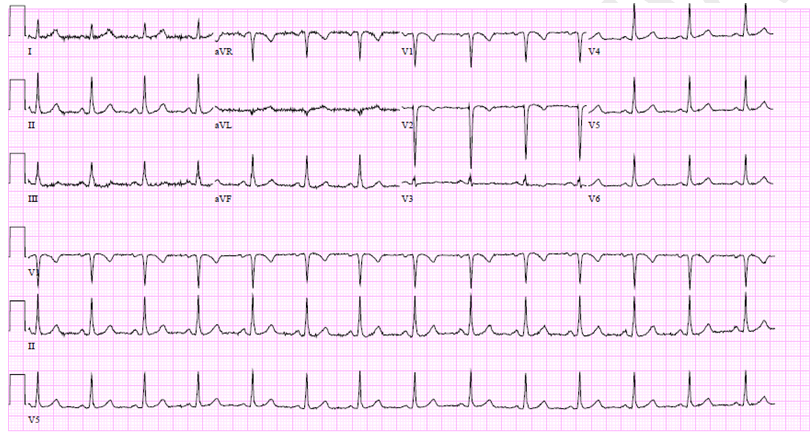
Case Report: We report a case of a 41-year-old female presented to our hospital with chest heaviness, shortness of breath, and nausea, which started at rest and lasted about 30 minutes. Her symptoms resolved on arrival to the emergency room. Electrocardiogram showed transient T wave inversions in V2 and V3 leads, and troponins peaked at 1.01 ng/ml 6 hours after arrival. She received standard therapy for non-ST elevation myocardial infarction. An urgent cardiac catheterization revealed severe vasospasm in 3 cm length of the proximal left anterior descending artery, and milder vasospasm in the mid-portion of the artery; spasm resolved after multiple doses of intracoronary nitroglycerin. We excluded the presence of common precipitants of coronary vasospasm. However, the patient admitted to phencyclidine use about two hours prior to the onset of symptoms, and a urine toxicology screen was positive only for the drug. Given the strong temporal relationship of symptoms to PCP use and absence of common precipitants of coronary vasospasm, we concluded that her coronary spasms were induced by PCP. Conclusion: We describe a case of acute coronary syndrome in a low risk patient thought to be induced by PCP. Our case illustrates the need for physicians to be aware of PCP ingestion as a possible cause of coronary artery spasm when presented with a young adult patient suffering from acute coronary syndrome. | |
|
Keywords:
Chest pain, Coronary vasospasm, Phencyclidine
| |
|
Introduction
| ||||||
|
Phencyclidine (PCP), a synthetic compound originally intended to be used as an anesthetic drug, has been abused throughout the United States for several decades. Its prevalent use has especially been noted in Washington DC where in 2012, up to 12% of male arrestees tested positive for the drug, compared to a 1% rate in other major cities in the country [1]. While PCP is principally noted for its hallucinogenic effects, it has also been reported to cause such cardiovascular effects as tachycardia, hypertension, and rarely cardiac arrest [2]. Even though animal studies have implicated PCP as a cause of coronary vasospasm, this has not been documented in humans to the best of our knowledge. We discuss the case of a young adult woman at low risk for coronary artery disease, who presented with acute coronary syndrome due to coronary vasospasm in the setting of acute PCP ingestion. | ||||||
|
Case Report
| ||||||
|
A 41-year-old African American woman presented to the emergency department complaining of chest heaviness, palpitations, shortness of breath, and nausea at rest, which lasted about 30 minutes. She had two similar episodes in the previous month, and these resolved without therapy. Her only cardiovascular risk factor was smoking of a one-fourth pack of cigarettes per day. Her current medications included only vitamins and iron. Symptoms had improved on arrival to the emergency room, and vital signs were within normal limits with a blood pressure of 105/58 mmHg and pulse rate of 85 beats/minute. Physical examination was normal. Electrocardiogram showed transient T wave inversion in both leads V2 and V3 (Figure 1). Laboratory studies revealed rising troponin levels that peaked at 1.01 ng/ml 6 hours after arrival. She was diagnosed with non-ST elevation MI and given standard therapy of aspirin, clopidogrel, and enoxaparin, and she was subsequently prepared for urgent coronary angiography. Coronary angiography revealed severe vasospasm in 3 cm length of the proximal left anterior descending artery, as well as a milder vasospasm in the mid-portion of the vessel (Figure 2A). Three doses of 200 mg intracoronary nitroglycerin were needed to relieve the vasospasm, after which there were no areas of flow-limiting stenosis identifiable in the coronary arteries (Figure 2B). Further history revealed PCP ingestion about 2 hours prior to the onset of symptoms, and a urine drug screen was positive only for phencyclidine. The patient was discharged on sublingual nitroglycerin as needed, and advised to avoid PCP and other drugs of abuse in the future. | ||||||
| ||||||
|
| ||||||
|
Discussion
| ||||||
|
To the best of our knowledge, this is the first reported association between PCP ingestion and acute coronary syndrome. Our patient was a young adult woman at low risk for coronary artery disease who presented with chest pain at rest and was found to have severe coronary spasm that was reversed by nitroglycerin during angiography. Urine toxicology screen was positive for PCP, but negative for other stimulants such as cocaine or amphetamine. We considered and excluded other common triggers for coronary spasm (Table 1) [3] [4] . She had a history of cigarette smoking but she did not smoke any cigarettes prior to onset of symptoms on the day she presented. We suggest that the coronary vasospasm may have been caused by PCP ingestion since her symptoms started only about 2 hours after smoking PCP. PCP (1-(1-phenylcyclohyxyl) piperidine hydrochloride) is a noncompetitive NMDAR (N-methyl-D-aspartate receptor) antagonist initially introduced in the 1950s as a dissociative anesthetic agent but withdrawn because of its prolonged unmanageable side effects [5]. It is now a commonly abused street drug in major US cities, especially Washington DC [1]. The major cardiovascular effects in cases of PCP toxicity are hypertension and tachycardia [2] , probably due to the inhibition of neuronal catecholamine reuptake or potentiation of noradrenaline release [6]. Although undocumented in humans, animal studies have demonstrated the effects of PCP on coronary vasculature [7] [8] [9][10]. In vitro, PCP appeared to have a vasoconstrictive effect on the coronary arteries in pigs and dogs. It also caused a reversible reduction of coronary blood flow in guinea pigs [7] [8] [9] [10] . While PCP induced a paradoxical increase in coronary blood flow in dogs, a simultaneous ECG recording showed that ischemic changes were present [10]. The effects of PCP on the coronaries were inhibited by detromethorphan, a direct inhibitor of the PCP receptor [7]. This suggests that PCP may act directly on receptors in animal coronary arteries. Recent data on PCP effects in humans is not extensive most likely because it is not a widely prevalent drug of abuse [1], and because its clinical use has been discontinued for many years. Additionally, many street drug abusers ingest multiple drugs, and thus there may be confounding effects of these drugs if their activity and pharmacokinetics are not well known. For example, up to 34% of male arrestees in major US cities tested positive for multiple drugs in 2012 [1]. The closest drug to PCP that is in clinical use is Ketamine (2-(2-chlorophenyl)-2-(methylamino)cyclohexan-1-one). Ketamine is a structural analogue of PCP with similar effects but less toxicity, and it is used as a dissociative sedative for brief procedures, particularly in children. The side effects of ketamine and PCP are similar at toxic doses, and in addition, the former has been associated with chest pain when used for analgesia or as a drug of abuse. Our patient developed chest pain two hours after smoking PCP. We acknowledge that the temporal relationship does not prove PCP as the culprit. However, evidence from animal studies and reports on ketamine (a structural analogue of PCP) use in humans support the suggestion of PCP as the precipitant of coronary spasm in our patient. | ||||||
| ||||||
|
| ||||||
|
Conclusion
| ||||||
|
Although there is paucity of data in humans, phencyclidine (PCP) has been shown to cause vasoconstriction and reduction in coronary blood flow in animal models. Additional studies are needed to confirm the effects of the drug on the human coronary artery. Our case illustrates the need for physicians to be aware of PCP ingestion as a possible cause of coronary artery spasm in young adult patients presenting with acute coronary syndrome. | ||||||
|
Acknowledgements
| ||||||
|
We acknowledge the suggestions of R. F. Gillum, MD, MS and Adedayo Ogunleye, DO. | ||||||
|
References
| ||||||
| ||||||
|
[HTML Abstract]
[PDF Full Text]
|
|
Author Contributions
Hakeem Ayinde – Substantial contributions to conception and design, Acquisition of data, Analysis and interpretation of data, Drafting the article, Revising it critically for important intellectual content, Final approval of the version to be published Robert Solomon – Acquisition of data, Drafting the article, Revising it critically for important intellectual content, Final approval of the version to be published Maria-Elise Sanchez – Acquisition of data, Analysis and interpretation of data, Drafting the article, Final approval of the version to be published James Diggs – Acquisition of data, Analysis and interpretation of data, Revising it critically for important intellectual content, Final approval of the version to be published Prafulla Mehrotra – Substantial contributions to conception and design, Analysis and interpretation of data, Revising it critically for important intellectual content, Final approval of the version to be published |
|
Guarantor of submission
The corresponding author is the guarantor of submission. |
|
Source of support
None |
|
Conflict of interest
Authors declare no conflict of interest. |
|
Copyright
© 2015 Hakeem Ayinde et al. This article is distributed under the terms of Creative Commons Attribution License which permits unrestricted use, distribution and reproduction in any medium provided the original author(s) and original publisher are properly credited. Please see the copyright policy on the journal website for more information. |
|
|