
  |

|
 |
|
Clinical Image
| ||||||
| Prominent tibial tubercles | ||||||
| Michael Flannery1, Damien Knudson1, Yumeng Zhang1 | ||||||
|
1MD, FACP, University of South Florida, Morsani College of Medicine, 12901 Bruce B Downs Blvd. MDC Box 19 Room L1041, Tampa, Florida.
| ||||||
| ||||||
|
[HTML Abstract]
[PDF Full Text]
[Print This Article]
[Similar article in Pumed] [Similar article in Google Scholar] 
|


| How to cite this article |
| Flannery M, Knudson D, Zhang Y. Prominent tibial tubercles. Int J Case Rep Images 2015;6(10):652–654. |
|
Case Report
| ||||||
|
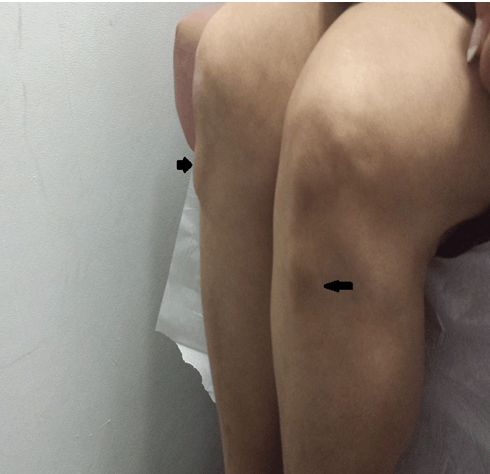
Bilateral enlargement or hypertrophy of the tibial tuberosities (tubercles) is seen in our patient who previously had been diagnosed with sternoclavicular hyperostosis [1]. Our patient presented with these symptoms of approximately six months duration with no further increase in size. The tubercles (Figure 1) were moderately painful to touch with no warmth or erythema. The patient is a 49-year-old female with a history of hypertension and hypertriglyceridemia and osteoarthritic joint pain. Her medications included: tramadol 50 mg every six hours as needed, lisinopril 20 mg daily, hydrochlorothiazide 12.5 mg daily and fenofibrate 145 mg daily. Examination showed no fever or lymphadenopathy at any site. Both tubercles were enlarged right greater than left with generalized tenderness at the site of the tubercle but no pain at any other site around the knee. The patient had no history of Osgood-Schlatter disease as an adolescent. There were no recent infections and once enlarged there was no further growth of the lesions. Prior radiographic imaging of the sternoclavicular joint demonstrated no evidence of tumor or infection. Her laboratory studies were unremarkable [1]. The patient was treated with heat alternating with cold packs for 15 minutes four times daily along with meloxicam 15 mg daily. The patient could not afford a patellar band. The patient has ongoing diffuse idiopathic skeletal hyperostosis (DISH). | ||||||
| ||||||
|
| ||||||
| ||||||
|
Discussion
| ||||||
|
Enlargement of the tibial tubercles in an adolescent would be classic for Osgood-Schlatter disease; however, our patient has no history of the disease, nor did she has evidence of the disease six months previously. Over use of the quadriceps muscle could result in an inflammatory process of the tibial tubercle. Our patient gave no specific history of a change in her activities that would suggest such inflammation. Of course the differential includes infection and tumor. However, she had no fever or leukocytosis. In addition, her involvement was bilateral and stable with no further growth making such diagnosis less likely. Complications include fracture of the ossicle and potential treatments may include laparoscopic excision of an enlarged tubercle. Another possibility, given her prior diagnosis of sternoclavicular hyperostosis, would be an extraspinal manifestation of diffuse idiopathic skeletal hyperostosis (DISH) [2]. The hallmark of the disease is the ossification and calcification of the anterolateral aspect of the thoracic spine requiring involvement of at least four contiguous thoracic segments with preserved disc spaces and lack of apophyseal joint degeneration. Involvement may be asymptomatic in many individuals, while others suffer pain and decreased mobility. Peripheral involvement is usually distinguished by involvement of joints not usually involved by primary osteoarthritis, increased hypertrophic changes and calcification and ossification of enthesis (inflammation of connective tissue between tendon or ligament and bone) in sites other than joints. Some examples include hyperostosis of the ribs, sternoclavicular joint, olecranon and tibial tubercles. Interesting DISH is associated with a metabolic profile of hypertension, dyslipidemia and diabetes mellitus [2]. In our patient, non-steroidal anti-inflammatory drugs have offered relief along with tramadol. Her metabolic conditions have been treated appropriately and she needs to be monitored for diabetes. Radiography of her tibial tubercle on the right can be seen in Figure 2. | ||||||
|
Conclusion
| ||||||
|
Our patient has two area of hyperostosis sternoclavicular and tibial tuberosity generating a theory that she may have extra-spinal feature of diffuse idiopathic skeletal hyperostosis (DISH). | ||||||
|
Keywords
| ||||||
|
Enlarged tibial tubercles, Diffuse idiopathic skeletal hyperostosis, Osteoarthritic joint pain, Osgood-Schlatter disease, Osteoarthritis | ||||||
|
References
| ||||||


|
[HTML Abstract]
[PDF Full Text]
|
|
Author Contributions
Michael Flannery – Substantial contributions to conception and design, Acquisition of data, Analysis and interpretation of data, Drafting the article, Revising it critically for important intellectual content, Final approval of the version to be published Damien Knudson – Analysis and interpretation of data, Revising it critically for important intellectual content, Final approval of the version to be published Yumeng Zhang – Analysis and interpretation of data, Revising it critically for important intellectual content, Final approval of the version to be published |
|
Guarantor of submission
The corresponding author is the guarantor of submission. |
|
Source of support
None |
|
Conflict of interest
Authors declare no conflict of interest. |
|
Copyright
© 2015 Michael Flannery et al. This article is distributed under the terms of Creative Commons Attribution License which permits unrestricted use, distribution and reproduction in any medium provided the original author(s) and original publisher are properly credited. Please see the copyright policy on the journal website for more information. |
|
|